

Era 8 of 12 in our timeline of Pokémon card eras. This era printed cards horizontally, turned a video-game mechanic into a permanent collecting category, and produced the promos that still set the ceiling for anything modern.
Companion pages: Sealed XY product · grading Mega cards.
Quick answer
The XY era ran from 2013 to 2016 and is defined by Mega Evolution — cards printed sideways, in landscape orientation, the only cards in the hobby’s history to do so. Twelve English sets, a mechanic that requires the previous evolution to be in play, and a promo programme that produced the most valuable modern cards of the pre-2019 period.
If a Pokémon card is horizontal, it is from this era. There is no other case.
The sideways card
Mega Evolution cards are printed landscape. Turn one sideways and the illustration reads correctly, which means the card does not fit a standard binder page, does not fit a standard toploader in the usual direction, and does not sit in a stack with other cards.
That single design decision makes this the easiest era to identify and the most awkward to store. It also explains a quirk in the population data: landscape cards were handled differently from the moment they were pulled, because they did not fit anywhere. Collectors either sleeved them immediately or left them loose in a box.
Four properties define a Mega card:
- Landscape orientation. Unique to this era and never repeated.
- MEGA printed before the name, and the card evolves from an
EXrather than from a normal Pokémon. - Your turn ends when you Mega Evolve. That rule is printed on the card, and it is why Mega cards were a tempo decision rather than an automatic upgrade.
- Every Mega has a full-art version. The full art is the scarce printing, as with the
EXcards that came before.
The twelve sets
| Set | Release | Note |
|---|---|---|
| XY | February 2014 | Mega Evolution debuts; the landscape layout appears |
| Flashfire | May 2014 | Charizard returns; the era’s first major chase set |
| Furious Fists | August 2014 | Fighting-type focus; strong competitive cards |
| Phantom Forces | November 2014 | The era’s strongest competitive set, and its least opened in sealed form |
| Primal Clash | February 2015 | Primal Reversion; Kyogre and Groudon |
| Roaring Skies | May 2015 | Rayquaza Mega; one of the era’s most collected cards |
| Ancient Origins | August 2015 | Hoenn mythology; small print |
| BREAKthrough | November 2015 | BREAK mechanic introduced alongside Mega |
| BREAKpoint | February 2016 | The smallest print run of the era |
| Fates Collide | May 2016 | Mewtwo Mega; the era’s most reprinted art |
| Steam Siege | August 2016 | Last standard set before the anniversary set |
| Evolutions | November 2016 | A Base Set reprint — see below |
The promos are the era’s real ceiling
The video essay that inspired this series makes a claim worth repeating: the main mechanic of this era was Mega Evolution, but the era’s most valuable cards were not in the sets at all. They were promos — cards distributed through Pokémon Center stores, magazine insertions and events, mostly in Japan.
Three categories drive it:
- Licensed character crossovers. The most famous is the Mario Pikachu pair, released in 2016 through Japanese Pokémon Center stores, in which Pikachu is printed wearing Mario and Luigi costumes. They were never released in English, were sold in limited quantity at a specific event, and are among the most recognisable Japanese promos ever printed.
- Poncho Pikachu series. A run of Pikachu promos dressed in other Pokémon’s costumes, released across 2014 to 2016. The series is a complete collecting project, and complete sets of it are scarce.
- Event and tournament promos. Distribution was tied to attendance, so the population was set by the number of people who showed up rather than by a print run.
The pattern is the same one that repeats across this timeline: a card whose scarcity comes from how it was distributed rather than from how many were printed is structurally scarcer than any set card, because there is no print run to increase.
The anniversary set that closes the loop
In November 2016 the era ended with Evolutions, a set that reprinted the 1999 Base Set with modern borders and updated text. It is the only time the hobby has been given a direct, affordable reprint of its own origin.
Two things make it interesting. First, it is a legitimate way to own the 1999 artwork without paying 1st Edition money — the art is the same, the card is not. Second, its Charizard holo has become a chase card in its own right, which is a useful illustration of how reprints behave: a reprint suppresses the price of the original only slightly, and creates a new collectible in the process.
If you are building a timeline collection and cannot afford era one, Evolutions is the honest substitute — provided you label it as what it is. Set codes make the difference unambiguous.
Where the quiet value sits
- Non-Charizard, non-Rayquaza Megas. The era printed dozens of Mega cards. The market prices perhaps six. The rest are landscape full arts from a visually distinctive era, trading at the price of a mid-era holo.
- BREAKpoint. The smallest print run of the era, released in February 2016 into a market that was not yet in the 2016–2017 boom. It is the era’s scarcest set and its least discussed.
- Phantom Forces sealed. The strongest competitive set of the era, which means it was opened to build decks rather than to hold. Sealed supply is thinner than the set’s fame suggests.
- Japanese XY-P promos outside the famous three. The promo programme ran for three years. The Mario and Poncho cards get the attention; the rest of the run is priced as bulk.
How to identify an XY era card
- Landscape orientation — Mega cards only. Nothing else in the hobby is printed sideways.
MEGAbefore the name, or aBREAKevolution card with a gold border and the word BREAK.- Set symbol in the bottom-right and a copyright year of 2014, 2015 or 2016.
- Japanese promos from this era carry a
XY-Pnumbering rather than a set number, which is the quickest way to tell a promo from a set card.
Storing a card that does not fit
Landscape cards are the one case where the standard storage advice does not apply directly, because the card’s long edge is the top edge.
Three rules. First, never store a Mega card vertically in a binder pocket — the card will bow along its short axis and the landscape art will show the bend. Second, use a rigid holder that is at least 3×4 and place the card horizontally inside it; a 3×4 rigid toploader takes a landscape card without forcing it. Third, for a full-art Mega, use a Pro-Grade Display Slab, because the point of the card is the wide illustration and a standard sleeve hides it.
And for a Japanese promo from this era, the sleeve matters more than usual: these cards were distributed in paper envelopes and many were handled before they were ever sleeved. Our acid-free penny sleeves are the right first layer for anything that has spent a decade out of one.
Where this era sits on the timeline
The XY era follows the Black & White era, whose full-art layout it kept. It is followed by the Sun & Moon era, which replaced Mega with GX and moved the chase from the Pokémon to the trainer. The full timeline puts all twelve in order.
What these cards actually look like
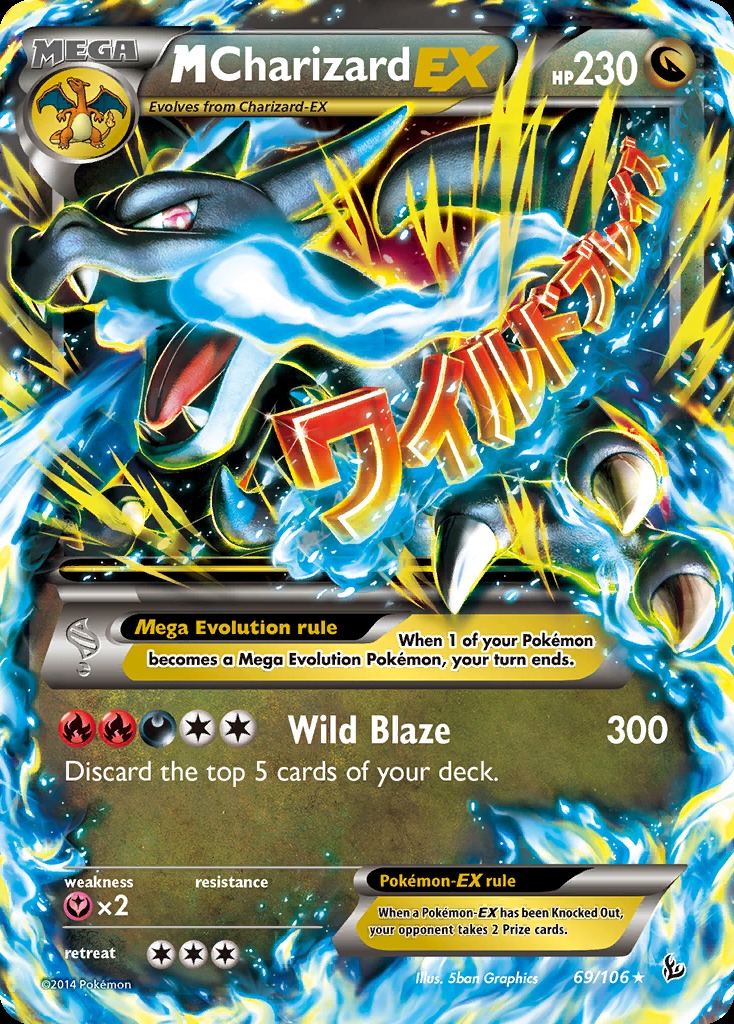
This era contains the only cards in the hobby printed sideways, and the shape is the identification.
MEGA precedes the name, and the end-of-turn rule is printed in the text box.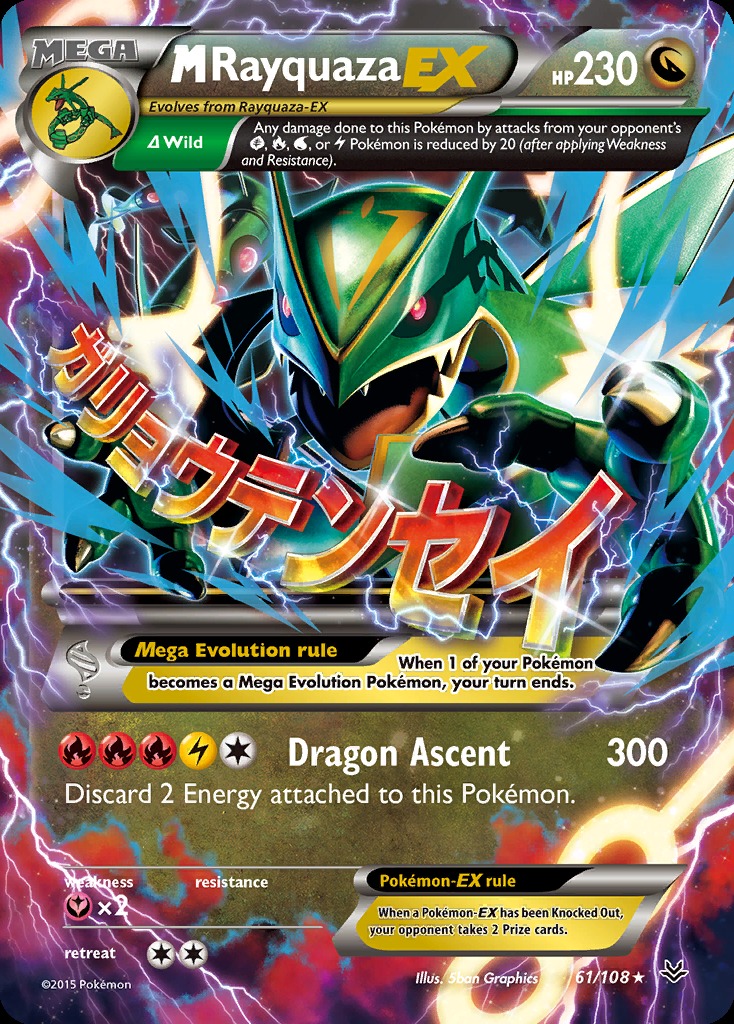
XY-P number instead of a set number. The Mario Pikachu pair looks like this: a full-card illustration of Pikachu in costume, released through Pokémon Center stores rather than in a pack.Image sources for this page: images.pokemontcg.io/xy2/69_hires.png (M Charizard-EX) and xy6/61_hires.png (M Rayquaza-EX). The Japanese XY-P promo discussed in the text is not in the public scan database and is not shown here; it would have to be sourced from official Pokémon Center Japan material. Served from /wp-content/uploads/2026/10/. Card names and artwork are trademarks of Nintendo, Creatures Inc. and GAME FREAK inc.; scans are used here for identification and commentary.
Frequently asked questions
Why are Mega Evolution Pokémon cards sideways?
Because the design required a wider illustration than a portrait card allows. Mega cards were printed in landscape orientation for the entire XY era, 2013 to 2016, and never again. A horizontal Pokémon card is from this era without exception.
What is the most valuable XY era card?
Not a set card. The era’s Japanese promos carry the highest prices, led by the 2016 Mario Pikachu pair released through Pokémon Center stores. Their scarcity comes from distribution rather than print run, which is the scarcest structure in the hobby.
Is XY Evolutions the same as Base Set?
No. It reprints the 1999 Base Set artwork on modern card stock with updated text, set symbols and a 2016 copyright. The art is the same; the card is not. It is the closest thing to an affordable Base Set, and it should always be described as a reprint.
What does BREAK mean on an XY card?
A second mechanic introduced in late 2015 alongside Mega Evolution. A BREAK card evolves from a normal Pokémon and is printed with a gold border and the word BREAK. It is visually distinct from a Mega card and much cheaper.
Are XY era cards worth grading?
The Mega full arts and the Japanese promos, yes. The landscape format means careless storage damage is common, so high grades are scarcer than the print run implies. Standard-art cards and the BREAK tier usually do not justify the cost.
Sources
Sources and further reading
- The Pokémon Company — set records for XY (February 2014) through Evolutions (November 2016).
- Official card text — the Mega Evolution rule, including the end-of-turn condition.
- Pokémon Center Japan — the 2016 Mario Pikachu promo distribution and the 2014–2016 Poncho Pikachu series.
- PSA population reports — Mega cards and Japanese XY-P promos, by grade.
- CardSpicy — How to read a set code, for separating Evolutions reprints from the 1999 original.
- CardSpicy — Era 7 — Black & White, the era immediately before this one.
Related reading
- All twelve Pokémon card eras — the timeline this page belongs to.
- Era 1 — Base Set, 1996 to 2001 — what Evolutions reprints, and why the original is still a different asset.
- Era 7 — Black & White, 2010 to 2013 — where the full-art layout began.
- Era 9 — Sun & Moon, 2016 to 2019 — GX, Tag Team, and the trainer portrait.
- Storing sealed Pokémon boxes — relevant to BREAKpoint and Phantom Forces.
Nothing on this page is investment advice, and no grade outcome is promised for any card. Prices quoted are published third-party figures as of 2026 and are reference ranges, not offers.
Where to go next
- The CardSpicy card index — every card we track, with its PSA 10 population and market history (195 cards).
- The illustrator index — every artist behind those cards, card by card (110 artists).