

Grading companion to Era 2, the e-Card era. Part of the twelve-era timeline. This page quotes no prices and no population figures; it explains the structure that decides whether a submission makes sense.
Quick answer
The card in this era that most deserves a slab is not the Crystal — it is the ordinary holo, because the Crystal’s full-face relief turns the surface subgrade into a risk multiplier while a standard holo keeps its foil behind a window where a scratch costs less. The Crystal treatment covers the whole face, artwork and text box alike, so every defect sits on a reflective field that a grader examines at an angle. On a normal holo the foil is confined to the art window and the border absorbs what happens outside it. The Crystal has no equivalent dead space.
That inverts the instinct. The era’s most desirable cards are its worst grading candidates, and its least discussed cards — the plain holos — are the ones where the fee buys a grade the card can actually reach. What follows is why the relief behaves that way, and what to check before either class goes in an envelope.
Why the Crystal treatment amplifies surface risk
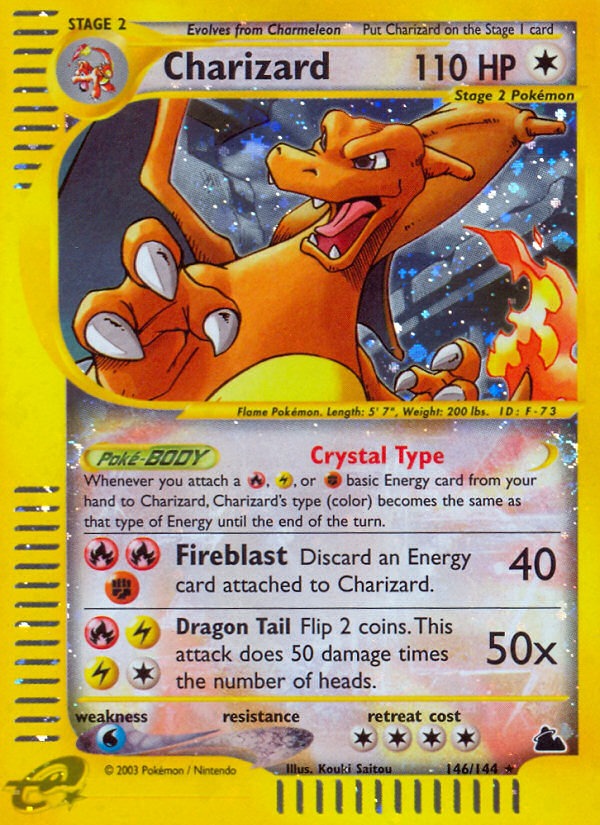
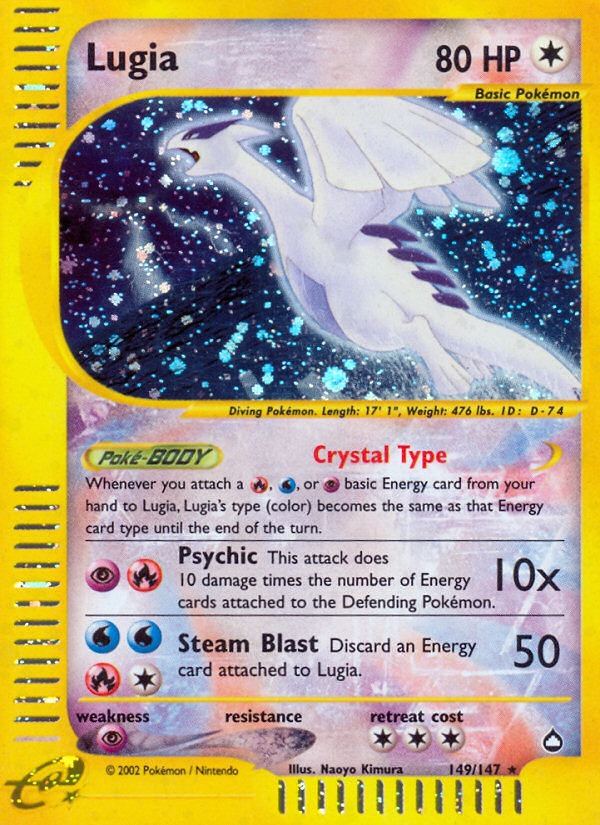
A Crystal card is not a holo with a pattern. The foil field runs under the artwork, under the text box and out to the border, and it carries a fine relief rather than a flat shimmer. That has three consequences for grading, and they compound.
First, the area assessed as surface roughly doubles. On a standard holo a scuff on the yellow border is a border matter, judged against flat colour; on a Crystal the same scuff is in the foil, where light reveals everything. Second, the relief holds what lands on it — dust, skin oil, sleeve fibre — and wiping pushes it further in. Third, the text box is printed over foil rather than board, so the densest block of small type sits on the least forgiving substrate.
None of this is a manufacturing fault. It is a design that looks extraordinary and grades badly, and the two facts are connected: the same relief that catches the eye catches the wear.
Which classes in this era are worth submitting
The era ran three sets — Expedition, Aquapolis and Skyridge — and the card classes inside them behave very differently at the grading stage.
| Card class | Surface exposure | Where the grade usually dies | Submit? |
|---|---|---|---|
| Crystal (whole-face relief) | Entire card face | A single hairline in the foil, or haze in the relief, with no dead space to absorb it | Only after a raking-light check that passes cleanly; otherwise the fee buys a cap |
| Standard holo rare | Art window only | Border whitening, which the era’s wide margin usually survives | The best candidate in the era: foil is contained, and the border is a buffer |
| Skyridge holo | Art window only | Border whitening; the last set of the era has the thinnest raw supply | Yes — the same card class as any other holo, from the shortest run |
| Non-holo rare | Flat gloss only | Almost nothing, which is also the problem | No; a clean copy is not scarce enough to justify a slab |
| Common and uncommon | Flat gloss only | Nothing worth grading | No |
The pattern is that surface risk scales with how much of the card is foil, and this era has the widest spread between its best and worst class. The Crystal sits at one end and the standard holo at the other, and they are printed on the same sheet stock in the same year.
What the rest of the era gets right
Three things make the ordinary holos from these sets better submissions than their reputation suggests.
The print run was short and the sales were poor. This was Wizards’ final era, released into a game that was contracting ahead of the handover to Nintendo, so the sets did not sell in the volume of the era before or the era after. A thin print run means a thin raw pool, and the clean copies are not sitting in every binder the way Base Set Unlimited copies are.
The print quality is better than the old-back era. Centring is generally tighter than on 1999 stock, the stock is stiffer, and the cut edge does not whiten as readily — so a card that survived in a sleeve has a realistic route to a high grade. And the cards were played less: by 2002 the organised play scene had thinned, and the format did not reward these cards the way the later ex era rewarded its own. A smaller share of the surviving pool is played, so the condition distribution is shifted upward.
Five checks before an e-Card goes in a submission
- Rake the light across the face at a shallow angle, not straight on. On a Crystal this is the only way to see the relief properly. What you are looking for is a break in the pattern — a single line where the texture stops and the light runs straight instead.
- Look at the text box as a separate surface. It is printed over foil on a Crystal and over board on a holo, and on both it is where a defect is most visible because the type is dense and small. A scuff through a line of text reads worse than the same scuff on blank background.
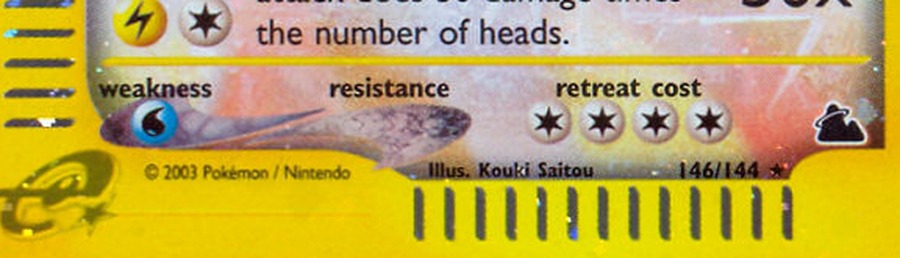
- Check the strip along the bottom border. Every card in this era carries a dot-code strip there, on the border where contact happens first. Scuffing across it is a border defect, and it is easy to miss because the eye goes to the artwork.
- Check the four corners against a dark background. The stiffer stock resists denting, so what you find at the corners is usually abrasion rather than impact — a small bright point rather than a flattened tip.
- Decide whether the card is the class you think it is. A Crystal and a standard holo can look similar in a flat photograph, because both are reflective across much of the face at some angles. Grading the wrong class costs the same as grading the right one.
What to do with a Crystal you already own
The argument against submitting a Crystal is not that the card is bad. It is that the card’s best feature and its worst grading liability are the same feature.
If the relief passes a raking-light check with no breaks and no haze, the card is a legitimate submission and surface will not be what holds it back. If the check finds a hairline, the card is a candidate for a holder rather than a slab: a raw Crystal in a rigid case shows the treatment at least as well, without a printed number that records the flaw permanently. A slab does not hide a defect; it publishes it.
Storing e-Card holos and Crystals
The physical problem in this era is specific: the relief holds particles, and the border is thin enough that contact shows.
A Crystal stored in a paper sleeve that has picked up grit abrades its own raised texture every time it moves, and the damage is not reversible because the relief is pressed into the foil rather than printed on it. The first layer has to be clean and smooth on the inside. A matte premium sleeve is the right first layer here for the same reason it is right on old-back stock: the surface you are protecting is the one that reflects.
Repeated insertion is the second problem. An e-Card is stiffer than a 1999 card, so it resists the slide less and scrapes the holder’s edge more, and the dot-code strip along the bottom border is directly in the path. A press-fit rigid case removes the slide: the card is placed, not pushed, and the case holds it flat so the relief is not flexed while it is handled.
A rigid 3×4 toploader remains the practical second layer for anything going through the post, and is adequate for a standard holo. For a card that will sit on a shelf rather than travel, a display slab keeps the whole face visible.
None of these stop the one process that matters most, which is humidity cycling. These cards are laminated in the same way as the era before them, and repeated expansion and contraction is what produces the faint haze that reads as surface wear. A stable room, away from an exterior wall, does more than any holder.
Where this sits
This era follows the Base Set era grading page, where the constraint is a closed population rather than a surface design, and precedes the EX era page, where the failure moves from the face to the edge. Between the three, the definition of a grading candidate shifts twice. For the card-level story, see Era 2; for the full sequence, the twelve-era timeline.
Frequently asked questions
Does a Crystal card always grade worse than a holo from the same set?
Not always, but it is held to a harder surface standard because the whole face is foil. Two cards in identical condition can come back with different surface assessments purely because one has more reflective area for a defect to sit on.
Can haze on a Crystal be cleaned off?
Usually not, and the attempt is the bigger risk. Haze that sits in the relief is in the laminate rather than on it, so wiping redistributes it and can leave a directional mark that reads as a scratch.
Is a Skyridge holo a better submission than one from Expedition?
The standard is the same and the stock is comparable. What differs is supply: Skyridge was the last of the three and sold into the weakest market of the three, so its raw pool is the thinnest.
Why is this era’s card stock stiffer than Base Set?
The stock changed between the two eras as the printer moved to a different board, and the practical result is that a 2002 card resists denting but abrades rather than deforms. That changes what you look for: less corner flattening, more edge brightening.
Do the three sets in this era grade the same way?
The standard is the same and the stock is comparable. What differs is supply: Skyridge was the last of the three and sold into the weakest market of the three, so its raw pool is the thinnest. That affects what a grade is worth, not what the grade is.
What the cards in this era actually look like
The two Crystals below are the clearest illustration of the problem this page describes: the treatment that makes the card desirable is visible everywhere the surface is assessed.
Sources
Sources and further reading
- Wizards of the Coast — Expedition, September 2002; the first English e-Card set.
- Wizards of the Coast — Aquapolis, January 2003, and Skyridge, May 2003; the last two sets before the Nintendo handover.
- Wizards of the Coast — the e-Reader dot-code strip printed along the lower border of every card in the three sets.
- CardSpicy — PSA vs BGS vs CGC, for how surface is weighted against centring and edges.
- CardSpicy — Reading a population report, for why a thin print run and a thin population are not the same statement.
- CardSpicy — Era 2 — e-Card, 2001 to 2003, for the set history this page assumes.
Related reading
- Era 2 — e-Card, 2001 to 2003 — Expedition, Aquapolis and Skyridge in full.
- Grading Base Set era cards — the previous era, where the population is the constraint.
- Grading EX era cards — the next era, where the edge replaces the face as the problem.
- All twelve Pokémon card eras — the timeline.
- PSA vs BGS vs CGC — how the sub-assessments differ between companies.
- Sealed e-Card product — the one era where the box outran the cards.
Nothing on this page is investment advice, and no card or grading service is offered for sale here. Grades are assigned by third-party companies; the descriptions of surface behaviour, print runs and set composition are structural and are not population figures or prices.
Where to go next
- The CardSpicy card index — every card we track, with its PSA 10 population and market history (195 cards).
- The illustrator index — every artist behind those cards, card by card (110 artists).
Leave a Reply