🛒0

Category: Buying & Collecting

CardSpicy articles about buying and collecting — price ladders, buying checks, fakes, shipping and what to buy first.

  • Duel Masters in its 25th-anniversary year: dated products

    Quick answer

    CardSpicy tracks what a publisher has actually put a date on, and Duel Masters is marking a 25th-anniversary year with a line of products that behave differently from a normal card game’s. The third set of the current Reverse Card edition released on 19 September 2026, and a separate go-round of the game’s premium “God Art” line is a Magic: The Gathering collaboration sold only to order, with an order window that ran from 10 September to 2 October 2026. Those two products are the reason to look at this game’s schedule even if you do not play it.

    The most collectible Duel Masters products of the season were never on a shop shelf. They were made to order, and the window to order them has closed.

    What Duel Masters is, and the shape of its year

    Duel Masters is Takara Tomy’s trading card game, and its product line is published in Japan with Japanese prices. Its year is organised differently from a game that runs one booster every few months. Alongside a regular expansion series it runs a premium line called God Art, made to order through Takara Tomy’s own web store, and an extra-pack series that springs from player votes. The 25th-anniversary year adds a further layer of anniversary products on top of both.

    That mix produces a schedule where the products a collector cares about most are not the ones with the widest distribution. It is worth naming that pattern early, because the rest of this page is largely a consequence of it. Our glossary covers the general terms if any of the product labels here need unpicking.

    The dated Duel Masters line

    Release or window Product How it is sold
    10 September to 2 October 2026 God Art Kizuna: Duel Masters x Magic: The Gathering, two products Made to order, Takara Tomy web store only
    19 September 2026 Reverse Card Edition Vol.3, code DM26-RP3 Expansion pack, retail
    14 to 15 November 2026 Duel Masters Grand Prix 2026 2nd Event

    The table is short on purpose. Duel Masters announces its products earlier than it publishes every specification, and several items on the current schedule are dated but not yet fully detailed, including the 2026 Duel King extra pack described below. Where a detail is not published, this page says so rather than filling the gap with a third-party figure.

    The Magic: The Gathering collaboration, and the made-to-order model

    The headline product of the season is a two-part collaboration between Duel Masters and Magic: The Gathering, released under the God Art label’s “Kizuna”, or bond, line. It is not a reprint set and not a normal booster. It is a pair of small, all-foil boxed products in which Duel Masters cards are reimagined by artists who work on Magic: The Gathering.

    Product What it is Cards
    God Art Kizuna 01: Invitation to Dominaria Duel Masters creatures re-drawn as if they lived on Magic’s plane of Dominaria 7, one each, all foil
    God Art Kizuna 02: You Are a Planeswalker Duel Masters spells re-drawn around Magic’s Planeswalker characters 7, one each, all foil

    Two things make this product unusual. The first is the made-to-order model. Takara Tomy lists both products as produced only to order, sold exclusively through its own web store, with an order window that ran from 10 September to 2 October 2026, a limit of four of each per person, and no cancellations after ordering. There is no retail allocation and there is no second print run in the ordinary sense; the quantity produced is the quantity ordered. For a card product, that is closer to a commissioned print than to a booster, and it is why these items should not be judged by the usual rules about reprints.

    The second is the content. The first product takes seven Duel Masters creatures and has them illustrated by Magic artists, with Takara Tomy naming the artists involved alongside their best-known Magic work. The second takes seven Duel Masters spells and frames them around Magic’s Planeswalker characters, including a reference back to a character that debuted in a Magic April Fool’s promotion. Neither product contains Magic cards. They are Duel Masters cards with Magic art direction, which is the distinction that decides what they are worth to a collector: they are a curiosity within one game, not a crossover playable in two.

    The same God Art line carries two further collaborations on its own pages, one themed to a Tokyo setting and one to the Monster Hunter Wilds game series. Both sit in the same made-to-order category, which is the pattern worth remembering: the God Art label is where this game puts its artisan products, and artisan products here are ordered rather than bought off a shelf.

    The Reverse Card edition, and a card with twenty-five copies

    The regular expansion line’s current set is Reverse Card Edition Vol.3, carrying the code DM26-RP3, which released on 19 September 2026. Takara Tomy’s own listing prices it at 6,000 yen per box including tax and applies a purchase limit of four boxes per person or household. The set’s top tier is built on the game’s Dream Rare treatment, and its lead card is a fusion of two well-known creatures into a single “Dispecter”.

    The detail that matters for a collector is the serial numbering. The set includes a serial-numbered version of its Dream Rare, and Takara Tomy states that only twenty-five of these exist worldwide, each stamped with a different serial number. A print run of twenty-five is small enough that the card functions as a piece of memorabilia rather than as a playable card, and it is the kind of inclusion that tends to pull boxes off the shelf even from buyers who do not play the game. Our page on whether it is worth grading a card covers the general question of when a card like that repays the cost of grading it.

    The set also continues the game’s habit of tiers aimed at different audiences at once. Secret and Treasure versions continue from earlier sets, a Character Premium Treasure group covers five characters from an earlier story arc, and an artist-collaboration group continues alongside them. Each box additionally carries a bonus pack tied to the anniversary, which Takara Tomy lists as a randomly included item rather than a guaranteed one.

    Where the game’s cards come from: a player vote

    One product on the schedule deserves its own note because of how it was designed. Duel Masters’s extra-pack series occasionally takes its contents from a player vote, and the 2026 Duel King product is built that way. Takara Tomy ran a poll through the summer of 2025 asking players to choose their favourite creatures from the game’s history, and states that the results produced a group of twenty-five Dispecters for the pack.

    Takara Tomy’s own page for that product currently marks its product details as to be updated later, so the release date and the full contents are not yet published. What is published is the design intent: the pack’s lead cards are set by what players voted for, and the results were announced on the product page. That is a materially different process from a designer-chosen list, and it is the sort of product that a player who has followed the game for years will read differently from a newcomer.

    What this page does not claim

    Four limits, stated plainly.

    • The dates and prices are Takara Tomy’s Japanese listings. They are published in yen and describe the Japanese edition of the game. A date or price here should not be treated as applying to another region or another currency.
    • Some products are dated but not fully specified. Takara Tomy has marked the specification of the 2026 Duel King extra pack as to be updated later. Nothing here states a contents figure that the publisher has not published.
    • Made-to-order products are not reprints in the usual sense. The God Art collaboration was produced to the quantity ordered, so the ordinary reasoning about reprint risk does not apply to it in the same way.
    • No valuation. CardSpicy makes no valuation or investment recommendation about any card or sealed product, and describes the serial numbering and the made-to-order model as features of the products rather than as forecasts of value.

    If you are buying into any of these, our card market report covers the wider price picture. If you are storing what you buy, the card protection guide and the storage boxes page cover the first decisions, and sleeve sizes settles the question of fit. For a product made to order, opening the box or keeping it sealed is a decision to make before the box arrives rather than after.

    Frequently asked questions

    When did the Duel Masters Magic: The Gathering collaboration release?

    It was sold to order rather than released to retail. Takara Tomy took orders from 10 September to 2 October 2026 through its own web store, and the products are produced to the quantity ordered, so there is no general retail release date.

    What is the Duel Masters God Art line?

    It is Takara Tomy’s premium line for cards and supplies that use high-quality illustration and finishing, split between an “extreme” strand built on the game’s own world and a “Kizuna” strand built on collaborations. The Magic: The Gathering products sit in the collaboration strand.

    When did Reverse Card Edition Vol.3 release?

    The set carrying the code DM26-RP3 released on 19 September 2026. Takara Tomy prices it at 6,000 yen per box including tax and applies a four-box purchase limit per person or household.

    How many copies of the serial-numbered card exist?

    Takara Tomy states that twenty-five serial-numbered versions of the set’s Dream Rare card exist worldwide, each stamped with a different serial number.

    Are these products available outside Japan?

    The listings described here are Takara Tomy’s Japanese product pages, published in yen. Availability and dates outside that market are set separately, so these figures should not be read as worldwide ones.

    Sources

    Sources and scope
    1. Takara Tomy’s official Duel Masters God Art product page, used for the two Magic: The Gathering collaboration products, Invitation to Dominaria and You Are a Planeswalker, the seven all-foil cards in each, the named Duel Masters cards and Magic artists, the made-to-order method, the exclusive sale through Takara Tomy’s web store, the order window from 10 September to 2 October 2026, the four-per-person limit and the no-cancellation terms, and the further God Art collaborations listed on the same page.
    2. Takara Tomy’s official Duel Masters product page for Reverse Card Edition Vol.3, carrying the code DM26-RP3, used for the Dream Rare treatment, the Dispecter that combines two named creatures, the serial-numbered version with twenty-five copies worldwide and a different serial number on each, the continuing Secret, Treasure, Character Premium Treasure and artist-collaboration groups, the anniversary bonus pack included at random in each box and the set’s new abilities.
    3. Takara Tomy’s official listing for the same set, used for the release date of 19 September 2026, the price of 6,000 yen per box including tax and the four-box purchase limit.
    4. Takara Tomy’s official Duel Masters product page for the 2026 Duel King extra pack, used for the statement that its contents arose from the player poll run through the summer of 2025 and produced twenty-five Dispecters, and for the statement that the product details are to be updated later.
    5. Takara Tomy’s official Duel Masters product and event pages, used for the 25th-anniversary campaign, the Grand Prix event on 14 to 15 November 2026, and the sleeves and rubber playmats added to the supplies line.
    6. Our own pages on grading, card protection, card sleeve sizes, storage boxes, opening a box or keeping it sealed, the card market report for October 2026 and the collecting glossary, used for the internal links.
    7. Scope note: only details published by Takara Tomy on its own pages are stated as confirmed. Full card lists are not reproduced, and no contents figure is stated where the publisher has not published one. CardSpicy makes no valuation or investment recommendation.

    Release dates, product contents and prices are set by the publisher and can change. Check Takara Tomy’s own product page before ordering, and note that the listings described here are the Japanese edition’s, priced in yen.

    Related reading

  • Does Buying Japanese Cards and Selling Them in America Still Work?

    Quick answer

    CardSpicy indexes cards, so the honest form of this question is arithmetic rather than opinion. Buying a card in Japan and selling it in America has to clear four separate costs before it clears anything at all: freight, the 15 percent US import charge that replaced the old exemption, the marketplace selling fee, and the price gap itself. On the most recent full-market count we have, 392 of 71,076 card and grade combinations were cheaper in Japan at all, and only 7 cleared every gate on the same day.

    A price gap is not a margin. The margin is what is left after three fees, and on most cards nothing is left.

    The four gates

    Walk through them in order, because a trip that fails at the first one does not need the other three.

    1. The gap. The Japanese price has to be below the Western price after both are read on a comparable basis — same card, same grade, same condition band, same window of sales.
    2. Freight. Shipping a card from Japan to the United States is a flat cost whatever the card is worth, which means it weighs far more heavily on a cheap card than on an expensive one. The figure used here is $14.00.
    3. The import charge. The de minimis exemption that used to let small parcels in free has been removed, and a 15 percent charge now applies to the declared value. On a $12 card that is $1.91; on a $31 card it is $4.72.
    4. The selling fee. Selling on a marketplace costs a percentage of the sale price, so it scales with the card. At the rate used here it is roughly 14 to 15 percent of the Western price.

    Two of those four are flat or near-flat and two are proportional, which is why the answer changes with card value. A cheap card is squeezed by freight; an expensive card is squeezed by the fee and the tax. The middle is where a trip can work, and the middle is narrow.

    The shipping mechanics themselves — what a parcel from Japan actually costs now, and what the charges are called at the border — are set out in shipping to the US after de minimis, which is the companion piece to this one.

    A trip that does not clear

    The clearest way to see the effect is to follow one card all the way through. This is a real pair of medians from a full-market brief dated 4 October 2026, not a constructed example.

    Line Amount
    Japan median, raw Near Mint $12.71 (38 real sales)
    United States median, raw Near Mint $26.78 (5 real sales)
    Shipping, Japan to United States −$14.00
    Import charge at 15 percent −$1.91
    Landed cost $28.62
    Net proceeds after the marketplace fee on the US median $22.83
    Net of everything −$5.79

    The card is about 111 percent more expensive in the United States than in Japan, which sounds like a trade and is not one. The gap is $14.07 a copy. Freight alone is $14.00, and the tax and the fee are larger than the remaining seven cents. The trip loses money before anything goes wrong, and the reason is simple: on a $12 card, a flat $14 shipping charge is more than the entire spread.

    A trip that does clear

    The same four gates, applied to a graded card instead of a raw one.

    Line Amount
    Japan median, PSA 10 $31.44 (4 real sales)
    United States median, PSA 10 $65.00 (3 real sales)
    Shipping, Japan to United States −$14.00
    Import charge at 15 percent −$4.72
    Landed cost $50.16
    Net proceeds after the marketplace fee on the US median $55.99
    Net of everything +$5.83

    This one clears, and it clears only because the card is graded. The gap is proportionally smaller than the raw example, but the absolute spread is far larger, and that is what makes the difference: a flat $14 freight charge is 45 percent of the Japanese price on the raw card and 45 percent on this one too, but the dollar amount it has to be covered by is two and a half times bigger.

    There is a second reason a graded card travels better, and it is not about the arithmetic. A PSA 10 is a defined, countable thing. Our comparison of PSA 10 and PSA 9 pricing sets out how much of a card’s value sits in the grade alone, and the population report explains why two copies of the same card in the same grade are not necessarily comparable. Both matter when you are matching a Japanese sale to an American one, because a mismatch in grade is not a price gap at all — it is two different products.

    Why the hit rate is so low

    The numbers are worth stating plainly, because they are the whole answer. Across 71,076 card and grade combinations with real recorded sales on at least one side in a 30-day window:

    • 392 cleared every gate except the fees — meaning they were genuinely cheaper on one side after looking at the price alone. Of those, 267 were cheaper in Japan and 125 were cheaper in the West.
    • 7 cleared everything, including freight, the import charge and the selling fee, on that day’s medians.

    So the second filter is the brutal one. Most of the 392 gaps are too small to survive a flat shipping charge, and the ones that are large enough tend to be on cards expensive enough for the proportional fees to eat the difference. The headroom sits in a band, and the band is thin. A count of 7 out of 71,076 is not a market; it is an exception that has to be found rather than assumed.

    Where the data is weakest

    One caveat belongs here rather than in a footnote, because it limits how precisely any of the above can be read. In the raw-card example, 28 of the 38 Japanese sales came from marketplaces that do not publish a sale date. For those rows, the 30-day window is the period in which the sale was recorded, not the period in which it sold.

    The two medians are still real prices from real sales. What cannot be claimed is that they are dated to the day. For a card where 74 percent of one side’s data carries that qualification, the gap is a direction rather than a precise figure, and a reader should treat it that way. The same caution applies to any Western median built on a handful of sales: three or five sales is a small sample, and one outlier can move it.

    What has to be true for a trip to work

    Four conditions, and with the current charges, all four have to hold at once.

    1. The absolute gap has to exceed roughly $20. Freight plus the import charge is a fixed floor of about $15 to $16 before the selling fee is counted. Below that, there is nothing to win.
    2. The card has to be worth shipping. A card expensive enough for a $20 gap to exist is usually expensive enough for the proportional fees to be significant, which is why the band is narrow.
    3. Both sides have to be measured on the same product. Same grade, same condition band, same printing. A Japanese raw price against an American PSA 10 price is not a gap.
    4. Time has to be free. Freight and turnaround mean the money is out of your hands for weeks, and a card’s price can move in that window. Nothing in the arithmetic above accounts for that.

    This is also why the same logic applies to the other direction. Selling Japanese cards into America and Chinese printings into America are both subject to the same four gates, and the language question adds a fifth consideration that is not about cost at all. What to collect across Japanese, English and Chinese cards covers that side of it.

    Frequently asked questions

    Is buying Japanese cards and selling them in the US still profitable?

    For a small number of cards, yes. On the most recent full-market count, 392 of 71,076 card and grade combinations were cheaper on one side after price alone, and 7 cleared freight, the 15 percent import charge and the selling fee on the same day. Most gaps are smaller than the flat cost of shipping a parcel.

    Why did it get harder?

    Because the import charge changed. The de minimis exemption that used to admit low-value parcels free has been removed, so a 15 percent charge now applies, and it applies on top of a flat shipping cost that was always there. Two of the four gates a trip has to clear are now fixed or near-fixed costs.

    Does grading a card change the answer?

    It can, because grading raises the absolute gap while freight stays flat. In the pair of examples here, a raw card with an 111 percent price gap lost $5.79, while a PSA 10 with a smaller proportional gap made $5.83. The card that worked did so because the dollar spread was larger, not because the percentage was.

    How much profit do I need to cover the costs?

    Roughly $20 of absolute gap as a floor, since shipping and the import charge together come to about $15 to $16 before the marketplace fee is counted. That is a rule of thumb rather than a threshold, because the fee scales with the sale price and the import charge scales with the declared value.

    Where does the price data come from?

    The medians quoted here are from a daily market brief that publishes Japanese and Western sale figures side by side, dated 4 October 2026. A large share of the Japanese sales in those figures come from marketplaces that do not publish a sale date, so the window is when the sale was recorded rather than when it happened.

    Sources

    Sources and scope
    1. A daily card market brief publishing Japanese and Western sale medians side by side, dated 4 October 2026 — used for the two worked examples, the four cost lines and the 71,076 / 392 / 7 counts.
    2. The same brief’s data-provenance notes — that 28 of 38 Japanese sales in the raw-card example come from marketplaces that publish no sale date.
    3. United States customs and import-charge basis for low-value parcels, as reflected in the 15 percent figure used in both examples.
    4. Marketplace selling-fee basis, as reflected in the per-sale fee lines used in both examples.
    5. Our own pages on shipping after de minimis, on PSA 10 versus PSA 9 pricing and on population reports, used for the internal links and for the grade-comparability point.
    6. Scope note: the figures here are secondary-market observations at the date cited and move quickly. Nothing on this page is a valuation or an investment recommendation, and CardSpicy quotes no prices of its own.

    A price gap is not a margin. Freight, the import charge and the selling fee are all real costs, and a card that clears them on one day’s medians may not clear them on the next.

    Related reading

  • What Past Anniversary Sets Did to Card Prices

    What Past Anniversary Sets Did to Card Prices

    Quick answer

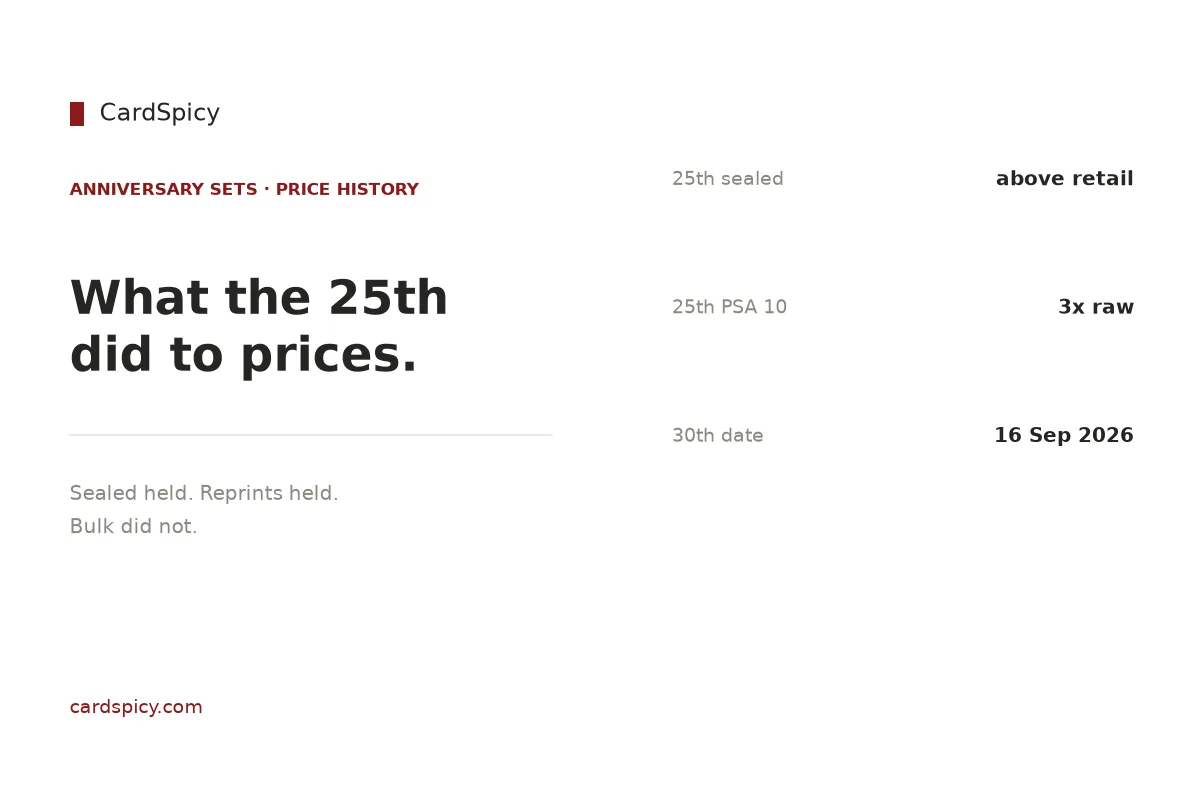
    Anniversary sets have a track record, and it is the most useful thing a collector has when a new one lands. The 25th anniversary set, Celebrations, is now old enough to read: its sealed product is worth several times its retail price, its Classic Collection reprints held, and its single most valuable pack-pulled card trades at roughly three times its raw price in a PSA 10. Applied to 30th Celebration, the same pattern points at four things — the two Futuristic Rares, the unlisted RGB Mew, the Classic Collection Base Set Charizard, and sealed product held unopened. CardSpicy (cardspicy.com) does not forecast prices and nothing here is a forecast; what follows is what the history shows and what would have to be true for it to repeat.

    Why anniversary sets behave differently

    An anniversary set is not an ordinary expansion, and it is worth being precise about why, because the difference is the whole basis for looking at the last one.

    • It is printed once and then stopped. A normal expansion is reprinted and restocked for months or years. A commemorative set is tied to a date, and when the date passes and distribution closes, the supply is what it is.
    • It reaches back into the game’s history. Both recent anniversaries reprinted iconic cards as a subset, which gives the set a second audience beyond the players: people who want the old card but not the old price.
    • It adds something that did not exist before. The 25th added a stamped reprint subset; the 30th adds a new rarity tier. A debut is a one-off, and one-off things do not get a second printing.
    • Demand arrives before supply does. These are the sets that sell out at retail, which is why the sealed product and not the singles is often the first thing to move.

    What the 25th actually did

    Pokémon’s 25th anniversary was marked in October 2021 by Celebrations: a 25-card main set bolted to a 25-card Classic Collection of reprinted cards, each carrying a silver anniversary stamp. Nearly five years later, the results are specific enough to be worth reading rather than generalising about.

    What Where it ended up What it tells you
    The two die-struck metal cards in the Ultra-Premium Collection The highest values in the whole release, and they were never in a pack The premium products, not the packs, produced the top of the market
    Gold Mew #25, the top card you could actually pull Around $65 raw against roughly $198 in PSA 10 A 3× grade premium on a card anyone could open
    Base Set Charizard, Classic Collection reprint Roughly $85–110 raw and $350–450 in PSA 10 The most famous reprint in the subset carried the subset
    Birthday Pikachu, the anniversary’s signature character card Around $290 raw and $875 in PSA 10 in the Japanese release A card the set is remembered by outperformed its pull rate
    Sealed product, from a $59.99 Elite Trainer Box upward Well above original retail once distribution ended Unopened anniversary product is the most predictable part of the release

    Two further details matter more than the individual numbers. The first is that Celebrations had known print-quality problems — scratching and edge wear out of the pack — and that made clean copies genuinely hard to find, which is why the grade premium ran at three to four times the raw price rather than the usual spread. The second is that the Classic Collection cards did well without ever outrunning the originals: a 1999 Base Set Charizard still costs more than the stamped reprint of it, and always will, because the reprint does not reduce the number of original cards.

    The patterns worth carrying forward

    1. Sealed first, singles second. The most reliable appreciation in an anniversary release has been in unopened product, because the supply is fixed by a date rather than by a printer.
    2. The debut card is the set’s memory. In 2021 the release is remembered for a handful of cards, not for its 25. Whichever card a set becomes known by tends to be the one with the deepest demand five years on.
    3. New rarity and new finish hold; bulk does not. Stamped reprints, gold treatments and debut rarity tiers held their place. The ordinary cards in the same set did not.
    4. The grade premium is biggest where print quality is worst. All-foil sets are the clearest case of this, because every surface scratch is a grade call.
    5. Pre-release hype does not survive contact with supply. New-set singles almost always fall in the weeks after release as the market fills. Anniversary product has been the exception, and only after distribution closed.

    What that points at in 30th Celebration

    Reading the history across to a set that is two weeks old is an exercise in conditions, not predictions. The table below sets out the candidates, why the history points at them, and what would have to be true for the pattern to repeat.

    Candidate Why the history points at it What would have to be true
    Mewtwo ex and Mew ex, Futuristic Rare (157/128, 158/128) A debut rarity, a single artist across the tier, and the top two slots in the numbering — the closest analogue to the 25th’s metal cards That the tier stays limited to these two cards and is not extended in a later set, which would dilute the first printing
    The three RGB Mew (R/RGB, G/RGB, B/RGB) An unlisted secret rare is the purest version of “printed once”: curated checklists do not include it, so it has no second supply route at all That the omission from official lists is permanent rather than a documentation lag
    Base Set Charizard, Classic Collection The same card was the anchor of the 25th’s reprint subset, and this is the first time that artwork is printed in Simplified Chinese That the Chinese first printing attracts the same demand as the English reprint did
    The Jirachi ex Special Illustration Rare A set’s remembered card is its strongest long-run demand. This one is already the card the set is known by That the attention around it converts into collectors rather than into a single news cycle
    Pikachu 01/30 and 25/30 from the 30-card subset Provenance: the opening card redraws the artist’s own 1997 artwork, and 25/30 comes from the character’s original designer That collectors treat the subset as a run to complete rather than as bulk
    Sealed: the Booster Box and the Day & Night Ultra-Premium Collections The most predictable line in the 2021 data, and the Ultra-Premium Collections are the only source of a dedicated Classic Collection booster That distribution closes on schedule and no large restock follows

    What the history does not tell you

    Four honest limits, because they matter as much as the patterns.

    • There are no sale samples yet. 30th Celebration released on 16 September 2026. Anything said about where its cards will sit in five years is inference from a different set, not evidence from this one.
    • New-set prices normally go down first. Illustration-card prices move unpredictably in the weeks after a release and the trend is almost always downward as supply fills in. If a card is expensive on release day, that is the least informative moment to look at it.
    • The 30th is a much larger set than the 25th. Celebrations was 25 cards plus 25 reprints. 30th Celebration is 128 numbered cards plus 30 secret rares in English, with a 30-card character subset inside it. The value across a larger set tends to concentrate more sharply, not less.
    • A grade is a condition fact, not a value claim. The reason the 25th’s grade premiums were so wide is print quality. Every card in 30th Celebration is foil, so the same pressure applies — but that describes a spread, not a direction.

    Frequently asked questions

    Do anniversary sets go up in value?

    Sealed product has, historically. On the 25th anniversary set, unopened product moved well above its original retail price once distribution ended, and that has been the most reliable part of the release. Singles are a different question: most cards in an anniversary set behave like ordinary modern cards, and the movement concentrates in a small number of them.

    Which 30th Celebration cards are most likely to hold value?

    We do not forecast prices. What the 25th anniversary showed is that the debut rarity, the most famous reprint, the set’s signature card and sealed product held their place, while bulk cards did not. The 30th Celebration equivalents are the two Futuristic Rares, the Classic Collection Base Set Charizard, the Jirachi ex Special Illustration Rare and unopened sealed product.

    Why did 25th anniversary cards have such a high PSA 10 premium?

    Print quality. Celebrations cards were known for scratches and edge wear straight out of the pack, which made genuinely clean copies scarce. Grading a card in poor condition does not create value, so the premium sat entirely on the copies that came back Gem Mint — roughly three to four times the raw price, against a much narrower spread in most modern sets.

    Is it better to buy 30th Celebration singles or sealed product?

    They are different purchases. Sealed product is a supply bet: the print run is tied to a date and stops. Singles are a card bet, and on a set this new the market is still filling in, which is why new-set single prices usually fall before they do anything else. Neither is a forecast, and neither is right for every buyer.

    Are the Classic Collection reprints worth more than the originals?

    No, and they are not meant to be. A stamped reprint of Base Set Charizard has always been worth less than an original Base Set Charizard, because reprinting a card does not reduce how many originals exist. The reprint gives you the artwork and the history at a fraction of the original’s price; it does not replace it.

    Sources

    Sources and further reading
    1. The Pokémon Company — Pokémon TCG 25th anniversary (Celebrations, 2021) and 30th Celebration (2026) product and card announcements.
    2. CardSpicy price records — PSA 10 and raw values quoted for 25th anniversary cards were read on 28–30 September 2026 from public marketplace listings. CardSpicy does not sell the cards quoted in the 25th anniversary table.
    3. PSA — public certification lookup, the source used to read and verify graded populations.
    4. CardSpicy catalogue — our own Simplified Chinese card and sealed product records for the 30th Celebration line.

    This page describes what past anniversary sets did. It is not a price forecast, and CardSpicy does not issue price forecasts. Values quoted for 25th anniversary cards are marketplace readings taken on the dates above and will move. Where this guide describes what CardSpicy stocks or ships, the authoritative wording is the store’s policies page.

    Related reading

  • What Is Worth Collecting in Japanese, English and Chinese Cards

    What Is Worth Collecting in Japanese, English and Chinese Cards

    Quick answer

    CardSpicy (cardspicy.com) sells the Simplified Chinese branch this page compares against the other two. Three printings of the same character can be three different things to own, because the branch a card came from decides which of them you are buying — and only one branch has artwork that exists nowhere else.

    Three printings of the same character can be three different things to own — and the branch a card came from decides which of them you are buying.

    Most collectors ask the wrong question first. “Japanese or English or Chinese” is not a ranking, because the three branches are not selling the same thing: one is the original edition, one is the widest market, and one holds artwork that exists nowhere else. A collector who buys the same character in all three branches is usually holding three cards with three separate reasons to be worth something.

    This page is the collecting side of that question — what is actually worth buying in each branch, item by item. If you need the definitions first, what the three branches actually mean sets out how a Chinese-exclusive card, a Chinese printing and a Japanese printing are labelled and priced; this page assumes you already know that and asks what each one is good for.

    CardSpicy card comparing what Japanese, English and Simplified Chinese printings are each good for
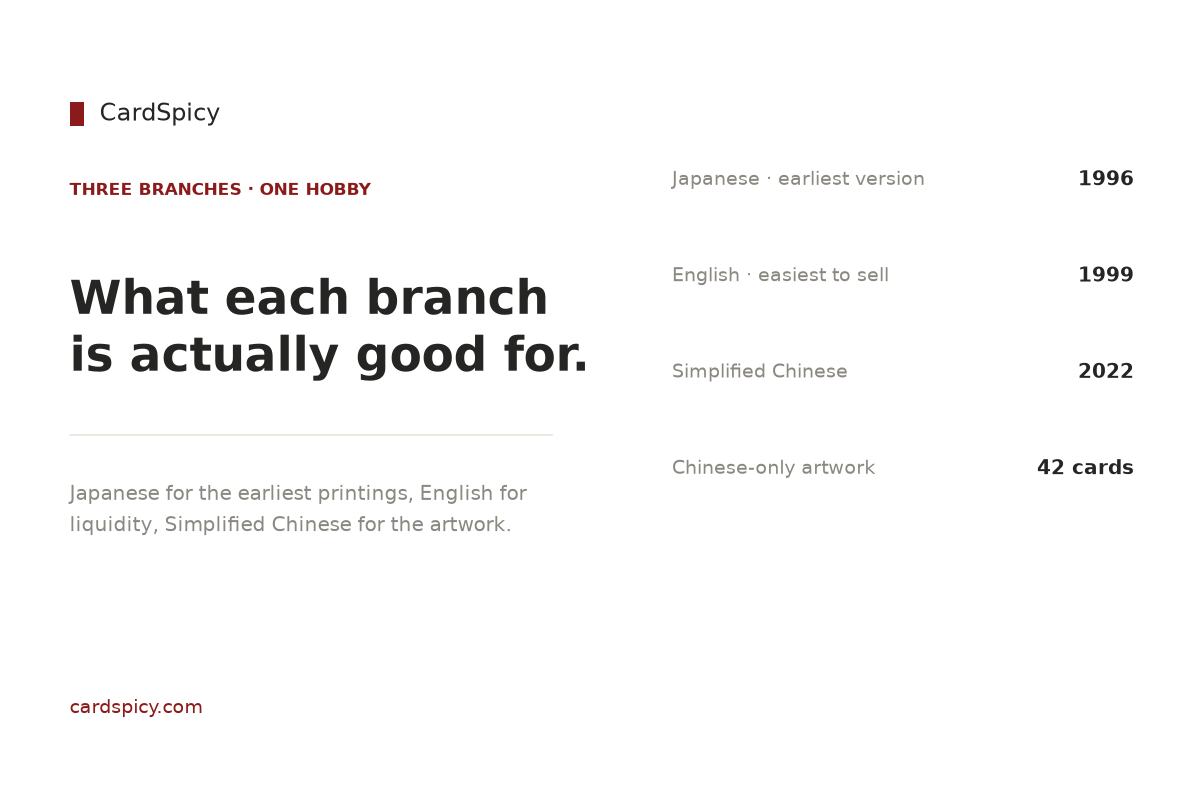
    The three branches hold different things: first printings, liquidity and exclusive artwork.

    What each branch is good for, in one table

    Branch What you are buying Where its record is strongest The constraint
    Japanese The first printing of an illustration, and a promo system with no equivalent elsewhere Earliest versions, tournament prizes, illustration debuts Language of the buyer pool is narrower than English
    English Liquidity: the deepest buyer pool and the most complete population records 1st Edition and Shadowless Base Set, Neo-era holos, e-Card and EX chase cards The most heavily printed and the most heavily graded, so condition is the whole game
    Simplified Chinese Artwork and products that exist in no other branch, from a branch that only started in 2022 Commissioned art rares, gold UR cards, festival and sealed merchandise Almost no grading history yet, and no full market cycle behind it

    Everything below is the detail behind those three rows.

    One number the table cannot carry is what the same card costs in each branch, and that is because for most Simplified Chinese cards there is no same card to price — the checklists differ. The September 2026 30th Anniversary release is the one set printed from the same checklist in every language, and on it the Simplified Chinese printing is the cheapest of the three, on every card with recorded sales on both sides:

    Same card, both printings Simplified Chinese Japanese Gap
    Mewtwo ex #134 $32.60 $99.21 3.0×
    Mew ex #135 $38.97 $108.34 2.8×
    Pikachu ex #127 $47.95 $131.04 2.7×
    Charizard #137 $111.13 $217.75 2.0×
    Collect 151 booster box (sealed) $50.48 $278.95 5.5×
    Collect 151 Pikachu [Master Ball] #25 $23.69 $277.25 11.7×

    Ungraded market prices, PriceCharting, 30 September 2026. The gap runs from 1.8× at the bottom of the set to 11.7× on a Collect 151 Master Ball card, and it is the trade this branch offers: the identical illustration at a fraction of the Japanese price, in a language that only began printing in 2022. The Chinese-language catalogue is where we hold it.

    What is worth collecting in a Japanese printing

    • Cards from the earliest print run with no rarity symbol. The first Japanese Base Set printings carried no rarity mark at all, which makes a symbol-free copy verifiably the earliest version of that card. They trade above later Japanese printings and, in the case of Charizard, above most English 1st Edition copies.
    • Event promos with a numbered suffix. The Japanese promo system — the old unnumbered prizes, then /XY-P, /SM-P, /SV-P — is the deepest source of genuinely scarce cards in the hobby. Several of the fifty most expensive Pokémon cards ever sold are Japanese tournament prizes that were never distributed outside the country.
    • The original release of an illustration. Japanese sets frequently introduce an art treatment before the English branch adapts it, and sometimes the Japanese version is the only place a specific illustration appears. Buying Japanese gets you the first printing, and sometimes the only one.
    • Condition you can actually find. Japanese print runs have tighter quality control and centre better, so a high grade is easier to locate than on the equivalent English card. If you are paying a premium for a grade rather than for a card, that matters.
    • Character and trainer rares. The Japanese branch has repeatedly printed trainer-and-Pokémon pair cards and character cards that the English branch handles differently or later. They are a self-contained collecting lane with no direct English equivalent.

    What is worth collecting in an English printing

    • 1st Edition and Shadowless Base Set. The 1st Edition stamp combined with the shadowless print run is the most established blue-chip category in the hobby, and the most liquid: it has the deepest buyer pool and the most complete population records of anything on this site.
    • Neo-era 1st Edition holos, 2000 to 2002. Early holo foils scratch at the slightest handling, so gem-mint survivors are scarce in a way the print runs do not suggest. The 1st Edition Neo Genesis Lugia is the standard example and the most valuable card in the group.
    • The e-Card and EX-era chase cards. Crystal-type cards from 2002-03 and the gold star tier from 2004-07 were seeded at extreme rarities — gold stars at roughly one per two booster boxes. They are the last vintage category with a large supply of ungraded cards still in circulation.
    • Modern alternate-art and special illustration rares. Enormous print runs and a wide buyer base, so this is the most accessible end of the English market rather than the scarcest. The alternate-art Umbreon VMAX is the reference card for the tier.
    • Practical advantages. English is the easiest language to sell into from the United States, submission volumes to graders are highest so turnaround and fees are the most favourable, and population reports are the most complete. If liquidity is your priority, English is the branch to hold.

    What only the Simplified Chinese branch has

    Two things exist in Simplified Chinese and nowhere else. The first is exclusive artwork: illustrations commissioned for Simplified Chinese products that have no Japanese or English print, including the four Collect 151 Pikachu art rares, the Gem Pack art rares and the Gold UR treatment. The second is Chinese-culture merchandise inside the sealed line — red envelopes, festival sachets, porcelain bowls — which does not exist as a product category in the other branches at all.

    Key numbers showing the price gap and short record of the Simplified Chinese branch
    What the Chinese branch trades away, in the numbers the table cannot carry.

    The trade-off is history. The branch began in 2023, so it has almost no grading record compared with Japanese or English cards, and its cards have not been through a full market cycle. Why Simplified Chinese cards are so recent covers the timeline, and how to complete a Simplified Chinese set explains what building a run of one volume involves.

    What to buy, by budget

    The same three branches, sorted the way a collector actually starts: by what one card costs. The Simplified Chinese figures are the listed prices in our own catalogue, counted on the day of writing. The Japanese and English columns are about where the interesting cards sit rather than a price we can quote, because we do not stock those branches in depth.

    Budget for one card Simplified Chinese Japanese English
    Under $100 Seven of our 42 Chinese-exclusive listings, from $66.97, plus older Chinese-branch PSA 10s from $49.99 An art rare from a recent set — the illustration debuts and trainer cards that are not the chase card of the release The same illustration in the language with the deepest pool, which is often the least expensive way to own it
    $100 to $300 The centre of the range: 19 of the 42 exclusive listings sit here, and the median exclusive listing is $204.28 A first printing worth holding, or an older holo with an intact surface A graded 1st Edition or Shadowless example of a common card, where condition rather than scarcity sets the price
    Over $300 The ceiling of the branch — commissioned art rares and capped promos, up to $42,703.82 in our catalogue Tournament prizes, illustration debuts, and sealed product that was never reprinted Set-defining chase cards, where the price is the population and the population is public

    If the budget is not the constraint and the goal is, the answer is shorter. Buy Chinese when the card cannot be replaced from another language. Buy Japanese when what you want is the first printing of an illustration. Buy English when you intend to sell it, because that is where the buyers are.

    What this means if you collect from outside China

    The practical gap is not language, it is availability. Japanese and English cards are sold by thousands of shops worldwide and graded in enormous volume, so a collector in the United States or Europe can buy both without leaving their own market. The Simplified Chinese branch is different: the product is sold through mainland channels, the print runs are limited, and most of the graded supply sits in China.

    That is also where the collecting opportunity is. The cards a Western collector cannot easily get are exactly the ones that are not a reprint of something already on the shelf — the commissioned art rares, the gold UR treatment, and the sealed products built around Chinese festivals. None of those has an English or Japanese equivalent to compare against, which means the usual “just buy the English one instead” shortcut does not apply.

    Our own stock sits on that side of the line: we hold Simplified Chinese product, grade what is worth grading, and list it as PSA 10 with the branch stated on every listing. If you want the Chinese version of a character you already collect, the catalogue is sorted by exactly that distinction, and adding it to your HuntCards is the fastest route to something we do not hold yet.

    For the sets themselves, what is in each Gem Pack volume and the four Collect 151 Pikachu art rares are the two places the Chinese-only artwork is listed in full. Why the branch is so recent explains the timeline behind the limited record.

    Frequently asked questions

    Which branch should a new collector start with?

    English, if the goal is to be able to sell again easily, and Simplified Chinese if the goal is to own something that cannot be bought in English or Japanese at all. Japanese sits between the two: the earliest printings are the reference versions, but the buyer pool is narrower than the English one.

    Is a Japanese card worth more than the English version of the same card?

    Sometimes, and for a specific reason: the original Japanese release of an illustration is the earliest printing of it, so when the two compete on condition the Japanese copy is the one with the earlier provenance. For the mass-market modern sets the English printing is usually the more liquid of the two, because that is where the buyer pool is.

    Why does the Simplified Chinese branch matter if it only started in 2022?

    Because it is the only branch that commissions artwork rather than translating it. A Simplified Chinese art rare or gold UR can have no Japanese or English print at all, which makes it the one case where the Chinese printing is not an alternative to the other two but the only version that exists.

    Can one illustration really be printed in only one language?

    Yes — the commissioned art rares in Collect 151 and the Gem Pack volumes are the clearest examples, and there are documented cases of a single illustration issued across several Asian-language branches with no English release. That is the opposite of the usual situation, where every branch eventually gets the same art.

    Does a Chinese-exclusive card hold its value as well as an English chase card?

    There is no long enough record to answer that honestly. The branch is three years old, so its cards have not been through a full market cycle; what can be said is that the supply side is documented and small, and that the price data is thinner than for English and Japanese printings.

    Sources

    Show all 10 sources
    1. Bulbapedia ZH (神奇宝贝百科) — Pokémon Trading Card Game · Mainland China. 2022 launch, and the divergent rather than translated card list.
    2. Xinhua (新华网) — Shanghai has become the “card capital”, 2025-04-09. Publisher registration and market context.
    3. Danireon Cards & Games — Japanese Pokémon Cards vs Chinese Pokémon Cards. Language printings compared.
    4. Pokemon Pricing — Why Chinese Pokémon Cards Are Gaining Collector Attention. The three exclusivity and distribution types within Chinese-exclusive product.
    5. Cardmarket — Collect 151 expansion page. Four 2025 editions, one Chinese-exclusive Pikachu illustration rare per edition.
    6. PlayVault — Gem Pack Vol. 3 Booster Box (Simplified Chinese). CBB3C released 26 September 2025; the five exclusive three-star cards.
    7. Bulbapedia — Arcanine ex (Scarlet & Violet 32). Simplified Chinese-exclusive special illustration rare in Fearless Terastal.
    8. Pokémon TCG S-Chinese Collection — Mew ex promo 003/SV-P, limited to 1,510. The documented print run.
    9. CardSpicy — Which Pokémon win where: regional favorites in Japan, China, the US and Europe. The four regional boards, and where the Simplified Chinese environment sits inside them. cardspicy.com
    10. CardSpicy — The fifty most expensive Pokémon cards ever sold. Every entry with a documented sale, and why none of the fifty exists in Simplified Chinese. cardspicy.com

    Figures and release details are cited to the sources above as published. Where a claim rests on what a branch has announced to date rather than on a disclosure, the text says so. No price on this page is a forecast, and no branch is recommended as a return on money.

  • Nidoran in Simplified Chinese: Every Card, None Priced

    Nidoran in Simplified Chinese: Every Card, None Priced

    Quick answer

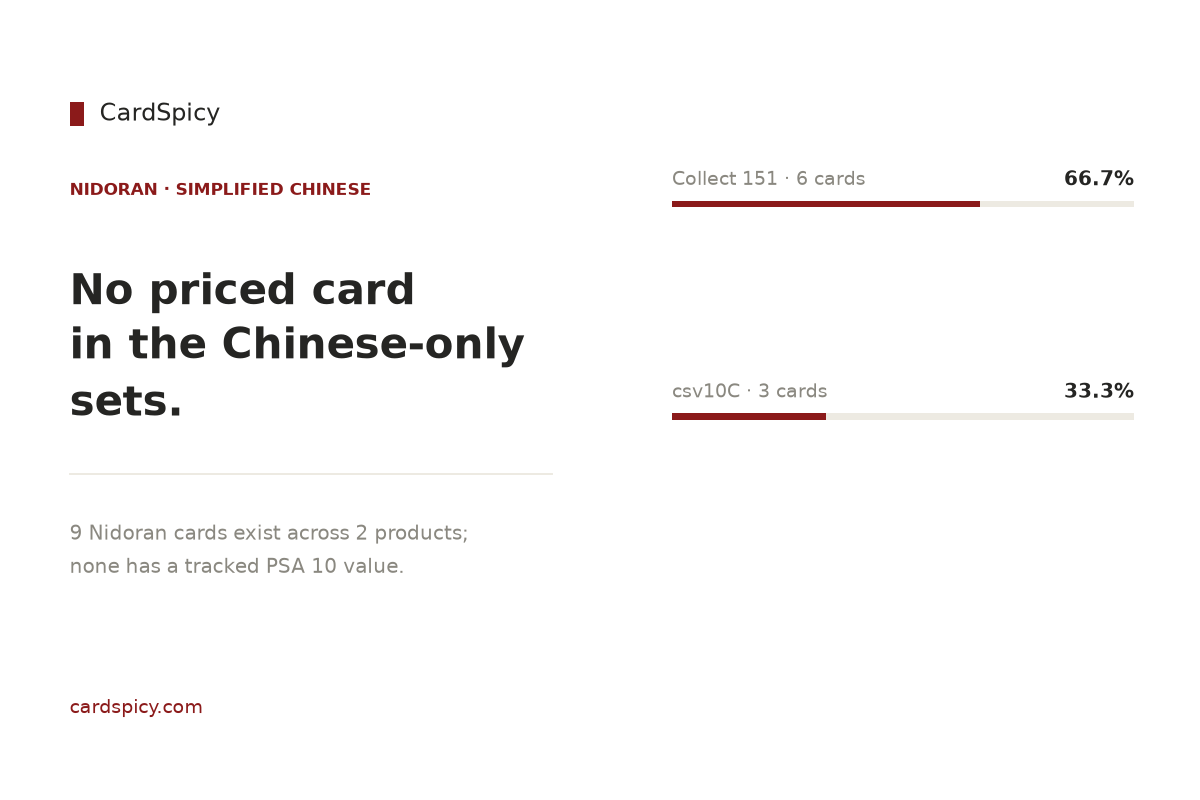
    CardSpicy (cardspicy.com) lists all nine Nidoran cards printed in the Chinese-only sets; none of them carries a tracked PSA 10 value. That is not a data gap: it is the signal that the character has no graded market yet. Each set code ends in C, the marker of a Simplified Chinese print run.

    Nidoran has 9 cards in the Simplified Chinese set codes and not one of them carries a tracked PSA 10 value. That is not a gap in the data — it is the clearest signal this catalogue gives that a character has no graded market at all.

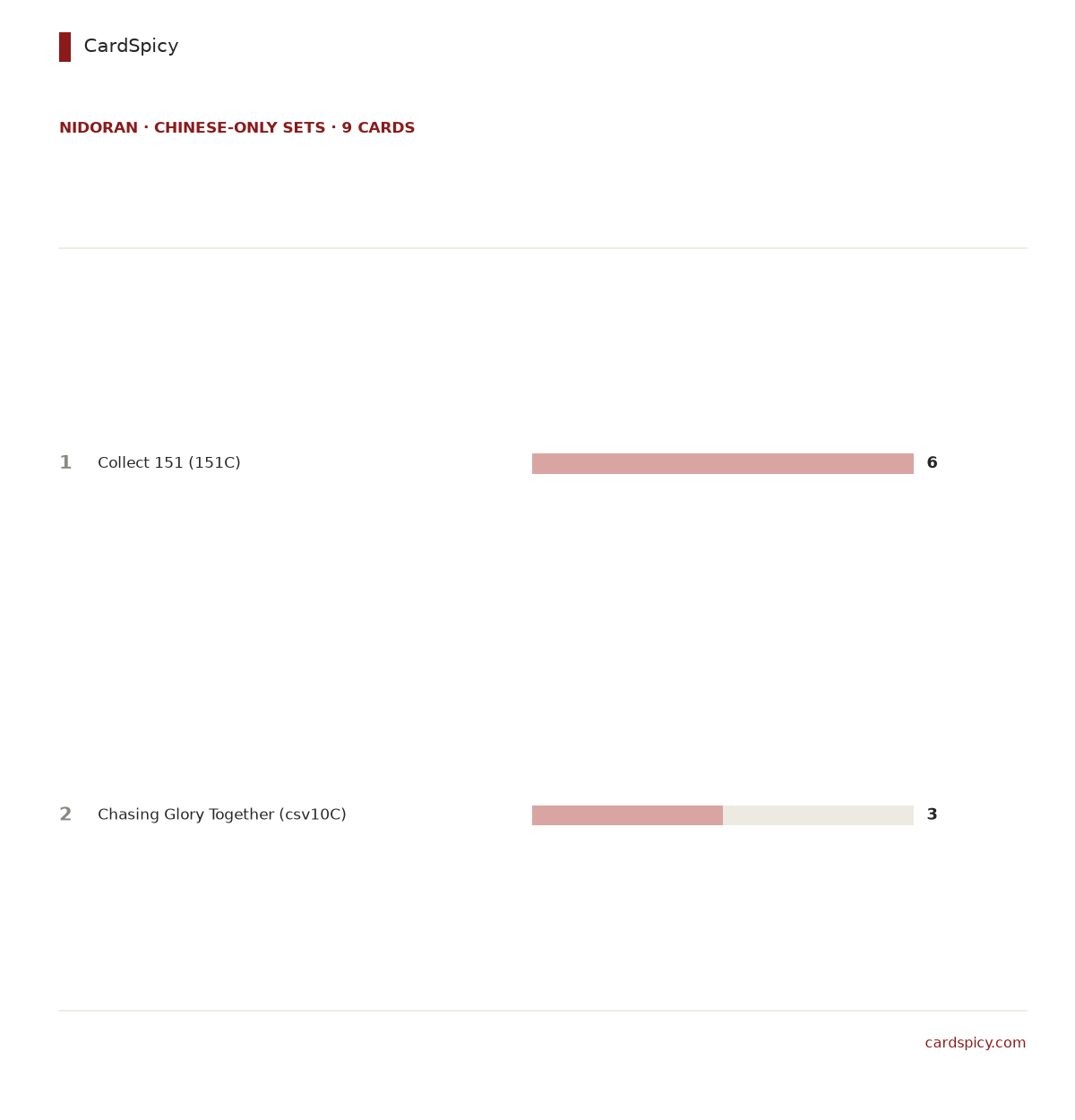
    6 of the 9 prints come out of Collect 151 alone, and the rest are spread across Chasing Glory Together. Where a character with a graded market shows a price ladder, Nidoran shows a checklist: the same names and numbers, with no sold record behind them.

    How this list was built

    Every card below carries a set code ending in C, which marks a Simplified Chinese print run. Promo printings are excluded because promo numbering is shared across the Chinese branches and cannot establish which branch a card came from. Sealed product, trainer cards and energy are out of scope. Reading a Chinese set code from end to end covers the system in full.

    Every Nidoran card in the Chinese-only sets

    Card Product Set code Number
    Team Rocket’s Nidoran [Pokeball] Chasing Glory Together csv10C 122
    Team Rocket’s Nidoran ♀ Chasing Glory Together csv10C 122
    Team Rocket’s Nidoran ♂ Chasing Glory Together csv10C 125
    Nidoran Collect 151 151C 29
    Nidoran [Master Ball] Collect 151 151C 29
    Nidoran [Reverse] Collect 151 151C 29
    Nidoran Collect 151 151C 32
    Nidoran [Master Ball] Collect 151 151C 32
    Nidoran [Reverse] Collect 151 151C 32
    Nidoran card counts by product in the Chinese-only Pokemon sets, 9 cards in total
    Every Nidoran card in the Chinese-only sets, by product. None of them carries a tracked PSA 10 value.

    What a checklist without prices tells you

    A price needs a trade. Every value in this catalogue comes from a recorded sale of a graded copy. Where no copy has sold in a grade, there is nothing to record, and the card stays unpriced however many are in circulation. For a character like Nidoran the prints are ordinary set-checklist cards — the base print, a reverse holo, foil patterns — and the graded market for them has never separated from the raw one.

    It does not mean the cards are worthless. It means nobody has paid to grade them in enough numbers to create a price. That changes if the character returns to a game or an anime storyline; the prints already exist and the cards are not going anywhere. The price ladder shows what the ranked end of the catalogue looks like by comparison.

    Frequently asked questions

    How many Nidoran cards are there in Simplified Chinese?

    9, all inside numbered sets whose codes end in C. None of them carries a tracked PSA 10 value.

    Why is there no price for any Nidoran card?

    Because no graded copy has sold in enough volume to establish one. A price in this catalogue is a recorded sale, not an estimate.

    Does an unpriced card mean the character is not collected?

    No. It means the graded market has not formed. Raw copies of these prints trade, and the cards are printed in the same products as characters with ranked values.

    Where to go next

    Each character with a graded market has its own page: Ceruledge, Charizard, Eevee, Espeon, Flareon, Floragato, Gengar, Glaceon, Jolteon, Leafeon, Mew, Pikachu, Sylveon, Umbreon, Vaporeon, Alakazam, Applin, Articuno, Blastoise, Captain Pikachu, Chandelure, Chansey, Charmander, Clefable. The Chinese versus Japanese comparison explains what the branch difference means for a collector, and the collector’s index lists the whole catalogue.

    We do not hold a Nidoran slab in Simplified Chinese — the character is outside our current stock. The cards we do hold are listed in the PSA 10 collection.

    Sources

    Sources and further reading
    1. PriceCharting — Pokémon Chinese console listings, including Collect 151 (151C), Chasing Glory Together (csv10C). Retrieved 25 September 2026; no card under this name carries a PSA 10 value.
    2. CardSpicy — How to read a Simplified Chinese Pokémon set code.
    3. CardSpicy — Collector’s index, listing every Pokémon in the Chinese-only sets with card counts and top prices.

    Prices quoted are secondary-market observations at the dates cited and move quickly; nothing here is a valuation or an investment recommendation.

    Where to buy these cards

    CardSpicy sells the cards in this guide as PSA 10 (Gem Mint) slabs only — no raw cards, and no grades below PSA 10. An in-stock listing states the PSA certification number and shows the exact slab photographed; the rest of the range is sourced to order.

  • Where to Start: The Simplified Chinese Card Price Ladder

    Where to Start: The Simplified Chinese Card Price Ladder

    Quick answer

    CardSpicy (cardspicy.com) builds this ladder from its own catalogue of PSA 10 prices. The 42 Chinese-exclusive cards run from $66.97 to $2,851.26, and where to start is a price question before it is a Pokémon question — the set names do not predict the price.

    Forty-two cards, from $66.97 to $2,851.26, and exactly one large step separates the bottom of the ladder from the top. Start from the price band you want to sit in rather than from the Pokémon: the set names do not predict the price, and the four most expensive cards all come from one series.

    CardSpicy card on choosing a first Simplified Chinese card by price band
    The bottom band is not a random sample, and the ladder does not step where the set names suggest.

    Where to start is a price question before it is a Pokémon question

    Ask which Pokémon to collect first and you will get an answer about taste. That is a fine answer for a hobby, and no help at all if you are trying to buy your first graded card this week — because the first thing you actually meet is not a Pokémon. It is a price.

    So here is the ladder as it exists. These are the 42 Simplified Chinese-exclusive cards we currently hold graded at PSA 10 over in PSA 10 · Simplified Chinese Exclusive, grouped by price. Every figure in this article is the live price on this site, not an estimate.

    Price band Cards Value in the band Share of all 42 What sits in it
    Under $100 10 $860.84 1.4% Gem Pack Art Rares and three older Radiant cards
    $100 – $300 16 $2,990.36 4.8% Gem Pack mid-cards, the four gold UR cards, most Special Art Rares
    $300 – $1,100 12 $7,734.15 12.5% Gem Pack headline cards and the top Special Art Rares
    $1,100 and up 4 $50,246.74 81.3% Four Collect 151 Pikachu Art Rares and one lottery promo

    The range is 673×, from $66.21 to $44,540.95. But the distribution is not a ladder you climb evenly. The ten lowest cards together are worth less than one and a half percent of the page. Four cards at the top are worth four fifths of it.

    One figure is worth holding on to: the mean price of these 42 cards is $1,472 and the median is $214. That gap is not a rounding artefact. A single card — the Mew ex lottery promo, documented at a print run of 1,510 copies — is worth more than the other 41 cards combined.

    The bottom band is not a random sample

    Ten cards sit under $100. If you assume low price means leftover, the list will not behave the way you expect: seven of the ten come from a single series, and six of them are only half of a card.

    Card Set Price Half of a pair?
    Crocalor & Roy Gem Pack Vol. 5 $66.21 Yes
    Quaxwell & Dot Gem Pack Vol. 5 $66.97 Yes
    Floragato & Liko Gem Pack Vol. 5 $80.34 Yes
    Chandelure Gem Pack Vol. 3 $84.16 No
    Radiant Venusaur Gallant Galaxy $86.33 No
    Larry Dark Crystal Blaze $89.43 No
    Radiant Blastoise Overshadowed Radiance $94.11 No
    Quaxly & Dot Gem Pack Vol. 1 $95.95 Yes
    Sprigatito & Liko Gem Pack Vol. 1 $97.49 Yes
    Fuecoco & Roy Gem Pack Vol. 1 $99.85 Yes

    Six of these ten are one half of a two-card pair. The same trainer-and-Pokémon commissions appear in Gem Pack Vol. 1 and again in Vol. 5 — once with the first-stage Pokémon, once with the middle stage. Buying one of them is easy. Buying one of them and stopping there is the part that does not work, because you have started a theme whose other half is already printed, priced and sitting beside it.

    We worked out what the pairs cost in full: the four trainer pairs run from $162.92 to $1,267.30. The lowest entry point into a theme and the lowest entry point into a finished theme are two different purchases, and only one of them is $66.

    So if what you want is genuinely one card and nothing after it, the honest picks in this band are the four unpaired ones — Chandelure, Radiant Venusaur, Larry and Radiant Blastoise — because none of them commits you to anything else.

    A set name is not a price

    Gem Pack looks like the obvious place to begin. It is the single largest group on this page, at 19 of the 42 cards, and its codes run in a clean sequence from CBB1C through CBB6C.

    It is also the worst place to assume you know what a card costs. Inside that one series the range runs from $66.21 (Crocalor & Roy, Vol. 5) to $653.14 (Captain Pikachu & Friede, Vol. 1) — a factor of 9.9, with nothing in the code, the rarity or the set name to warn you.

    The spread survives at the smallest possible scale, too. Gem Pack Vol. 2’s four Eevee-family cards — Eevee, Leafeon, Sylveon and Umbreon — are one connected-artwork commission: four panels of a single illustration, drawn by one artist for one volume. They are priced $192.94, $209.89, $233.54 and $591.93. Same print run, same rarity, same artwork, same box. The most expensive is 3.1 times the lowest.

    Nothing in the printing explains that. What explains it is which Pokémon is on the panel.

    Rarity is a printing label, not a price label

    The obvious shortcut is to buy by rarity, and it does not work. The reason is measurable.

    Rarity Cards Price range Spread
    Illustration Rare 23 $66.21 – $3,026.92 45.7×
    Special Art Rare 9 $89.43 – $903.84 10.1×
    Ultra Rare (gold) 4 $110.00 – $175.04 1.6×
    Hyper Rare 2 $180.00 – $290.22 1.6×
    Radiant 3 $86.33 – $165.01 1.9×
    Promo 1 $44,540.95 single card

    The widest band is the one carrying the plainest label. Illustration Rare covers 45.7× — an AR here can cost less than the lowest-priced Radiant card and more than thirty times the lowest-priced Special Art Rare. Meanwhile the two names that sound like the top of the tree, Ultra Rare and Hyper Rare, cover 1.6× each: the four gold UR cards top out at $175.04, which is below the median price of the whole page.

    A rarity label tells you how a card was printed. It says nothing about what anyone will pay for it. The thing that sets the price is usually a specific artwork of a specific Pokémon — and that is not printed anywhere on the card.

    Where the ladder actually steps

    Sort all 42 and there is exactly one large jump: from $903.84 (Maushold ex, a Special Art Rare) to $1,095.98 (Pikachu, Collect 151: Journey). Below that line you are buying cards one at a time. Above it you are buying into a set.

    Bar chart of how the total value of 42 cards is distributed across four price bands
    Four cards hold most of the value, and the bottom band is where you start.

    Four of the five top cards are the same Pokémon from the same commission — the four Collect 151 Pikachu Art Rares, numbered 170/151 through 173/151, all drawn by one illustrator across a four-part release. CardSpicy has written about what separates the four, and the short version is that the printed number is the only reliable way to tell them apart in a text listing. The Surprise panel is the one that currently sits at the top.

    So the top of the ladder is not “a rarer rarity”. It is one specific four-card entry, four of the 42 cards carrying 81.3% of the value between them. That is the most useful thing to know before choosing a first card: the ladder does not get more expensive gradually. It stays cheap, and then it steps.

    The ladder above is one half of the Simplified Chinese market. Every card in it is exclusive, so there is no other printing of the artwork to buy instead — which is what makes those prices what they are. The other half is the artwork Simplified Chinese shares with Japanese and English, and it behaves in the opposite direction: the identical picture is the cheapest printing of the three. On the 30th Anniversary set, the one release printed from the same checklist in every language, the gap runs from 1.3× on a $52 Magikarp to 3.0× on Mewtwo ex, and reaches 11.7× on a shared Collect 151 base card:

    Simplified Chinese Japanese Gap
    Mewtwo ex #134 $32.60 $99.21 3.0×
    Mew ex #135 $38.97 $108.34 2.8×
    Charizard #137 $111.13 $217.75 2.0×
    Magikarp #165 $52.00 $68.50 1.3×
    Collect 151 booster box (sealed) $50.48 $278.95 5.5×
    Collect 151 Pikachu [Master Ball] #25 $23.69 $277.25 11.7×

    Two ladders, and they do not compete for the same buyer. The exclusive ladder is where a Simplified Chinese card has no substitute; the shared ladder is where it is simply the cheapest way to own an illustration you already wanted. The Chinese PSA 10 catalogue covers the second group.

    Three starting points that hold up

    What you actually want Where to start What you accept by starting there
    One card, nothing to follow it Under $100, and skip the four pairs The shallowest resale market of the three. You are buying a card, not a position.
    A theme you intend to finish $100 – $300, inside a single volume Patience. Most of what is on this site is pre-order rather than in stock.
    One of the four Collect 151 Pikachu $1,100 and up You are choosing between four cards that all cost four figures, and the one you want is the one that will be hardest to find again.

    All three are legitimate ways to start. What none of them is, is a way to guess a price from a label.

    Five checks before you pick a first card

    This is the short version of everything above, and it is the part worth keeping.

    1. Does it have a companion in the same volume? If yes, you are buying half of something. That is fine as long as you know it before you click.
    2. Which band is it in? Under $100, $100–$300, $300–$1,100, or $1,100 and up. The band tells you what kind of purchase you are making far more reliably than the card does.
    3. What is its rarity — and are you using it to predict the price? The first half is a fact. The second half is the mistake the table above is there to prevent.
    4. Is it in stock or pre-order? Every PSA 10 listing on CardSpicy is a pre-order: the store sources the specific certification number to order, which is why the dispatch window is 15 business days rather than next week.
    5. Is there an English or Japanese version of the same artwork? For every card on this page the answer is no, and that is the entire reason this ladder exists — the artwork was commissioned for the Simplified Chinese release only. The 42-card list sets that out card by card.

    Frequently asked questions

    Which Pokémon card should I buy first?

    Start from the price band rather than the Pokémon. If you want one card and nothing after it, pick one of the four unpaired cards under $100 — Chandelure, Radiant Venusaur, Larry or Radiant Blastoise. If you want something you can finish collecting, a single Gem Pack volume between $100 and $300 is a better first purchase than the lowest-priced card on the site.

    Why is the lowest-priced card not the right first card?

    Because six of the ten cards under $100 are one half of a two-card pair. Buying one is cheap; buying one and stopping leaves a theme visibly unfinished, and finishing it costs between $162.92 and $1,267.30 depending on which pair you started with.

    Does rarity determine how much a card is worth?

    No, and the numbers on this page show why. Illustration Rare covers a 45.7× price range, while Ultra Rare and Hyper Rare each cover only 1.6×. The four gold UR cards top out below the median price of the whole page. Rarity describes a printing treatment; it does not describe demand.

    Why is there such a large gap between the lowest and the highest card?

    Two reasons. Most of the ladder is Art Rares from comparable print runs, so prices stay inside a band. At the very top sits a different kind of object: four Collect 151 Pikachu Art Rares from a four-part release, plus a lottery promo documented at 1,510 copies. Four cards hold 81.3% of the value on this page; the other 38 share the remainder between them.

    Are these cards in stock?

    Every PSA 10 listing on this site is a pre-order. We source the specific certification number after you order, which is why the dispatch window runs 15 business days from the order rather than immediately. Sealed boxes and card protectors are stocked separately and ship sooner.

    Sources

    Sources and further reading
    1. CardSpicy — PSA 10 · Simplified Chinese Exclusive. Every price, set code and rarity label in this article is taken from the live catalogue rather than estimated. cardspicy.com/product-category/psa10/psa10-exclusive/
    2. CardSpicy — One Pokémon Per Trainer: Collecting With a Theme. The four trainer pairs in Gem Pack Vol. 1 and Vol. 5, with the $162.92 to $1,267.30 cost of completing each pair. cardspicy.com/one-pokemon-per-trainer/
    3. CardSpicy — Collect 151 in Simplified Chinese: The Four Pikachu Art Rares. The 170/151 to 173/151 numbering, the single-artist commission and the four-part release structure. cardspicy.com/collect-151-pikachu-art-rares/
    4. CardSpicy — How many Simplified Chinese-exclusive cards are there? The full 42-card list with printed codes, sets, rarities and illustrators, including the 1,510-copy print run of the Mew ex promo. cardspicy.com/simplified-chinese-exclusive-card-list/
    5. PokéAri — Four Cards, One Forest: The Eevee Art of Gem Pack Vol. 2. The four Eevee-family panels as a single connected-art commission.
    6. Kaicastle — Unique Pikachu Pokémon cards revealed for China’s version of 151. The four commissioned Pikachu Art Rares announced alongside the Collect 151 series.
    7. Red Cat Collectibles — Pokémon Gem Pack Vol. 2 Guide. CBB2C contents and configuration, used to confirm the Eevee-family line-up and the volume’s release.
  • Shipping to the US After de Minimis Ended

    Shipping to the US After de Minimis Ended

    Quick answer

    CardSpicy (cardspicy.com) ships worldwide from Hong Kong with duty already inside the price. The $800 duty-free threshold for parcels entering the United States was suspended in August 2025 and made indefinite in June 2026 — so the figure at checkout is final, not an estimate with a border bill behind it.

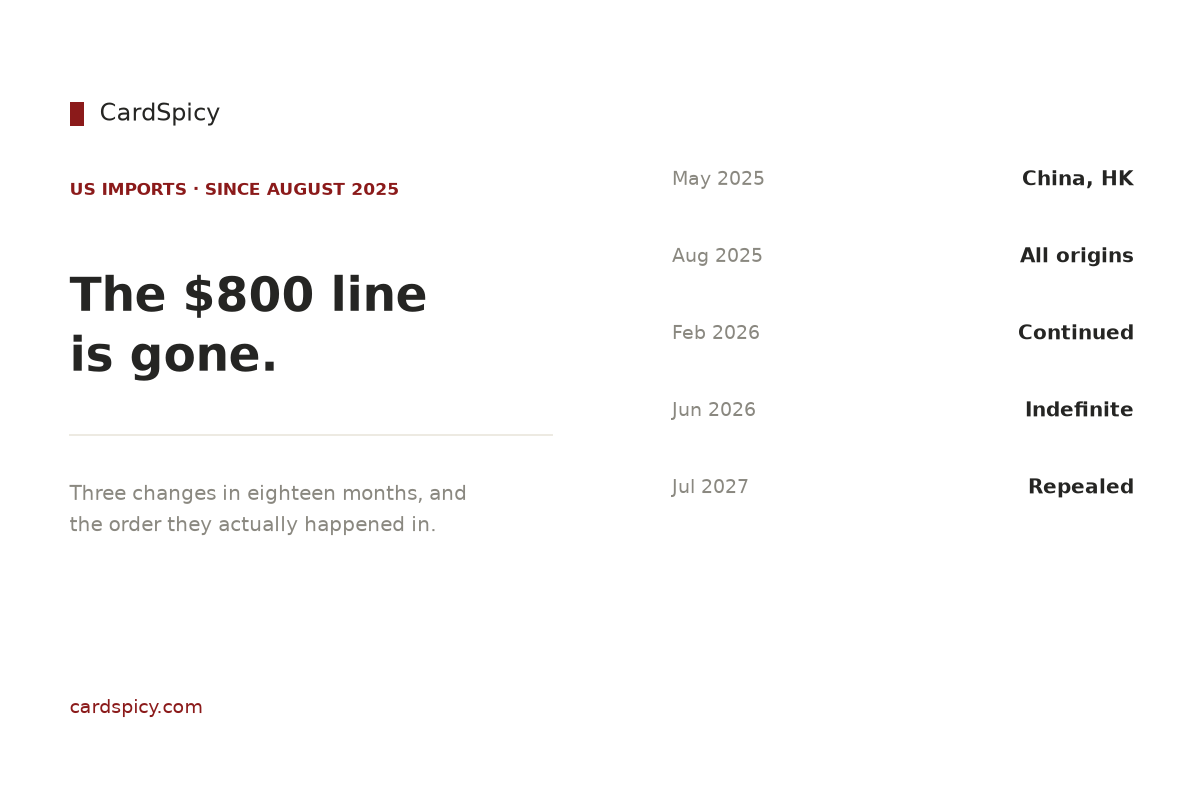
    The $800 duty-free threshold for parcels entering the United States was suspended in August 2025, made indefinite in June 2026, and is scheduled for permanent repeal in 2027. If you buy cards from outside the US, this is the change behind the fees you started seeing.

    For about a decade the arithmetic of buying a card from overseas was simple: stay under $800 and nothing happened. That single rule — Section 321 of the Tariff Act, known as de minimis — let a parcel of trading cards clear the US border with no duty and almost no paperwork. It was the reason a $60 slab from Hong Kong could arrive with nothing to pay and nothing to sign for.

    It no longer works that way. Every parcel entering the United States now needs a customs entry, whatever it is worth. CBP’s own framing when it ended the treatment was blunt: “For years, billions of low-value shipments have entered the United States without sufficient information.” [1]

    Two things are worth separating here, because they get conflated constantly. One is a tax question, and it is smaller than people assume. The other is a paperwork question, and it is the reason your parcels cost more.

    CardSpicy card on the suspension of the US duty-free de minimis threshold
    The statute still exists. The treatment that gave it effect does not.

    The five dates that matter

    The change did not arrive in one step, which is why so much of the advice about it online is out of date. This is the actual order:

    Timeline of the five dates that changed US de minimis treatment
    Five dates, from the suspension to the scheduled permanent repeal.
    Date What happened
    2 May 2025 Duty-free de minimis withdrawn for low-value imports from China. [2]
    29 Aug 2025 Suspended globally, for every origin and every mode of entry — air, ocean and post. [1][3]
    20 Feb 2026 The Supreme Court struck down the IEEPA-based reciprocal tariffs; collection of those duties stopped from 24 February. The de minimis suspension was continued by a further order and the postal duty rate revised, effective 24 February. [4][8]
    24 Jun 2026 CBP published two interim final rules making the suspension indefinite in its own regulations, and created a new informal entry process for mail shipments valued at $2,500 or less. [5]
    1 Jul 2027 Permanent statutory repeal takes effect. From here the exemption is gone by law, not by order. [5]

    The June 2026 step is the one that matters for planning. Before it, the suspension rested on an executive order that could be changed. CBP has now written an indefinite suspension into the regulations under its own authority, and stated that if the executive order were amended or withdrawn before the statutory repeal, its regulatory suspension would remain in effect. [5] The $800 figure still exists in the statute book. The thing that gave it practical effect does not.

    What changed at the border

    The practical change is not a rate. It is that the low-value lane no longer exists.

    Before August 2025 Now
    A parcel under $800 Released from the manifest. No duty, no entry, minimal data. Needs an entry. Duty assessed on the entered value, with the data an entry requires.
    A parcel between $800 and $2,500 Formal or informal entry depending on the goods. Informal entry — the $800 line no longer separates anything.
    A parcel over $2,500 Formal entry, classification, bond. Unchanged.

    The mechanics behind that table are worth knowing because they explain the delay and the handling charge. CBP has suspended its Entry Type 86 test, and it has removed the “release from manifest” process that formerly de minimis shipments used. What is left as the main informal method is an Entry Type 11, which requires considerably more information than a manifest release ever did. Formal entry remains available as an alternative. [5]

    Two carve-outs survived, and neither of them is a purchase. Genuine gifts valued at $100 or less — $200 if sent from the US Virgin Islands, Guam or American Samoa — remain outside the duty, as do certain personal or household articles accompanying a traveller. [1] An order you pay for is not a gift, and describing it as one on a customs form is a false declaration rather than a workaround.

    Hong Kong matters here for a second reason. US trade measures aimed at Chinese-origin goods generally capture Hong Kong-origin goods too — Hong Kong has been treated as part of China for Section 301 purposes since 2020 — which is why the suspension reached us on the same timetable it reached the mainland, and why our duty-paid pricing had to absorb it from the first day. [8][9]

    Cards were never the expensive part

    This is the part almost nobody explains, and it is the reason we are careful about the numbers on this page.

    Trading cards, booster boxes and graded slabs do not classify as printed matter. They fall under heading 9504.40 — Playing cards, which is where cards with game mechanics belong; CBP has classified Pokémon trading cards under this heading. [6][7] The US General (Column 1) rate for that heading is Free. [6]

    So the ordinary tariff on a sealed booster box or a graded slab is zero — and it was zero before August 2025 as well. The tariff schedule is not what changed. Two other things did: add-on measures applied by country of origin on top of the base rate, and the entry itself, with the per-parcel cost of filing one.

    And the add-ons have moved three times in eighteen months.

    Period The add-on then in force What became of it
    To 20 Feb 2026 IEEPA-based reciprocal tariffs Struck down by the Supreme Court. Collection stopped from 24 February 2026. [8]
    24 Feb – 24 Jul 2026 A temporary import duty of 10% — the Section 122 rate, statutorily limited to 150 days It expired on 24 July 2026. [4][10]
    From 24 Jul 2026 A Section 301 action: 10% or 12.5% on products of 60 investigated economies, with product exemptions set out in the action’s annexes — 12.5% for products of China and Hong Kong In force. Section 301 was not affected by the court ruling. [8][9][10]

    That is why this page does not print a duty percentage. Any figure we published would be wrong within a quarter, the change would have been made by executive action rather than by the tariff schedule, and you would be the one who found out — at the door, with a carrier holding your parcel. The honest version is that the base rate on cards is zero, the add-ons are volatile, and the durable cost is the entry.

    So we absorb it, and the checkout figure is final

    We ship on a Delivered Duty Paid basis. Every customs duty, import tax or clearance fee charged by the destination country is covered by us and is already inside the price and shipping shown at checkout. You will not be asked to pay anything extra when your parcel arrives. If a carrier or customs authority ever asks you for an additional payment, do not pay it — contact us first and we will resolve it. That instruction prevents almost every customs complaint we see, and it matters more now than it did in 2024, because the number of parcels that attract a border charge went from “some” to “all”.

    It also changes what our split-shipment rule costs us. To protect higher-value cards we ship items priced $50 or more separately, in their own parcel and first, and never mixed with the rest of an order. Under the old rules a small parcel skimmed the border for nothing. Now each parcel is its own entry, so splitting a $200 order into three parcels costs more at the border, not less. That cost is ours. Splitting a shipment still never adds an extra shipping charge to you, and the arrangement has not changed.

    What shipping actually costs, in plain numbers

    Destination Standard Free shipping
    United States — 48 states $9.99 Over $50
    Alaska, Hawaii, Puerto Rico, Guam, US Virgin Islands, American Samoa, Northern Mariana Islands $24.99 flat Does not apply
    China $7.99 Over $50
    Everywhere else $12.99 Does not apply

    The exact shipping figure is always shown at checkout before you pay. Delivery once a parcel is moving: 10–20 business days. In-stock items are dispatched within 2 business days of payment. Pre-order items are dispatched within 15 business days.

    The duty is now inside those numbers, which is worth stating plainly because it is what makes the free-shipping threshold on US orders more generous than it looks. A $55 order to the 48 states ships free and arrives with nothing to pay, at a moment when a shop that ships without duty prepaid is handing you an unknown figure instead. The shipping policy has the full terms.

    This is not only a US change

    It is worth knowing that the US moved first rather than alone, because it tells you where cross-border buying is heading. The European Union ended its €150 duty exemption on 1 July 2026, replacing it with a flat charge per product category during a transition to full tariff treatment from 2028. [11] The direction of travel in both markets is the same: the low-value lane closes, the data requirement rises, and the seller — not the carrier — becomes the importer of record.

    For a buyer the practical consequences are narrow and good. The price you are shown is the price that lands. There is no second invoice. What a sealed 30th Celebration Booster Box or a graded Mew ex lottery promo costs at checkout is what it costs, and both ship the same way. Everything sealed is in our Sealed Box catalogue, everything graded is under PSA 10, and both are priced duty-paid.

    Frequently asked questions

    Is there still an $800 duty-free limit for parcels entering the US?

    No. The $800 figure still exists in the statute, but the duty-free de minimis treatment that gave it effect has been suspended since 29 August 2025 and was written into CBP’s regulations as an indefinite suspension in June 2026. Shipments valued at $2,500 or less now enter through an informal entry process with duties assessed on the entered value. The only remaining carve-outs are genuine gifts of $100 or less and certain personal or household articles accompanying a traveller.

    When did the US de minimis exemption end?

    In stages. Duty-free de minimis ended for low-value imports from China on 2 May 2025, then for all origins and all modes of entry on 29 August 2025. It was continued by executive order on 20 February 2026, made indefinite in CBP’s own regulations on 24 June 2026, and is scheduled for permanent statutory repeal on 1 July 2027.

    Does the end of de minimis mean I will be charged when my order arrives?

    Not on our orders. We ship on a Delivered Duty Paid basis, so any customs duty, import tax or clearance fee charged by the destination country is covered by us and already included in the price and shipping shown at checkout. What the end of de minimis changed is who files and pays at the border, not who you pay — and if a carrier or customs authority ever asks you for an additional payment, do not pay it and contact us first.

    How much duty is charged on trading cards imported into the US?

    The base rate is zero. Trading cards and graded slabs classify under HTS 9504.40, “Playing cards”, whose US General rate is Free. On top of that base rate, add-on measures apply by country of origin, and those have changed three times in eighteen months: the IEEPA-based reciprocal tariffs were struck down in February 2026, a flat 10% temporary duty under Section 122 ran from 24 February to 24 July 2026, and a Section 301 action putting 12.5% on products of China and Hong Kong took effect on 24 July 2026. Because the add-ons move by executive action rather than by the tariff schedule, we do not publish a rate — we absorb whatever the current one is.

    Does splitting an order into smaller parcels avoid the duty?

    No. Duty is assessed on the entered value of each parcel, so splitting a $200 order into four $50 parcels leaves the same total duty to pay and multiplies the number of entries. It also works against you on handling, because each parcel is cleared separately. We split orders for one reason only — to move items priced $50 or more in their own parcel, first, so a high-value card is not travelling with everything else — and we absorb the extra entry cost that now comes with doing it.

    Sources

    Sources and further reading
    1. U.S. Customs and Border Protection — CBP modernizes low-value shipment processing. The regulations indefinitely suspend duty-free de minimis treatment for low-value imports valued at $800 or less; all shipments valued at $2,500 or less are subject to applicable duties, except genuine gifts valued at $100 or less ($200 from the Virgin Islands, Guam and American Samoa) and certain personal or household use articles accompanying travellers; importers must provide more detailed information on international mail shipments; the executive order “Suspending Duty-Free De Minimis Treatment for All Countries” took effect on 29 August 2025.
    2. The White House — Further Amendment to Duties Addressing the Synthetic Opioid Supply Chain in the People’s Republic of China as Applied to Low-Value Imports (presidential action, April 2025). The order that ended duty-free de minimis treatment for low-value imports from China, effective 2 May 2025.
    3. The White House — Suspending Duty-Free De Minimis Treatment for All Countries (presidential action, July 2025). The order extending the suspension to all origins and all modes of entry, effective 29 August 2025, and announcing duty rates for international postal shipments.
    4. The White House — Fact Sheet: Temporary Import Duty to Address Fundamental International Payment Problems (February 2026). The temporary import duty and the revised duty rate for international postal shipments, effective 24 February 2026.
    5. Federal Register, 91 FR 120 (24 June 2026) — Suspension of the De Minimis Exemption. CBP amends its regulations under its own authority to suspend the Section 321(a)(2)(C) administrative exemption for non-postal shipments; the “release from manifest” process is no longer available for formerly de minimis shipments; the Entry Type 86 Test has been suspended, leaving Entry Type 11 as the main appropriate informal entry method, with formal entry remaining an option; CBP states that should the executive order be amended or removed before the statutory repeal, its regulatory suspension would remain in effect; the statutory repeal of the basis for de minimis takes effect from 1 July 2027.
    6. U.S. International Trade Commission — Harmonized Tariff Schedule of the United States, heading 9504.40.0000 “Playing cards”. General (Column 1) rate: Free. Column 2 rate: 10¢/pack + 20%.
    7. Dutiable — Trading Card HS Code 9504.40 — Pokémon, MTG, TCG. Trading card games — booster packs, starter decks and collector boxes — classify under 9504.40 rather than as printed matter, on the basis of WCO classification opinions; card sleeves fall under 3926.10 or 3924.90 and binders and deck boxes under 4202.12; US MFN rate Free, with Section 301 measures potentially applying to China-origin goods.
    8. Shapiro — Section 301 Tariffs (tariff news tracker). The Supreme Court struck down the administration’s IEEPA-based reciprocal tariffs in February 2026 (Learning Resources v. Trump); Section 301 tariffs were not affected and remain fully in force; Section 301 China List rates are 7.5% or 25% depending on the list, with 2024 sector increases; origin must be China or Hong Kong, and transshipment through Hong Kong of mainland-Chinese goods does not escape the duty; the 2026 measure runs at 10% or 12.5% by origin, with 12.5% the default rate for China.
    9. TariffWise — Section 301 Tariffs 2026: The Complete List by Product and Rate. Section 301 applies only to Chinese-origin imports, and Hong Kong has been treated as part of China for Section 301 purposes since 2020; Section 301 has survived multiple legal challenges, unlike the IEEPA-based tariffs.
    10. Tariffs Tool — Tariff rate breakdown for goods of Hong Kong origin. The chronology of the add-on measures: the IEEPA reciprocal tariff was struck down on 20 February 2026; a flat 10% rate under Section 122 applied from 24 February to 24 July 2026; because Section 122 is limited to 150 days under the Trade Act of 1974, it expired on 24 July 2026 and was replaced the same day by the Section 301 rate.
    11. State Post Bureau of the People’s Republic of China — EU ends its €150 duty exemption for low-value parcels. From 1 July 2026 the EU removed the customs exemption for goods valued at €150 or less, imposing a flat €3 charge per product category on B2C parcels entering the EU, with a further handling fee planned and a transition to classification-based duty from 1 July 2028.

    US customs and tariff measures are quoted from the government and regulatory sources above and were checked on 24 September 2026. These rules have changed repeatedly and may change again. The shipping rates and Delivered Duty Paid terms in this article are ours and are current as published in our shipping policy. No price in this guide is a forecast.