


Era 6 of 12 in our timeline of Pokémon card eras. Four English sets, about twelve months, and a design idea so awkward that it never came back: a single card that is only half a card.
Companion pages: Sealed LEGEND product · grading LEGEND pairs.
Quick answer
The LEGEND era ran from February to November 2010 in English — four sets, HeartGold & SoulSilver through Triumphant — and it introduced two mechanics that never returned: LEGEND cards, which are two cards that combine into one illustration, and Pokémon Prime, a holo tier with no rule box.
It is the shortest era in the timeline and the least researched. That combination is the whole investment case: a one-year era with two orphaned mechanics, printed into the tail of a recession, and largely ignored by the modern collector base.
Why it is short
The Diamond & Pearl era ran three years across eleven sets. The LEGEND era ran one year across four. The reason is timing rather than design.
HeartGold and SoulSilver shipped in 2010 as remakes of the 1999 Johto games, and the card sets were built to accompany them. That made the era a celebration of a specific pair of games rather than the launch of a new generation — and when the Black & White games arrived in late 2010, the cards moved on immediately. There was no room for a third year.
Short eras do something specific to supply: they concentrate a small number of cards into a narrow window, then stop. Everything from this era is a one-year print.
The four sets
| Set | Release | What it added |
|---|---|---|
| HeartGold & SoulSilver | February 2010 | LEGEND panels and Prime cards both debut |
| Unleashed | May 2010 | The strongest Prime cards of the era |
| Undaunted | August 2010 | Eeveelution Primes; the era’s best art |
| Triumphant | November 2010 | Closes the era; the scarcest of the four |
What a LEGEND card is, and why it is a preservation problem
A LEGEND card is printed across two physical cards. The top half carries the upper portion of the illustration and most of the text; the bottom half carries the rest, plus the attack. Stack them one above the other in the correct order and they form a single continuous image.
Nine LEGEND pairs exist across the era: Lugia, Ho-Oh, Entei & Raikou, Suicune & Entei, Darkrai & Cresselia, Dialga & Palkia, Palkia & Dialga, Rayquaza & Deoxys, and Kyogre & Groudon. Each pair is numbered as two consecutive cards in its set.
This structure creates a problem no other era has:
- Half a card is worth less than half the value. A collector will pay a premium for a matched pair and very little for a single half, because the object is the panel. This is the only place in the hobby where the pair is the unit and the single is the by-product.
- Pairs get separated. Cards are stored in number order in binders, which is exactly the order that splits a pair across a page turn. Two halves that lived in the same box for fifteen years frequently end up in different collections.
- Condition must match. A pair where one half is a 9 and the other is a 10 is not a gem-mint panel. Matching halves command a real premium, and mismatched ones are hard to sell at any price.
- The seam is the weak point. The illustration only reads correctly if the two edges meet cleanly. Any edge wear on the adjoining side is immediately visible in a way that edge wear on an outer border never is.
If you own a LEGEND pair, store the two halves together and in order. A penny sleeve on each half, then both halves into a single rigid 3×4 toploader is the simplest way to keep a pair from being separated, and for display the Pro-Grade Display Slab presents the panel as one object rather than as two cards.
If the seam is the concern rather than the pair, a press-fit case is the better holder: the halves sit flat against each other without either one sliding, so the adjoining edges cannot rub. The press-fit rigid card case takes a single half cleanly and keeps it from being pushed against its partner.
Pokémon Prime: the quiet tier
The second orphaned mechanic is easier to miss. Pokémon Prime cards are holos with a subtle foil treatment and no rule box at all — no ex, no LV.X, no GX. The only marker is the word Prime next to the name and a small foil pattern in the border.
Because Prime cards carried no rule box, they were not obviously special. Players used them; nobody hoarded them. Twenty-eight Prime cards were printed across the four sets, and the ones that were competitively strong — Typhlosion, Meganium, Feraligatr, Kingdra, Donphan — are exactly the ones that were played to death.
That is the same pattern as the previous era’s LV.X problem, and it is the era’s central collecting insight: the cards with no special frame are the ones that get used, and the ones that get used are the ones that do not survive in gem condition.
Where the value sits
| Category | Why it is interesting |
|---|---|
| Matched LEGEND pairs, both halves gem mint | The unit of the era, and structurally hard to assemble because the halves separate |
| Competitively strong Prime cards | Played heavily, low gem populations, and the era’s most identifiable cards |
| Undaunted Eeveelution Primes | Umbreon and Espeon Prime sit at the intersection of the era and the hobby’s most durable collector base |
| Triumphant sealed product | The last and scarcest set of a one-year era |
| Japanese L-series equivalents | The Japanese sets that fed these four English sets; different numbering, different card counts, and largely ungraded |
The era’s prices are not spectacular, and that is the point. This is the one era on the timeline where a complete, well-assembled collection is still achievable at a cost far below the eras on either side of it.
How to identify a LEGEND era card
- LEGEND: the word LEGEND appears after the Pokémon’s name, and the card carries a note that it is one half of a pair. The illustration is cut off at one edge — that is the seam, not damage.
- Prime: the word Prime appears after the name, with a foil pattern but no rule box and no rarity symbol in the corner.
- Everything else: the HGSS frame uses a gold-and-silver border with a Poké Ball motif at the top, and the copyright reads 2010 with Nintendo, Creatures and Game Freak credits.
- Set symbol in the bottom-right: a Poké Ball over a heart-and-soul motif for the base set, and distinct symbols for the other three.
Where this era sits on the timeline
The LEGEND era follows the Diamond & Pearl era and replaces LV.X with the LEGEND panel. It is followed by the Black & White era, which introduced the full-art EX and effectively invented modern card design. The full timeline puts all twelve in order.
What these cards actually look like
This is the only era whose cards are only half a picture, and the half is visible.
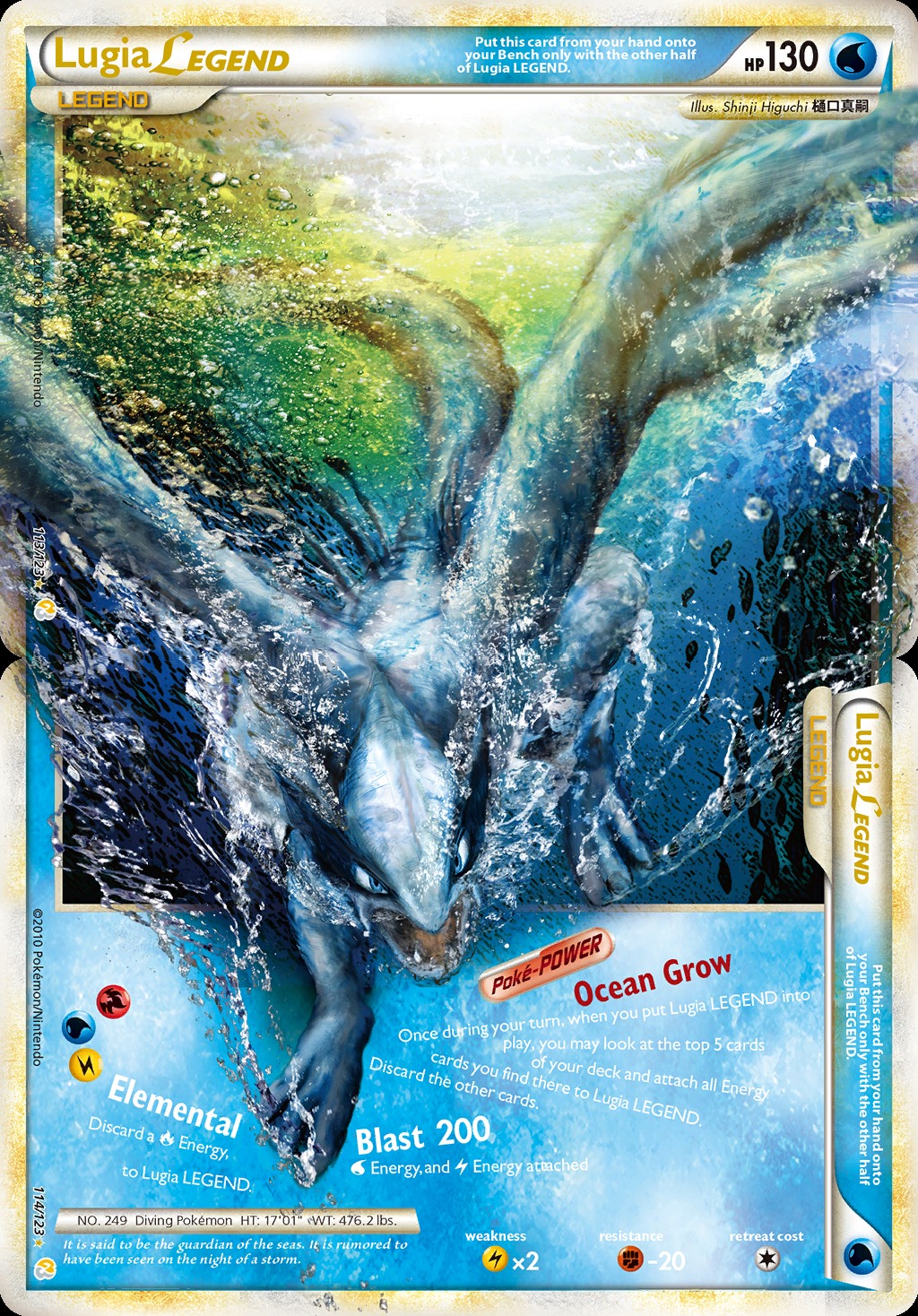
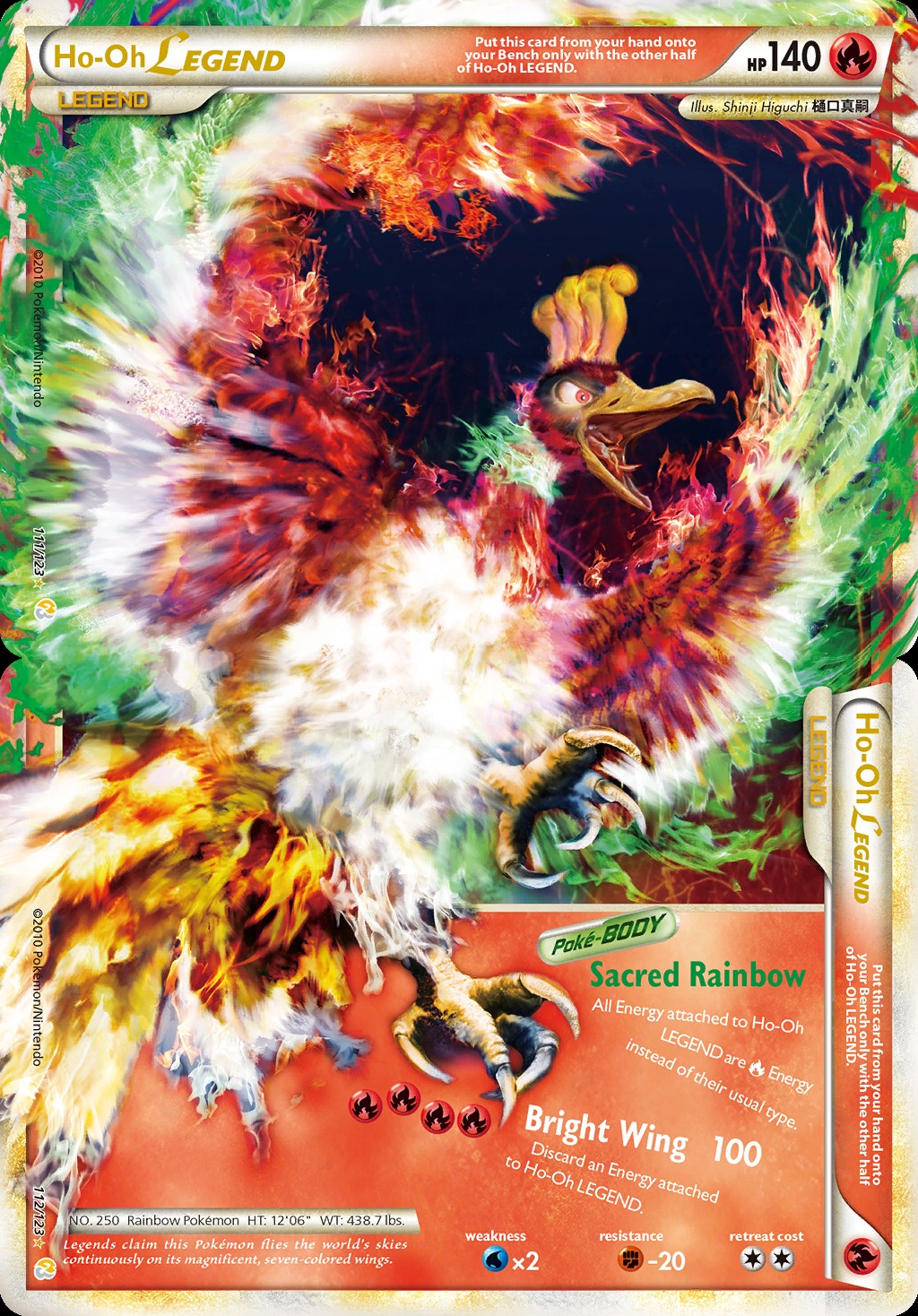
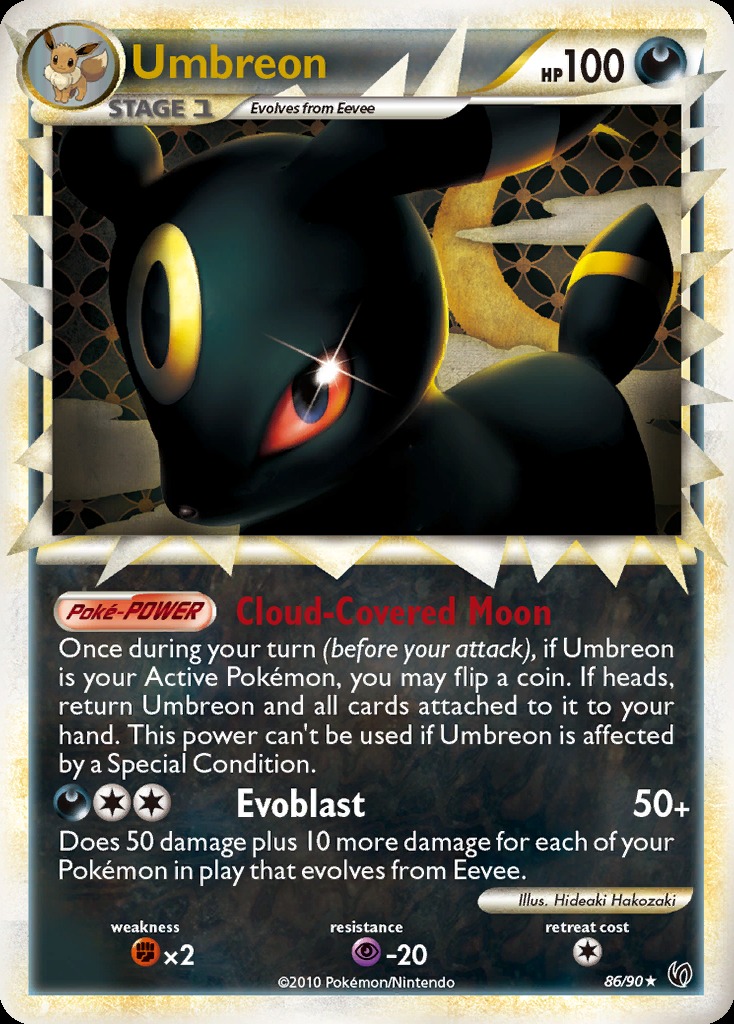
Image sources for this page: images.pokemontcg.io/hgss1/113_hires.png and 114_hires.png (the two halves of Lugia LEGEND), hgss1/111_hires.png and 112_hires.png (Ho-Oh LEGEND), plus hgss3/86_hires.png (Umbreon Prime). The LEGEND figures are the two halves stitched into a single image. Served from /wp-content/uploads/2026/10/. Card names and artwork are trademarks of Nintendo, Creatures Inc. and GAME FREAK inc.; scans are used here for identification and commentary.
Frequently asked questions
What is a LEGEND card in Pokémon?
A card printed across two physical halves that combine into one illustration. You need both halves to have the card. Nine LEGEND pairs exist, from Lugia and Ho-Oh through Kyogre & Groudon, and each pair is numbered as two consecutive cards in its set.
What is a Pokémon Prime card?
A holo tier from the 2010 LEGEND era, marked only by the word Prime after the Pokémon’s name and a subtle foil pattern. Prime cards carried no rule box, which is why they were treated as ordinary holos by players and why high-grade copies are scarce today.
Why is the LEGEND era so short?
Because it was built around the HeartGold and SoulSilver remakes rather than a new generation. When the Black & White games arrived in late 2010, the card line moved on immediately. Four English sets, roughly one year, then a complete redesign.
Is a single half of a LEGEND card worth anything?
Much less than half of a pair’s value. The collectible object is the panel, not the half, so single halves trade at a discount that is larger than their share of the image. Matched pairs in matching condition are where the price sits.
What is the rarest LEGEND era set?
Triumphant, the fourth and final set, released in November 2010 immediately before the Black & White redesign. It had the shortest selling window of the four and the smallest print run.
Sources
Sources and further reading
- The Pokémon Company — set records for HeartGold & SoulSilver (February 2010) through Triumphant (November 2010).
- Official card text — the LEGEND pair rule and the Prime designation, both printed on the cards.
- The Pokémon Company — the Japanese L-series sets that supplied the English LEGEND era.
- PSA population reports — LEGEND halves and Prime cards, by grade.
- CardSpicy — Era 5 — Diamond & Pearl, the era immediately before this one.
Related reading
- All twelve Pokémon card eras — the timeline this page belongs to.
- Era 5 — Diamond & Pearl, 2006 to 2009 — LV.X and the mythic turn.
- Era 7 — Black & White, 2010 to 2013 — the full-art redesign that ended this era.
- Era 3 — EX, 2003 to 2004 — the gold star, the other orphaned premium tier.
- Storing sealed Pokémon boxes — for Triumphant, the era’s scarcest sealed product.
Nothing on this page is investment advice, and no grade outcome is promised for any card. Prices quoted are published third-party figures as of 2026 and are reference ranges, not offers.
Where to go next
- The CardSpicy card index — every card we track, with its PSA 10 population and market history (195 cards).
- The illustrator index — every artist behind those cards, card by card (110 artists).