

Era 10 of 12 in our timeline of Pokémon card eras. This era has the largest print runs in the hobby’s history and the most expensive modern card in the hobby’s history. Both facts are true at once, and understanding why is the whole point.
Companion pages: Sealed Sword & Shield product · grading alternate arts.
Quick answer
The Sword & Shield era ran from November 2019 to March 2023 and is defined by alternate art — full-bleed illustrations that replace the standard art entirely, at a much lower pull rate — alongside the V, VMAX and VSTAR mechanics.
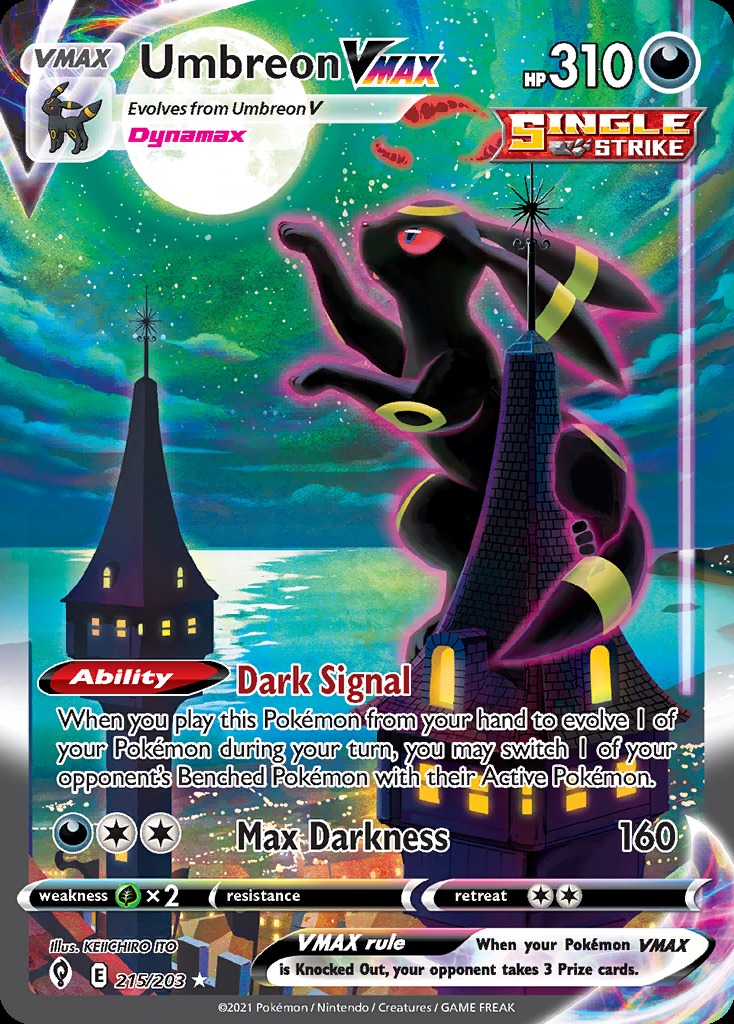
Its defining card is the Umbreon VMAX alternate art from Evolving Skies, universally called Moonbreon, which trades around $2,300 raw and roughly $3,900 to $4,400 in PSA 10 in 2026 — despite a PSA 10 population above twenty thousand. That is not a scarcity story. It is a demand story, and it is the most important thing to understand about this era.
Why this era looks different from everything before it
Three structural changes happened at once in 2019, and they compounded.
First, the cards went borderless almost completely. The full-art layout that Black & White introduced as a premium tier became the standard for every chase card.
Second, the alternate art tier was formalised. An alt art is not a reprint of the standard card with new art; it is a separate card in the set list, printed at a much lower rate, depicting the Pokémon in a scene rather than a portrait. The distinction matters because the scenes are what collectors want.
Third, and least discussed: the pandemic. The era spans the period when a very large number of adults re-entered the hobby simultaneously. Print runs went up, and demand went up faster. Evolving Skies shipped in August 2021, went out of print in 2023, and its booster boxes now trade at several times their original retail.
The sets that matter
| Set | Release | Why it matters |
|---|---|---|
| Sword & Shield | November 2019 | V and VMAX debut; alternate arts begin |
| Darkness Ablaze | August 2020 | Charizard VMAX; the era’s first mass chase |
| Champion’s Path | September 2020 | Charizard VMAX rainbow; short print, long demand |
| Vivid Voltage | November 2020 | Pikachu VMAX; the peak of the 2020 boom |
| Battle Styles | March 2021 | Single Strike / Rapid Strike split |
| Chilling Reign | June 2021 | Galarian birds; strong art, mid prices |
| Evolving Skies | August 2021 | The Eeveelution alt arts, and Moonbreon |
| Fusion Strike | November 2021 | Mew VMAX; largest set of the era |
| Brilliant Stars | February 2022 | Charizard V alt art; VSTAR debuts |
| Astral Radiance | May 2022 | Hisui focus; underrated art |
| Lost Origin | September 2022 | Giratina V alt art; the era’s second ceiling |
| Silver Tempest | November 2022 | Lugia V alt art |
| Crown Zenith | January 2023 | Galarian Gallery; the era’s final set |
The Moonbreon problem, stated honestly
Moonbreon — Umbreon VMAX alternate art, card 215/203 from Evolving Skies — is the most expensive English card of the modern era. In 2026 it trades around $2,300 raw and roughly $3,900 to $4,400 in a PSA 10.
Now the part that should give you pause. PSA has graded the card more than thirty thousand times, with roughly sixty-nine per cent of submissions receiving a 10. That is a PSA 10 population above twenty thousand. By every rule a collector learns in the vintage half of this timeline, a population that large should crush the price.
It has not, and there are three reasons.
- The demand is not collector demand, it is character demand. Umbreon is the most popular Eeveelution, the Eeveelution collector base is the most durable in the hobby, and the card’s night-carnival illustration is the most reproduced image of the era. That is a much larger buyer pool than a vintage card has.
- The population is large but the supply is locked. Twenty thousand graded copies sounds like a lot until you count how many are in permanent collections. Most PSA 10 copies of Moonbreon are not for sale at any price, which means the effective float is a small fraction of the population.
- The comparison set is the era, not the card. Moonbreon trades at three to five times the next-best alt art of the same era. It is priced as the emblem of a period, not as one card among many.
Whether that holds is a judgement, not a fact. What is a fact is that this is the first era on the timeline where population reports stop being a reliable guide to price, and that changes how you should think about every modern card after it.
Where the quiet value sits
- Non-Eeveelution, non-dragon alt arts. Dozens of alternate arts were printed in this era. The market prices perhaps fifteen. Astral Radiance, Chilling Reign and Silver Tempest all contain alt arts that trade at the price of a mid-era holo.
- Crown Zenith Galarian Gallery. The era’s final set, released in January 2023 into a market already turning toward Scarlet & Violet. The gallery sub-set is a complete collecting project and it is priced as an afterthought.
- VSTAR cards. The mechanic arrived late in the era, shipped in three sets, and was replaced almost immediately. Mechanically orphaned tiers are consistently underpriced across this timeline.
- Evolving Skies sealed, if you can find it. Out of print since 2023, with booster boxes at several times original retail. This is the one place where sealed supply is the scarce side rather than singles.
The licensed promo: Van Gogh Pikachu
The era also produced the most notorious licensed promo in recent memory: the Pikachu with Grey Felt Hat, released in 2023 in connection with the Van Gogh Museum. It was distributed through a museum promotion, the queue overwhelmed the museum’s systems, and the card was subsequently distributed through retail channels in a way that left a large but badly organised supply.
The result is a card that is common enough to be obtainable and famous enough to hold a premium, which is an unusual combination. It is also the clearest example of the era’s promotional strategy: cross-brand licensing, released in a window, with demand that vastly exceeded distribution.
How to identify a Sword & Shield card
V,VMAXorVSTARafter the name. VMAX cards are the large-format ones; VSTAR cards carry a VSTAR Power rule box.- Alternate art has no frame and depicts a scene rather than a portrait. If the Pokémon is doing something in a place, it is an alt art.
- Set symbol in the bottom-right and a copyright year of 2020, 2021 or 2022.
- Promos carry an
SWSHnumber rather than a set number, which distinguishes a Van Gogh Pikachu from any set card instantly.
The era’s storage problem: volume
Sword & Shield is the first era where the problem is not fragility but quantity. A collector who bought in 2020 and 2021 has hundreds of chase-tier cards, and hundreds of cards in soft storage is how edges get damaged.
Three practical rules for this era specifically. First, do not store alt arts in a binder with other cards — the borderless edge is the grade, and every page turn is contact. Second, keep the cards you are not displaying in rigid holders, not in a stack: a 3×4 rigid toploader per card is the only way to stop a stack from compressing the bottom of the pile. Third, for the handful you actually want to see, a Pro-Grade Display Slab is a better answer than a binder, because the point of an alternate art is the illustration and the slab is designed to be looked at.
And underneath all of it, a penny sleeve on every card before it touches anything else. This era’s cards are the most handled in the hobby and the most likely to be sold later, which makes the sleeve the highest-return item you can buy.
Where this era sits on the timeline
The Sword & Shield era follows the Sun & Moon era, whose GX mechanic it replaced with V. It is followed by the Scarlet & Violet era, which formalised the illustration tier into Art Rare and Special Art Rare. The full timeline puts all twelve in order.
What these cards actually look like
The alternate art is the first tier where the picture, not the frame, is the specification.
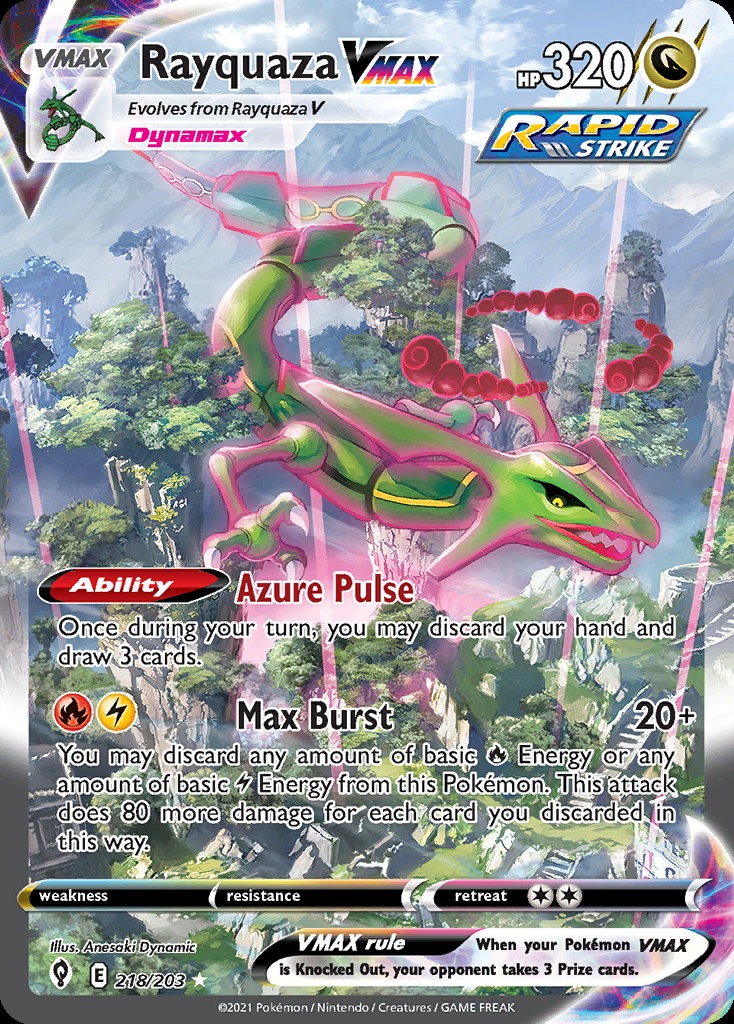
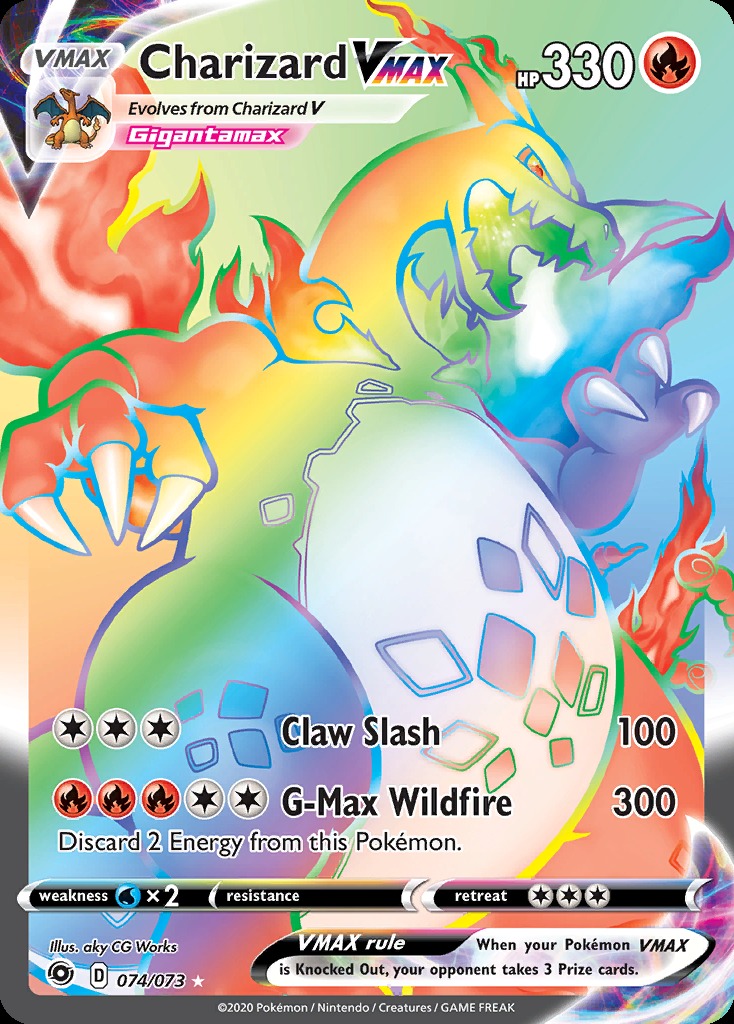
Image sources for this page: images.pokemontcg.io/swsh7/215_hires.png (Umbreon VMAX alternate art), swsh7/218_hires.png (Rayquaza VMAX alternate art) and swsh35/74_hires.png (Charizard VMAX, rainbow rare). Served from /wp-content/uploads/2026/10/. Card names and artwork are trademarks of Nintendo, Creatures Inc. and GAME FREAK inc.; scans are used here for identification and commentary.
Frequently asked questions
What is an alternate art Pokémon card?
A separate card in the set list, printed at a much lower rate than the standard art, depicting the Pokémon in a full-bleed scene rather than a portrait. The format was formalised in the Sword & Shield era and is the reason the era’s chase cards are the most expensive modern cards.
Why is Moonbreon so expensive if there are twenty thousand PSA 10 copies?
Because the price is driven by character demand rather than scarcity. Umbreon is the most popular Eeveelution, the card is the emblem of its era, and most graded copies are held permanently rather than offered for sale. A large population with a small effective float can still be expensive — but it is a different risk profile from a vintage card.
What is the difference between V, VMAX and VSTAR?
Three consecutive mechanics within one era. V is the base tier, VMAX is the large-format evolution that gives up three prize cards, and VSTAR is the late-era tier with a one-per-game VSTAR Power. All three appear in the same sets, which is why the era is confusing to date from the mechanic alone.
Is Evolving Skies still available sealed?
No. It went out of print in 2023 and booster boxes now trade at several times their original retail price. This is one of the few places in the modern era where sealed supply, not singles supply, is the scarce side.
What is the Van Gogh Pikachu card?
A promo released in 2023 in connection with the Van Gogh Museum, depicting Pikachu with a grey felt hat. It carries an SWSH promo number rather than a set number, and its distribution was more chaotic than its print volume, which is why it is both obtainable and expensive.
Sources
Sources and further reading
- The Pokémon Company — set records for Sword & Shield (November 2019) through Crown Zenith (January 2023).
- Official card text — the V, VMAX and VSTAR rules, including prize-card counts.
- PSA population reports — Umbreon VMAX alternate art and the Evolving Skies chase tier, by grade.
- Third-party graded price trackers — Moonbreon raw and PSA 10 ranges, and Evolving Skies sealed pricing, October 2026.
- The Van Gogh Museum — the 2023 Pikachu with Grey Felt Hat promotion.
- CardSpicy — How to read a set code, for separating promos from set cards.
Related reading
- All twelve Pokémon card eras — the timeline this page belongs to.
- Era 9 — Sun & Moon, 2016 to 2019 — GX, Tag Team and the trainer portrait.
- Era 11 — Scarlet & Violet, 2023 to 2025 — where the illustration tier gets a formal name.
- Era 12 — Mega Evolution, 2025 onward — the current era.
- Storing sealed Pokémon boxes — relevant if you are holding Evolving Skies.
Nothing on this page is investment advice, and no grade outcome is promised for any card. Prices quoted are published third-party figures as of 2026 and are reference ranges, not offers.
Where to go next
- The CardSpicy card index — every card we track, with its PSA 10 population and market history (195 cards).
- The illustrator index — every artist behind those cards, card by card (110 artists).