

Era 11 of 12 in our timeline of Pokémon card eras. Every era before this one priced a card by what it was. This one prices it by who drew it.
Companion pages: Sealed Scarlet & Violet product · grading AR and SAR cards.
Quick answer
The Scarlet & Violet era began in March 2023 and renamed the premium tiers to describe the art: AR (Art Rare), SAR (Special Art Rare) and UR, replacing the mechanic-based names of every previous era. The mechanic is terastalisation, printed as a lowercase ex with a terastal crown, and the era’s defining sets are 151, Prismatic Evolutions and the Eeveelution chase.
The rename is the important part. When a company names its rarest cards after the artwork rather than the game mechanic, it is telling you what it thinks it is selling.
The era where the illustrator became the product
Pokémon cards have always credited their illustrators in small print at the bottom. For twenty-seven years almost nobody read it.
Scarlet & Violet changed the collecting behaviour around that line. The Art Rare tier gave illustrators a full card face and no frame, which meant a single artist could produce something that read as a small painting. Collectors began chasing artists rather than Pokémon — a market that had existed in Magic: The Gathering and in Japanese promo collecting for years, but never at the centre of the Pokémon hobby.
The consequences run through everything in this era:
- Art Rare cards of unpopular Pokémon became expensive. When the reason to buy is the picture, the creature’s competitive value stops mattering.
- Specific artists developed identifiable markets. A card drawn by a sought-after illustrator trades at a premium over a card of the same Pokémon, same rarity, drawn by someone else.
- The Japanese market led. Japanese AR and SAR cards have consistently outperformed their English equivalents in percentage growth, because the Japanese print runs are smaller and the art-first collector base is larger there.
The sets that define the era
| Set | Release | Why it matters |
|---|---|---|
| Scarlet & Violet | March 2023 | AR and SAR debut; lowercase ex returns with terastal |
| Paldea Evolved | June 2023 | First strong SAR lineup |
| Obsidian Flames | August 2023 | Charizard ex; the era’s first mass chase |
| 151 | September 2023 | Kanto reprint and the Master Ball reverse holo |
| Paradox Rift | November 2023 | Paradox Pokémon; strong art, mid prices |
| Paldean Fates | January 2024 | Shiny subset returns |
| Temporal Forces | March 2024 | ACE SPEC cards return |
| Twilight Masquerade | May 2024 | Ogerpon; the era’s best-reviewed art |
| Shrouded Fable | August 2024 | Small special set; Pecharunt |
| Stellar Crown | September 2024 | Stellar terastal type |
| Surging Sparks | November 2024 | Pikachu ex; the era’s ceiling for a single card |
| Prismatic Evolutions | January 2025 | The Eeveelution set; Umbreon ex SIR leads |
| Journey Together | March 2025 | Trainer’s Pokémon; Pikachu ex SIR |
| Destined Rivals | 2025 | Team Rocket focus; the era’s last major release |
The 151 set, and the Master Ball reverse
151 is the most important set of the era and possibly of the last decade, for a reason that has nothing to do with the chase cards.
It reprinted the original 151 Pokémon with modern rules and new art, at a moment when a very large cohort of lapsed collectors was returning. That made it the single most effective on-ramp the hobby has ever had: it is the set you buy for someone who remembers 1999 and does not want to spend five figures to feel it again.
It also introduced the Master Ball reverse holo — a reverse foil pattern bearing a Master Ball motif, printed at a much lower rate than the standard reverse. Two things are worth knowing about it.
- The Master Ball pattern is a Japanese-market feature. It was introduced in the Japanese 151 release and is the reason Japanese 151 packs carry a premium over English ones.
- It is a parallel, not a rarity. The card underneath is an ordinary card; the pattern is the collectible. That structure — an ordinary card made valuable by a foil pattern — is the same one that made Legendary Collection reverse holos collectible in 2002.
What the art-first structure does to prices
Three prices illustrate how differently this era behaves from every era before it.
| Card | Why the price is where it is |
|---|---|
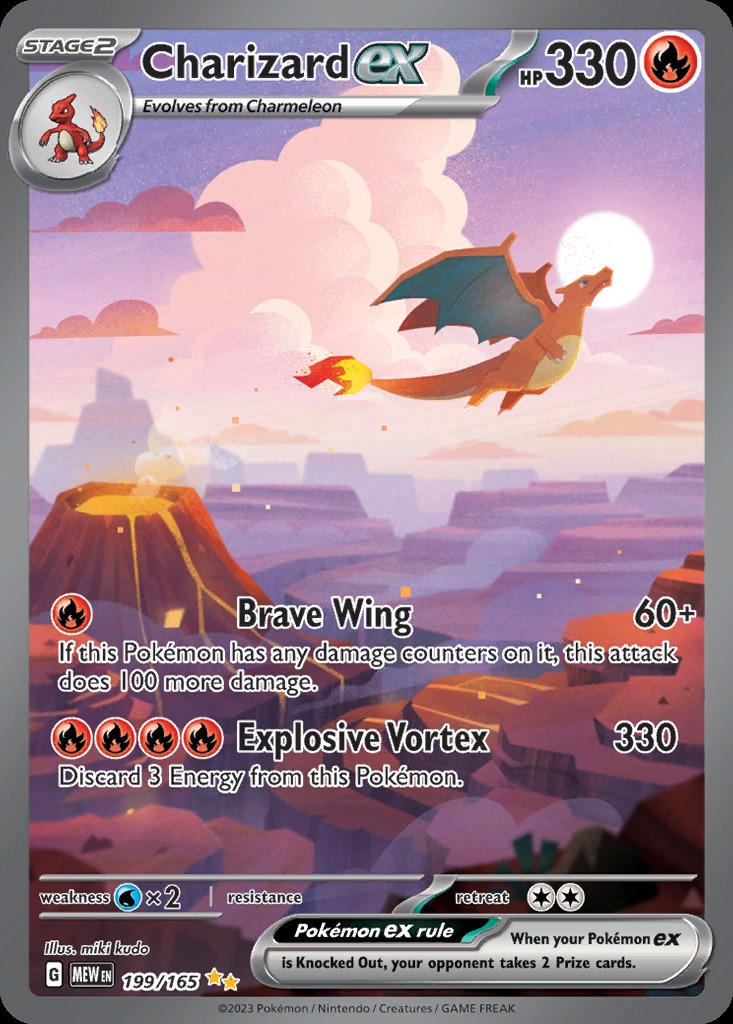
| Charizard ex SAR from 151 | The most recognisable Pokémon in the most nostalgic set of the decade; a PSA 10 sits in the high hundreds |
| Umbreon ex SIR from Prismatic Evolutions | The Eeveelution premium applied to a brand-new set; among the most expensive cards of the era within months of release |
| Japanese Art Rares of mid-popularity Pokémon | Small print runs, art-first demand, and a collector base that reads artist credits; several have outperformed English chase cards in percentage terms |
The pattern is consistent: the era’s prices track illustration quality and character popularity, and they track competitive value almost not at all.
Where the quiet value sits
- Art Rares of Pokémon nobody plays. The tier is enormous. The market prices perhaps forty cards and ignores several hundred. Every ignored AR is a full-card illustration by a credited artist, printed at a low rate in a set that will stop being opened.
- Japanese AR and SAR cards. Smaller print runs, larger art-first collector base, and a persistent discount against English pricing for anything that is not a top-tier chase.
- Twilight Masquerade and Paradox Rift. Both are regarded as strong art sets that were released between two more commercially visible sets, and both are priced accordingly.
- Sets that are out of print but not yet old. The window between “out of print” and “nostalgic” is historically where sealed product is cheapest relative to later value.
How to identify a Scarlet & Violet card
- Lowercase
exafter the name, with a terastal crown motif on the card. This is a different card from the 2003exand the 2010EX. - Rarity codes in the bottom-left —
AR,SAR,UR— rather than a symbol. - Set symbol in the bottom-right and a copyright year of 2023, 2024 or 2025.
- The illustrator credit at the bottom of the card, which for this era is worth reading before you decide what a card is worth.
Grading a modern card, honestly
This is the era where grading maths changed. For most of the hobby’s history, a card was worth grading if the grade premium exceeded the fee. Modern cards break that rule in both directions.
On the one hand, gem rates on modern cards are high — the stock is consistent and the print quality is controlled — so the population grows quickly and the grade premium compresses. On the other, the price of a raw copy is often high enough that a PSA 10 still adds real money.
The rule that survives: grade the card only if you can name the buyer for the graded version. A PSA 10 of a heavily collected character has a buyer. A PSA 10 of an AR card nobody is chasing does not, and the grading fee is then a loss.
For storage, this era’s cards are borderless, thin-coated and printed at enormous volume, which means the damage mode is edge scuffing from handling rather than anything structural. A penny sleeve immediately, a rigid toploader for anything you are not displaying, and a display slab for the handful where the illustration is the point. Because for this era, the illustration almost always is the point.
Where this era sits on the timeline
The Scarlet & Violet era follows the Sword & Shield era, whose alternate art it formalised into a named tier. It is followed by the Mega Evolution era, which brings Mega back for the first time since 2016. The full timeline puts all twelve in order.
What these cards actually look like
This era renamed its rarity tiers after the artwork, and the cards show why.
SAR in the bottom-left instead of a symbol. The 151 set reprinted the original 151 Pokémon with new art, which is why this card reads as nostalgia and as a modern illustration at the same time.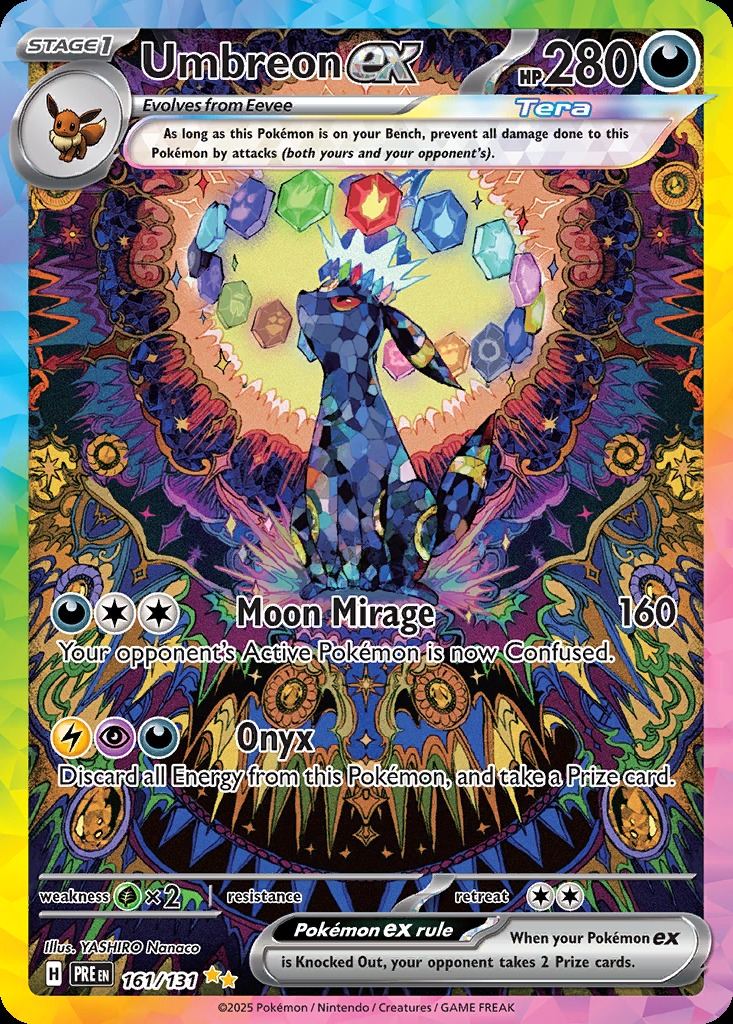
SIR code. It reached four-figure pricing within months of release, which is the clearest evidence that this era prices character and illustration rather than age.Image sources for this page: images.pokemontcg.io/sv3pt5/199_hires.png (Charizard ex, Special Art Rare) and sv8pt5/161_hires.png (Umbreon ex, Special Illustration Rare). The Japanese 151 Master Ball reverse discussed in the text is a Japanese-only foil pattern and is not in the English scan database, so it is not shown here. Served from /wp-content/uploads/2026/10/. Card names and artwork are trademarks of Nintendo, Creatures Inc. and GAME FREAK inc.; scans are used here for identification and commentary.
Frequently asked questions
What is an AR and an SAR Pokémon card?
Art Rare and Special Art Rare — the premium tiers of the Scarlet & Violet era, named after the artwork rather than a game mechanic. AR is the lower of the two, SAR the higher, and both are printed at low rates with full-card illustrations and no frame.
What is the Master Ball reverse holo?
A reverse foil pattern bearing a Master Ball motif, introduced in the Japanese 151 release and printed at a much lower rate than the standard reverse holo. The card underneath is ordinary; the pattern is what is collected. It is why Japanese 151 packs carry a premium.
Why are Japanese Scarlet & Violet cards worth more than English ones?
Smaller print runs, a larger art-first collector base in Japan, and tighter centring tolerances on Japanese stock. The gap is not universal — top-tier English chase cards still lead — but across the broad middle of the era, Japanese cards appreciate faster.
Is the 151 set worth collecting?
It is the most effective on-ramp in the hobby: the original 151 Pokémon, modern rules, and a price that does not require vintage money. It is also the most reprinted set of the era, so its sealed product is not scarce in the way an out-of-print 2021 set is.
Should I grade modern Pokémon cards?
Only if you can identify who will buy the graded copy. Gem rates on modern stock are high, so populations grow fast and premiums compress. A PSA 10 of a heavily collected character has a market; a PSA 10 of an overlooked Art Rare usually does not cover its grading fee.
Sources
Sources and further reading
- The Pokémon Company — set records for Scarlet & Violet (March 2023) through Destined Rivals (2025).
- Official card text — the terastal
exrule and the AR / SAR rarity codes. - The Pokémon Company Japan — the 151 release and the Master Ball reverse holo pattern.
- PSA population reports — Scarlet & Violet SAR cards by grade, including the 151 and Prismatic Evolutions chase tiers.
- Third-party graded price trackers — English and Japanese AR / SAR comparisons, 2026.
- CardSpicy — Era 10 — Sword & Shield, where the alternate art format began.
Related reading
- All twelve Pokémon card eras — the timeline this page belongs to.
- Era 10 — Sword & Shield, 2019 to 2023 — alternate art, VMAX, and Moonbreon.
- Era 12 — Mega Evolution, 2025 onward — the current era, and Mega’s return.
- Era 1 — Base Set, 1996 to 2001 — what 151 reprints, thirty years later.
- Open or keep sealed — the decision that matters most on a heavily reprinted set.
Nothing on this page is investment advice, and no grade outcome is promised for any card. Prices quoted are published third-party figures as of 2026 and are reference ranges, not offers.
Where to go next
- The CardSpicy card index — every card we track, with its PSA 10 population and market history (195 cards).
- The illustrator index — every artist behind those cards, card by card (110 artists).