

Sealed companion to Era 11, Scarlet & Violet. Part of the twelve-era timeline. No sealed prices quoted.
Quick answer
Scarlet & Violet is the first era where the expected value of opening a box is routinely below the price of the box — as the normal case rather than the occasional one. The mechanism is not demand. It is that the supply of the era’s premium cards is set by the size of the print run rather than by a fixed rarity ceiling.
That has a specific structural consequence. In earlier eras, a rare card stayed rare because the box it came from went out of print. Here, the premium tier is printed in proportion to an enormous run, so the ceiling keeps rising as long as the set is being printed. The set cannot become scarce while it is available.
What this means for sealed product is a change of purpose. A box from this era is not a container whose contents might be worth more than the box. It is a storage asset whose value depends entirely on the set eventually leaving print.
The era’s structural difference
Scarlet & Violet replaced the Sword & Shield rarity ladder with a new top tier — Art Rare, Special Art Rare, Special Illustration Rare — and the change is not cosmetic.
| Tier | What it is | Effect on a box |
|---|---|---|
| Art Rare (AR) | A full-art treatment at a comparatively accessible pull rate | Dilutes the top end; more desirable cards per box, each worth less |
| Special Art Rare (SAR) | The illustration tier above AR | The tier that decides a set’s ceiling |
| Special Illustration Rare (SIR) | Used interchangeably in places; the highest illustration tier | Concentrates value on a handful of cards per set |
| Hyper / gold | Gold-treated versions at very low pull rates | Adds a tail that does not lift the average |
The problem is the interaction between the tier structure and the print run. When a set is printed in very large volume over a long window, every tier’s population grows with it. A tier that is rare per pack is not rare in absolute terms once enough packs exist. So the top card’s population keeps climbing while the set is on shelves, and the box’s contents are being devalued by the same process that produces the boxes.
Why sealed still exists here
If opening is negative expected value, the obvious question is why anyone buys a box at all. There are three answers, and they are all rational.
- The set leaves print eventually. Every set does. Once it does, the box becomes the only way to obtain the cards in unopened form, and the sealed premium reappears. The question is timing, not direction.
- Some sets have a defining card that beats the average. A set whose top card is exceptional can have positive expected value even when the tier structure is against it, because the average is dominated by the tail.
- Some buyers are not buying expected value. They are buying the experience of opening, which is a legitimate purchase and is priced accordingly.
The third is more important than collectors admit. A large share of modern sealed demand is consumption, not investment, and consumption does not care about expected value. That is why the format survives a negative-EV structure.
What is scarce in this era
Almost nothing, and that is the honest position.
- Early sets that left print before the current wave of interest. The first Scarlet & Violet sets had a shorter shelf life than the later ones, so their sealed supply is thinner by timing rather than by design.
- Restricted-channel special sets. The same structural gap as every era: a product sold through fewer outlets has fewer units.
- Blisters and single packs. Retail-only, opened immediately, never kept. This has been true in every era of this timeline and remains true here.
- Nothing else. Describing current-print sealed product as scarce is a category error. It is available, and it will be available for as long as the sets are being printed.
The physical character of this era’s product
Scarlet & Violet packaging is the most robust in the hobby so far, and the failures are genuinely minor.
Matte laminate instead of gloss. This era moved to a lower-sheen finish on many products, which is a direct response to the scuffing problem of the Sword & Shield era. Abrasion is far less visible. The trade-off is that matte surfaces show fingerprints and grease, which gloss does not.
Thicker board, tighter folds. The boxes resist deformation well. The failure point moves to the fold lines, where the printed layer cracks under repeated flexing.
The wrap is the weak component. It is thin, and it tears at the corners rather than stretching. A corner tear with intact board underneath is normal.
Storing this era’s product
The matte finish is the thing to manage. Fingerprints on a matte laminate do not wipe off cleanly — they spread. Handle these boxes with clean dry hands or not at all, and do not use any cleaning product on the surface. A dry microfibre cloth is the only thing worth trying, and on a matte finish even that can leave a mark.
Because the boxes are rigid and the wrap is thin, the practical risk is a corner tear rather than a dent. Store them with the corners protected, not stacked in a way that a corner bears load.
Humidity is the long-term concern, and it is more serious for this era than the packaging suggests, because the cards inside are where the damage lands. A sealed box is not a humidity barrier — the board passes moisture — so a box stored in a damp room protects its contents no better than a sleeve would. Keep sealed product in a stable room, and if the room is humid, treat the box as permeable.
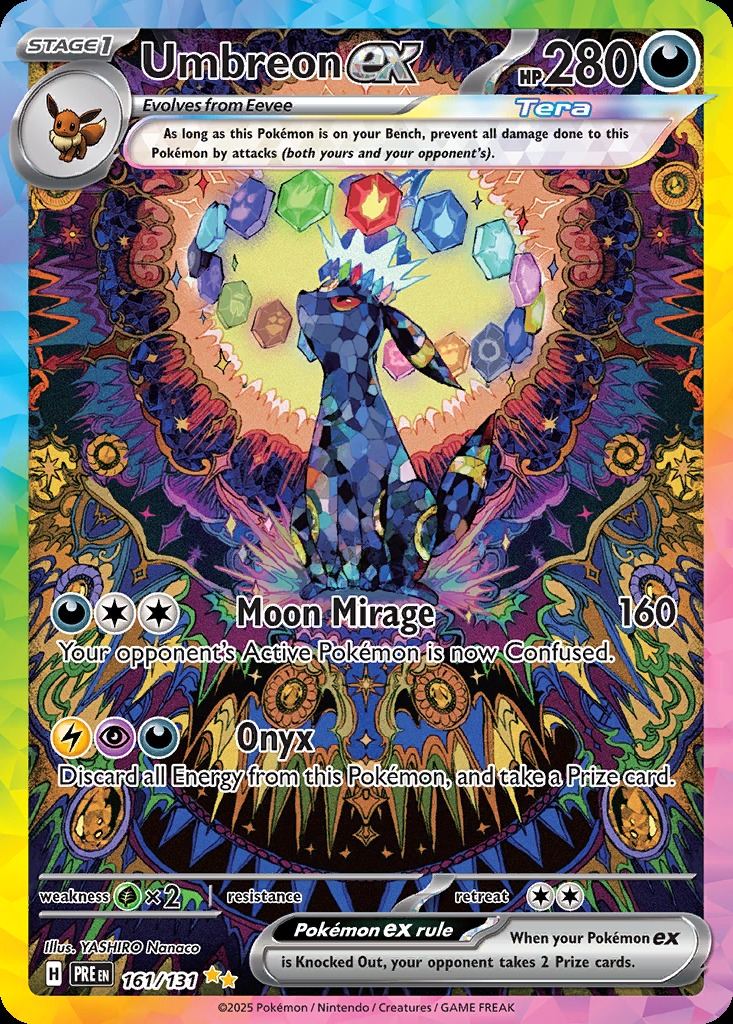
For the singles, the era’s cards are the hardest in the hobby to keep clean, because Art Rare and Special Art Rare cards are full-bleed with continuous foil and no border. A matte sleeve with a smooth interior is the first layer; a textured interior will burnish the foil over time. Then a press-fit case rather than a toploader, because there is no insertion path and therefore no abrasion across the face. For anything displayed, a display slab is the format that suits a full-bleed illustration.
Where this sits
The Scarlet & Violet sealed line follows the Sword & Shield sealed page, where volume and retention both peaked, and is followed by the Mega Evolution sealed page, which is too new to have a sealed market at all. For the card-level story see Era 11.
Frequently asked questions
Is opening a Scarlet & Violet box a loss on average?
Routinely, yes, because the premium tier’s supply grows with the print run while the set is available. That is a structural statement about the tier, not a prediction about any specific set.
Why are Art Rares easier to pull than the old chase cards?
Because they occupy a more accessible slot in the pack structure. The tier was designed to be reachable, which is good for collectors and bad for the average value of a box.
Will these sets become scarce later?
Every set eventually leaves print, and when it does the sealed premium returns. The uncertainty is timing, and this page does not forecast it.
Does a sealed box protect the cards from humidity?
No. The board is permeable. A sealed box is protection against handling and light, not against moisture, and treating it as a humidity barrier is a common and costly mistake.
What is the difference between AR, SAR and SIR?
They are tiers of illustration treatment with different pull rates. AR is the most accessible, SAR sits above it, and SIR is the highest illustration tier. The exact naming has shifted across sets, which is why the tiers are easier to understand by pull rate than by name.
What this era’s product actually looks like
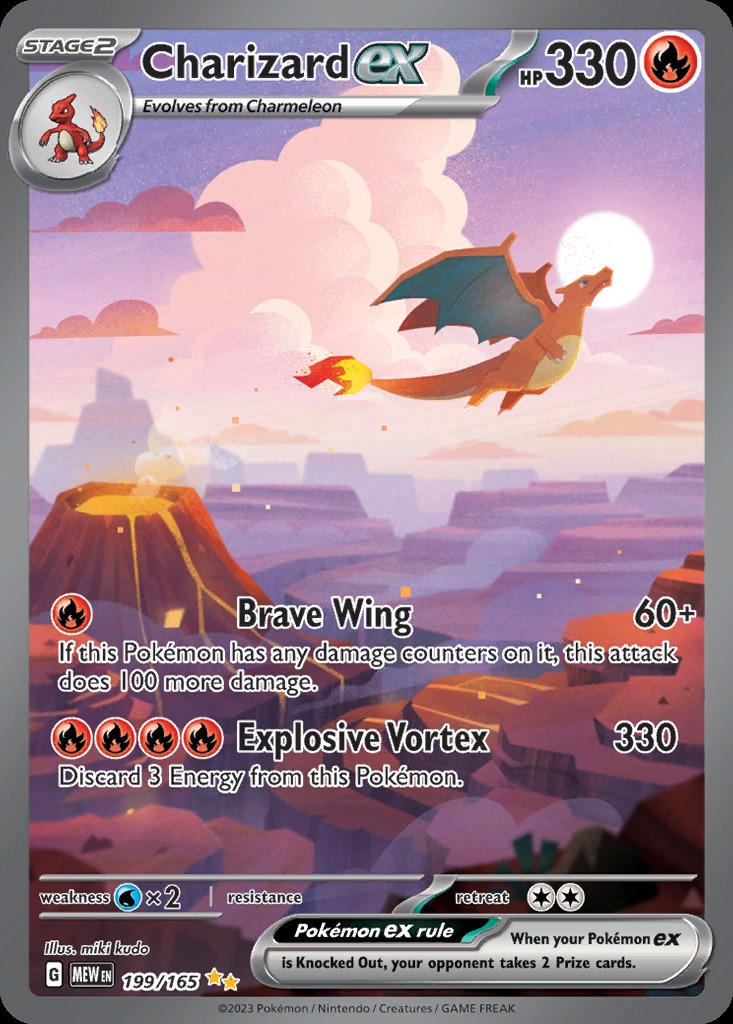
Art Rare and Special Illustration Rare changed what a premium card looks like: full bleed, continuous foil, no frame at all.
Sources
Sources and further reading
- Nintendo — Scarlet & Violet base set, March 2023, and the sets through 2025.
- Nintendo — the Art Rare, Special Art Rare and Special Illustration Rare tiers introduced in the Scarlet & Violet era.
- CardSpicy — Era 11, for the AR and SAR tiers and the era’s card structure.
- CardSpicy — Humidity, light and long-term card storage, for why a sealed box is not a moisture barrier.
- CardSpicy — Storing sealed Pokémon boxes.
- CardSpicy — Booster boxes or singles.
Related reading
- Era 11 — Scarlet & Violet, 2023 to 2025 — AR, SAR, and the artist as the product.
- Sealed Sword & Shield product — the era before, at peak volume.
- Sealed Mega Evolution product — the era after, which has no sealed market yet.
- All twelve Pokémon card eras.
- Humidity and long-term storage.
- Booster boxes or singles.
Nothing on this page is investment advice, and no sealed product is offered for sale here. Tier names are as published by the manufacturer; the expected-value statement is structural and is not a forecast for any specific set.
Where to go next
- The CardSpicy card index — every card we track, with its PSA 10 population and market history (195 cards).
- The illustrator index — every artist behind those cards, card by card (110 artists).
Leave a Reply