


Grading companion to Era 10, the Sword & Shield era. Part of the twelve-era timeline. This page quotes no prices and no population figures; it explains the structure that decides whether a submission makes sense.
Quick answer
The Umbreon VMAX alt art from Evolving Skies has an extremely large graded population and is still the ceiling of this era, which is the clearest evidence in the hobby that a big population does not by itself suppress a card — what decides is the structure of demand behind it, so an alt art should be judged on demand before population. Population is a supply measure. What a card is worth is a relationship between supply and the number of people who want it, and those two things can both be large. A card with a big population and a very wide demand base is not the same object as a card with a small population and a narrow one, and reading the first number without the second tells you nothing.
The reason this matters for a submission decision is that population is the number everyone quotes, because it is the only one that is published. Demand is not published anywhere. It has to be inferred from how many people talk about the card, how many listings there are relative to buyers, and whether the card is the one people name when they name the era. That inference is the actual work.
Why a graded population is not a census
A population report counts slabs, not cards. That distinction sounds trivial and it is the whole problem.
People grade the copies they think are good and leave the rest raw. So a graded population is a sample selected upward: it tells you how many people believed a card was worth the fee, and nothing about how many mediocre copies exist. When a card is the obvious chase of a heavily opened set, that selection is strong — almost every clean copy got graded, because grading it was the obvious thing to do.
Which means a large population on a card like that is evidence of attention, not of abundance. It says the card was worth submitting, repeatedly, by many people. That is a statement about demand, and it is being read as though it were a statement about supply.
What actually decides an alt art submission
The table is a screen rather than a scorecard. Each row is a question about structure, and the third column is what a yes tells you.
| Question | How to answer it without a database | What a yes tells you |
|---|---|---|
| Is demand broad or narrow? | Is this the card people name when they name the era, or a card people like once they see it? | Broad demand can absorb a large population; narrow demand cannot |
| How heavily was the set opened? | Was it a print run that stayed on shelves, or one that sold out and was reprinted? | Heavy opening means the raw pool is deep and the population will keep growing |
| Do you have a condition edge? | Was your copy pack-fresh, like almost every other copy that was graded? | If not, you are adding an average copy to a population of above-average ones |
| Is centring the variable? | Measure the borders; on a mass-printed card this is often the only differentiator left | If yes, the submission is a lottery on one measurement |
| What shape is the population? | Look at the distribution of grades rather than the total | A tight cluster means little room to stand out; a spread means the top is reachable |
The last row is the one that gets ignored. Size and shape are different questions, and shape is the more useful of the two.
Reading the shape of a population
A population that clusters tightly around the middle tells you that the cards being submitted are all similar, which is what happens when almost every copy was pack-fresh and centring is consistent. In that case the top grade is not scarce in a meaningful way and the step between adjacent grades is small.
A population with a long tail tells you something else: that a meaningful share of the submissions were marginal, which usually means the card came from a set with wide variance, or that people submitted copies they should not have. In that case the top grade is genuinely harder to reach and the step is larger.
Neither shape is better in the abstract. What matters is that the shape tells you where your copy is likely to land, and the total tells you nothing about that at all.
Five questions before an alt art is submitted
- Can you say who wants this card, in one sentence? If the answer is “people who like the artwork”, demand is narrow and personal. If it is “it is the card of the era”, demand is structural and broad.
- Is your copy better than the median submission? On a card where almost everything submitted was pack-fresh, the median is high, and an average copy adds nothing.
- What is the one thing that could still differentiate it? Usually centring, sometimes a print line. If there is no answer, the submission is a coin toss with a fee attached.
- Is the population still growing? On a set that is still being opened, it is. A population growing while you hold is a different risk from one that has settled.
- Would you still want the card if the number came back one step lower? If not, you are submitting for the number rather than for the card, and that is the most common reason people regret a submission.
Why the alt art treatment makes this harder
Alt art cards are printed in the same secret-rare slot as the other special cards in their set, so the supply is set by print volume rather than by rarity in any meaningful sense. This era’s print volume was the largest the hobby had seen, because it overlapped with a period of exceptional demand. The combination — a very large print run and a chase card inside it — produces the exact situation where population is large and demand is also large, and where the relationship between them is the only thing worth reading.
That is the paradox in one sentence: the era’s most-graded card is also its most-wanted card, and neither fact cancels the other.
Storing alt art cards
The physical issue with this era’s cards is that they are thick, heavily textured and slightly prone to bowing, and a bowed card in a rigid holder is under constant pressure at two corners.
Bow is the thing to watch. A card stored flat in a stack will take the shape of the stack; a card stored with a slight curve will keep it. A press-fit rigid case holds the card flat across its whole face, which is the correct treatment: it does not try to flatten a warp, it prevents one forming. A rigid 3×4 toploader is thinner and holds the card along the edges rather than the face, which is fine for transit and less good for long-term storage of a thick card.
The texture brings the second issue, which is dust in the pattern. The same rule as the previous eras applies: prevent rather than clean. A matte premium sleeve is the first layer, replaced when it has been handled much, and the card goes into the holder once rather than being cycled in and out to be looked at.
If the card is a display piece — and on this era it usually is, since the treatment is the point — a display slab keeps the face visible and the card flat, which is the combination the design was asking for.
Where this sits
This page follows the Sun & Moon grading page, where the card’s own layout was the main risk, and precedes the Scarlet & Violet grading page, where the supply side stops being closed at all and the arithmetic of batch submission turns negative. This is the page where the population report stops being a shortcut. For the card-level story, see Era 10; for the full sequence, the twelve-era timeline.
Frequently asked questions
Does a large population mean a card is common?
It means many copies were submitted. Because people grade the copies they think are good, a large population is a selected sample, and it says more about attention than about how many copies exist.
Why is the era’s most-graded card also its most desirable?
Because the two facts are driven by the same cause: the card was the one everybody wanted, so everybody graded it. Demand created the population rather than the population diluting the demand.
Should I avoid submitting a card with a big population?
Not automatically. The question is whether your copy is better than the median of what has already been submitted, and whether demand is broad enough to absorb more supply.
What is the single most useful thing to check before submitting an alt art?
Centring, because on a pack-fresh population it is usually the only variable left. Everything else was decided at the factory.
Is the population of this era still growing?
For sets that are still being opened, yes. A population that grows while you hold is a different exposure from one that has stopped moving, and it is worth knowing which you are in.
What the cards in this era actually look like
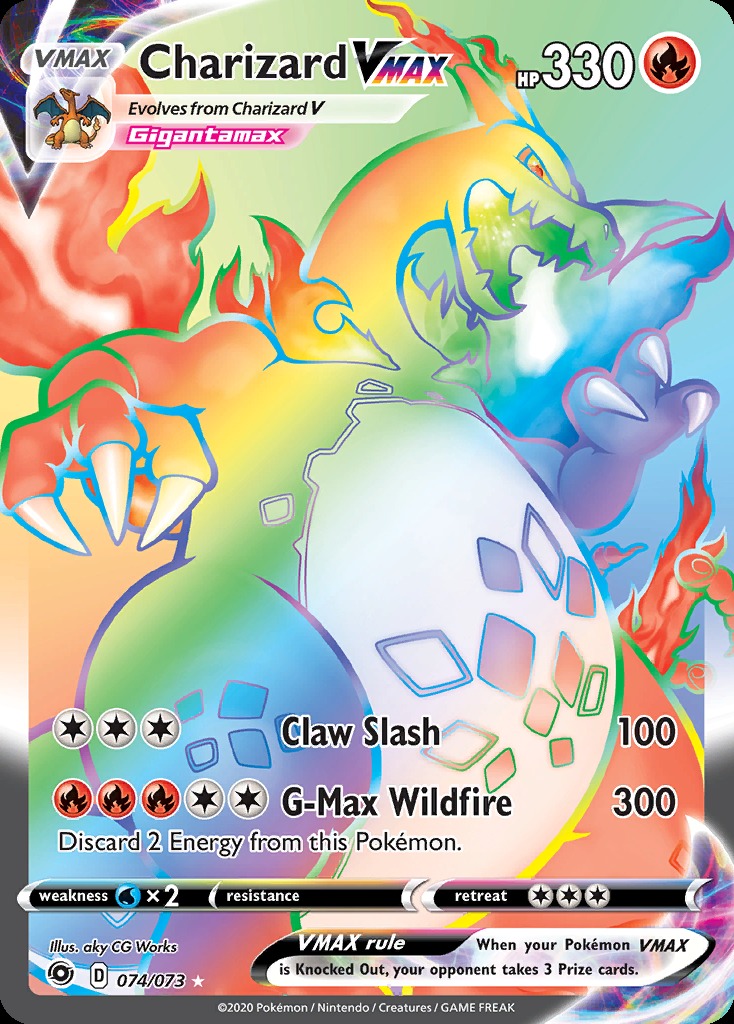
The alt art treatment puts the whole face under a textured foil with the artwork edge-to-edge inside a thin frame. These are the three most useful surfaces to study.

Sources
Sources and further reading
- The Pokémon Company — the Sword & Shield series, 2019 to 2023.
- The Pokémon Company — Evolving Skies, the set containing the Umbreon VMAX and Rayquaza VMAX alternate art cards.
- The Pokémon Company — the alternate art treatment, printed in the secret rare slot of each set.
- CardSpicy — Reading a population report, for how the totals are compiled and what they exclude.
- CardSpicy — PSA 10 vs PSA 9, for how a one-step difference behaves in practice.
- CardSpicy — Era 10 — Sword & Shield, 2019 to 2023, for the card-level history this page assumes.
Related reading
- Era 10 — Sword & Shield, 2019 to 2023 — alt art and the era’s chase cards.
- Grading Sun & Moon era cards — the previous era, and the densest text.
- Grading Scarlet & Violet era cards — the next era, where supply never closes.
- All twelve Pokémon card eras — the timeline.
- Reading a population report — size against shape.
- Sealed Sword & Shield product — the print volume behind the population.
Nothing on this page is investment advice, and no card or grading service is offered for sale here. Grades are assigned by third-party companies; the descriptions of population structure, demand and storage are structural and are not population figures or prices.
Where to go next
- The CardSpicy card index — every card we track, with its PSA 10 population and market history (195 cards).
- The illustrator index — every artist behind those cards, card by card (110 artists).
Leave a Reply