

Era 2 of 12 in our timeline of Pokémon card eras. Three English sets, one accessory nobody owns any more, and the lowest print run of any era. This is the era that looks least like Pokémon and is scarcest because of it.
Companion pages: Sealed e-Card product · grading e-Card cards.
Quick answer
The e-Card era is three sets — Expedition, Aquapolis and Skyridge — printed between 2002 and 2003, and it is the only era with a barcode on the card. The strip of dots along the bottom edge was read by Nintendo’s e-Reader accessory, which plugged into a Game Boy Advance. The mechanic it introduced was the Crystal type: Pokémon printed in a colourless, glassy treatment that did not match their normal type.
Skyridge was the last set Wizards of the Coast printed before the licence returned to Nintendo, and it had the smallest print run of any English Pokémon set. That single fact drives the era’s prices.
Why this era exists at all
In 2001 the Pokémon Company was trying to solve a problem it had created. The video games had moved to the Game Boy Advance, and the card game was still a paper product with no digital link. The e-Reader was the attempt at a bridge: a scanner that read dot codes printed on cards and unlocked content in the game.
Every card in the era carried that code. It ran in a thin band along the bottom of the card face, and it is the single most reliable way to identify an e-Card era card today — more reliable than the copyright date, because the band is physically part of the design.
The accessory failed commercially. Almost nobody owned an e-Reader, which means almost nobody had a reason to keep these cards, which means the survival rate is worse than the print run alone would suggest.
The three sets, and why only one of them is expensive
| Set | Release | Cards | What it is known for |
|---|---|---|---|
| Expedition | September 2002 | 165 | The first e-Card set; reintroduced Kanto Pokémon with new art and the barcode strip |
| Aquapolis | January 2003 | 186 | The middle set; Crystal Lugia and Crystal Kingdra; widely regarded as the best art of the three |
| Skyridge | May 2003 | 182 | The last Wizards set, the smallest print run, and the home of Crystal Charizard |
The pricing across the three is not even close. Expedition is affordable. Aquapolis is expensive. Skyridge is a different category entirely. The reason is not art quality — many collectors prefer Aquapolis — but that Skyridge shipped late in the licence period, in the smallest quantity, and immediately became the set that nobody could complete.
The Crystal type, explained properly
Crystal Pokémon are the era’s signature and its most misunderstood mechanic. They are not a rarity tier in the modern sense. They are a printing treatment applied to nine specific Pokémon, and each one was printed as a holo with a glassy, prismatic surface rather than the standard foil pattern.
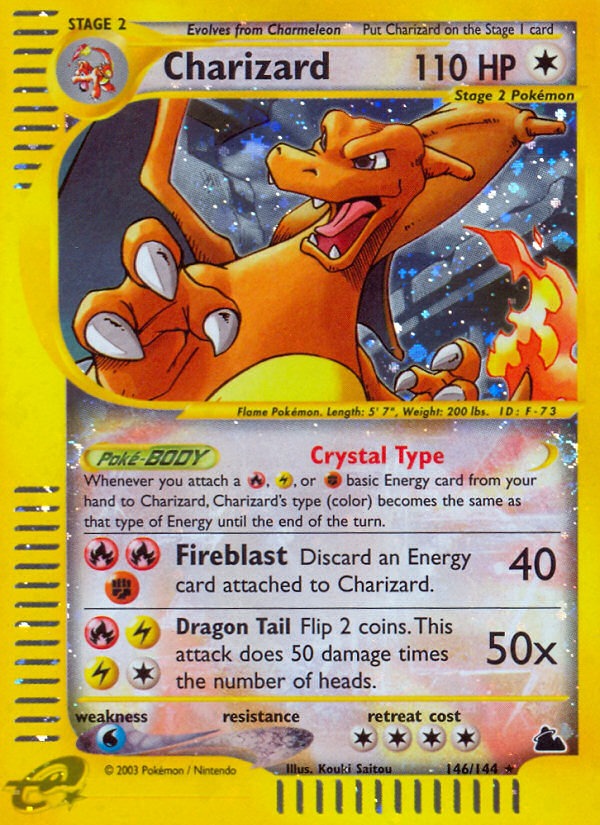
The nine Crystal cards are split across Aquapolis and Skyridge: Crystal Charizard, Crystal Ho-Oh, Crystal Kabutops, Crystal Celebi, Crystal Crobat, Crystal Golem, Crystal Kingdra, Crystal Lugia and Crystal Nidoking. They share three properties that matter for collecting:
- They are type-shifted. Crystal Charizard is not a Fire type. The treatment exists outside the normal type system, which is why the cards read as exceptions rather than variants.
- The holo covers the whole card face. Standard holos have a foil window around the artwork; Crystal cards are foiled edge to edge. This makes surface marks far more visible and far more damaging to a grade.
- The print run is small even within the set. Crystal cards were the chase tier of a small print run, which is the worst possible combination for anyone trying to buy one today.
The blue chip: Crystal Charizard
Crystal Charizard from Skyridge is the era’s defining card and one of the few non-1st-Edition vintage cards that trades in the tens of thousands. PSA 10 copies have recently sold in the low-to-mid $40,000s, with fewer than roughly twenty-five known in gem mint.
That population figure is the entire argument. It is not that the card is famous — it is that a thirty-year-old card with a full-face foil and a print run this small has almost no path to a 10. Every handling mark, every degree of off-centring, every soft corner removes a copy permanently. The population does not grow. It only shrinks as copies are damaged or locked into permanent collections.
For context on the era’s ceiling: a PSA 10 1st Edition Base Set Charizard sold for $550,000 in December 2025, and a PSA 10 Pikachu Illustrator was reported at about $16.5 million in February 2026. Crystal Charizard sits a full order of magnitude below both, which is either the era’s limitation or its opportunity, depending on which you think is mispriced.
Where the quiet value sits in this era
Four areas of the e-Card era are structurally scarcer than their prices reflect. All four share a property: they are hard to find without surface marks, and the market prices surface condition slowly.
- The other eight Crystal cards. Crystal Kabutops, Crystal Golem and Crystal Kingdra come from the same small print run and the same full-face foil problem as Charizard, at a small fraction of the price. The set-completion demand for nine cards is concentrated on one of them.
- Aquapolis holos. Widely considered the best art of the era and priced below Skyridge because the set is not the last one. The print run is not much larger.
- Reverse holos from all three sets. The e-Card era used a reverse foil pattern that is genuinely difficult to find unmarked, because the pattern sits on the whole card rather than a window. A clean reverse holo from Skyridge is scarcer than the equivalent holo.
- Sealed e-Card product. Almost none survives. The era was bought to be played by children, not held, and the boxes that remain are the single scarcest sealed category in English Pokémon.
How to identify an e-Card era card
Four checks, in order of reliability.
- The dot-code band. A thin horizontal strip of dots along the bottom edge of the card face, below the text box. If it is there, the card is from this era. No other era printed one.
- The layout. e-Card cards put the artwork in a frame that sits higher on the card than the Wizards layout, with the Pokédex data in a band beneath it. The proportions read as slightly taller and narrower than a Base Set card.
- The set symbol. A small icon in the bottom-right: Expedition uses a Poké Ball over a book, Aquapolis a stylised wave, Skyridge a mountain peak.
- The copyright line. 2002 for Expedition and Aquapolis, 2003 for Skyridge, followed by the Nintendo and Creatures credits rather than Wizards alone.
Curl, foil lift and the barcode problem
e-Card cards have a specific preservation problem that no other era shares: the dot-code band sits on the same surface as the foil, and it is the part of the card that gets touched.
- Foil lift at the edges. Full-face foil on a thin stock lifts at the border before it scratches. Once the foil has lifted even a fraction, the card is capped at a mid grade permanently, because the lift cannot be reversed.
- Barcode abrasion. The dot code is printed on the same layer as the surface finish. Rubbing it — in a sleeve, in a box, in a binder page — removes dots. A card with a rubbed code is still authentic, but it has lost the one feature that identifies the era.
- Humidity curl, worse than Base Set. The full-face foil on both sides of the stock means the card reacts to humidity in two directions at once. e-Card cards bow more than Base Set cards and are more prone to a slight S-curve.
What this means in practice: an e-Card card needs a sleeve the moment it is out of a pack, and it needs a rigid holder if it is going to be handled at all, because the surface is the value. Our penny sleeves are acid-free and thin enough not to abrade a full-face foil; the 3×4 rigid toploader keeps the card flat without pressure on the face; and for a Crystal card you intend to display, the Pro-Grade Display Slab holds it without the card touching the acrylic.
What this era teaches about the rest of the timeline
The e-Card era is the cleanest example of a rule that repeats across this entire timeline: the eras that failed commercially are the eras that became scarce. The e-Reader was a bad product. The cards were bought by children who played with them. Nobody held them. Three years later the licence changed hands and the sets stopped being printed while demand had not yet started.
Every later era with a failed gimmick — the LEGEND two-card panel, the Prime mechanic, the early V-UNION — follows the same pattern at a smaller scale. When a mechanic does not work, the cards are not kept, and the survivors are few.
Where this era sits on the timeline
The e-Card era follows the Base Set era, which it replaced by changing the back of the card. It is followed by the EX era, which removed the barcode, kept the modern back, and introduced the lowercase ex. The full timeline puts all twelve in order.
What these cards actually look like
e-Card cards are the most visually distinct objects in the hobby, and the two features that make them distinct are the two that wear first.
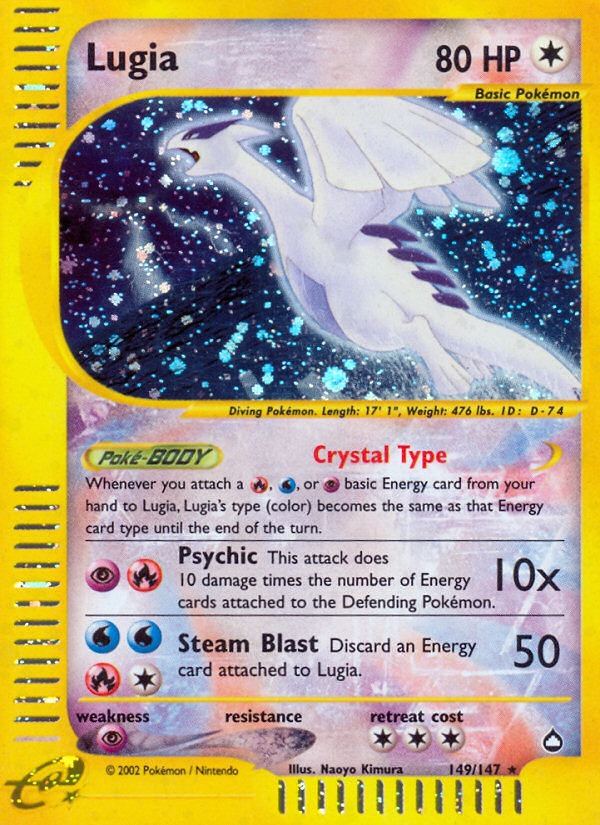
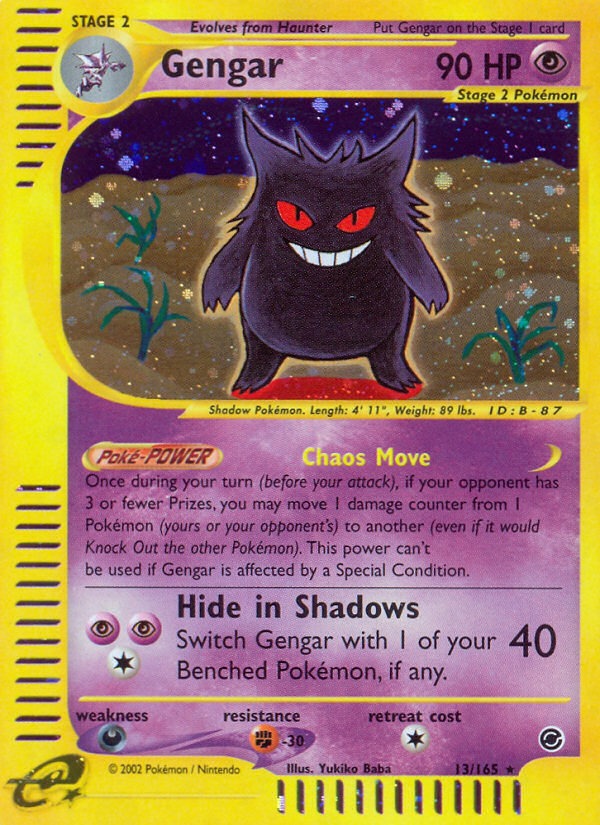
Image sources for this page: images.pokemontcg.io/ecard3/146_hires.png (Crystal Charizard), ecard2/149_hires.png (Crystal Lugia) and ecard1/13_hires.png (an Expedition holo). Served from /wp-content/uploads/2026/10/. Card names and artwork are trademarks of Nintendo, Creatures Inc. and GAME FREAK inc.; scans are used here for identification and commentary.
Frequently asked questions
What is an e-Card Pokémon card?
A card printed between 2002 and 2003 with a strip of dot codes along the bottom edge, readable by Nintendo’s e-Reader accessory. The three English sets are Expedition, Aquapolis and Skyridge. The band of dots is the definitive identifier and no other era printed one.
Why is Skyridge so much more expensive than Expedition?
Print run and timing. Skyridge was the last set under the Wizards of the Coast licence, released in May 2003 in the smallest quantity of any English Pokémon set, immediately before the licence changed hands. Expedition shipped earlier, in larger volume, and into a market that was still buying.
What does “Crystal” mean on an e-Card card?
It is a printing treatment, not a type. Nine Pokémon were printed with a full-face prismatic foil that sits outside the normal type system — Crystal Charizard, for example, is not a Fire type. The treatment covers the whole card face rather than a window around the artwork, which makes surface condition unusually important.
How many Crystal Charizard PSA 10 copies exist?
Fewer than roughly twenty-five are known in gem mint, against a set released in the smallest print run of any English Pokémon set. The population is effectively fixed: no more copies are being printed, and every handling mark removes one permanently.
Are e-Card cards worth grading?
For the Crystal cards and the Aquapolis and Skyridge holos, yes — the grade spread is wide and the supply at the top is fixed. For Expedition commons and uncommons, the grading cost usually exceeds the grade premium, and the answer is no.
Sources
Sources and further reading
- The Pokémon Company and Wizards of the Coast — set records for Expedition (September 2002), Aquapolis (January 2003) and Skyridge (May 2003).
- Nintendo — the e-Reader accessory and its dot-code format, Game Boy Advance era.
- Third-party graded price trackers — Skyridge Crystal Charizard PSA 10 sales in the low-to-mid $40,000s, 2026.
- PSA population reports — Crystal Charizard and the other eight Crystal cards, by grade.
- Heritage Auctions — PSA 10 1st Edition Shadowless Base Set Charizard, $550,000, December 2025, quoted here for era comparison only.
- CardSpicy — How to read a set code, for identifying printings by code rather than artwork.
Related reading
- All twelve Pokémon card eras — the timeline this page belongs to.
- Era 1 — Base Set, 1996 to 2001 — the old back that this era replaced.
- Era 3 — EX, 2003 to 2004 — the modern back, the gold star, and the end of the barcode.
- Era 4 — Delta Species, 2004 to 2006 — the other era that broke the type system on purpose.
- Storing sealed Pokémon boxes — relevant if you find e-Card era sealed product.
Nothing on this page is investment advice, and no grade outcome is promised for any card. Prices quoted are published third-party figures as of 2026 and are reference ranges, not offers.
Where to go next
- The CardSpicy card index — every card we track, with its PSA 10 population and market history (195 cards).
- The illustrator index — every artist behind those cards, card by card (110 artists).