

Era 4 of 12 in our timeline of Pokémon card eras. Every other era adapts a video game. This one invented a place, and then printed five sets set inside it.
Companion pages: Sealed Delta Species product · grading delta cards.
Quick answer
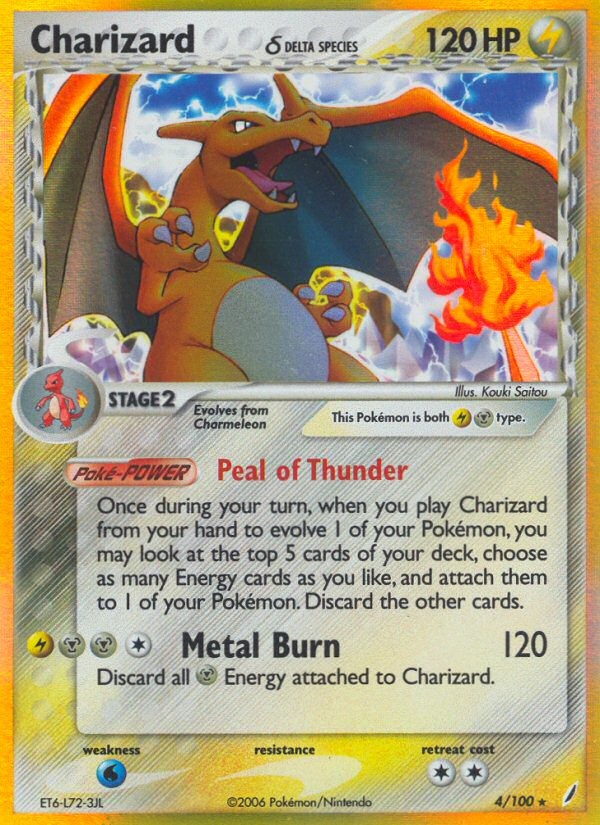
The Delta Species era runs from October 2005 to November 2006 and is defined by one mark: the Greek letter delta (δ) printed on the type line of a card. A δ card is a Pokémon whose type has been changed — Charizard printed as a Lightning type, Tyranitar as Fire, Mewtwo as Metal. The five English sets that carry it are EX Delta Species, EX Legend Maker, EX Holon Phantoms, EX Crystal Guardians and EX Dragon Frontiers.
The in-fiction reason is the part almost nobody knows: these cards are set in Holon, a research region that exists only in the card game. No main-series Pokémon game has ever depicted it.
The one era with its own world
Pokémon card sets normally follow the video games. A new generation ships, and the cards illustrate that region’s Pokémon, gyms and characters. Holon breaks the pattern completely.
The setting is a dry, arid research territory where scientists study Pokémon under an electromagnetic field. Exposure to that field alters a Pokémon’s type without changing the Pokémon. The result is a Charizard that discharges lightning, a Mewtwo that reads as a machine, a Rayquaza printed as a Metal type. The cards even carry the framing in their flavour text, which repeatedly refers to "Holon" and to the scientists working there.
This is why the era reads as the least Pokémon-like period in the hobby’s history, and why the video essay that inspired this series calls it the laboratory era. The art direction follows the premise: clinical whites, instrument panels, grid overlays, and Pokémon rendered as specimens rather than characters.
The five sets
| Set | Release | What it added |
|---|---|---|
| EX Delta Species | October 2005 | Introduces the δ type change and the Holon setting |
| EX Legend Maker | February 2006 | Fossil and legendary Pokémon re-typed; early gold star Mew |
| EX Holon Phantoms | May 2006 | The middle set, and the one most collectors consider the best art of the era |
| EX Crystal Guardians | August 2006 | The Lightning-type Charizard δ |
| EX Dragon Frontiers | November 2006 | Gold Star Charizard; the era’s ceiling and its ending |
How δ cards work, and why they are not just recolours
A δ card keeps the Pokémon’s name and illustration style but changes the energy it runs on. That is a mechanical change, not a cosmetic one. A Lightning-type Charizard cannot use Fire energy, and a deck built around it needs a completely different energy base.
Four properties define the tier:
- The δ symbol sits on the type line, immediately before the type name, in the same position where the type icon normally appears. It is part of the card’s typography, not a stamp.
- The foiling is standard, not special. Delta cards use the normal holo window. Unlike the e-Card Crystal treatment, there is no full-face foil, which is why this era’s cards survive surface damage better than the era before it.
- The type change is consistent within a set. A set’s δ cards are re-typed as a group, which is what makes the era collectible as a set rather than as individual cards.
- Some Pokémon were printed twice in the same era — once normal, once δ. The pair is the unit collectors chase, and the δ version is always the scarcer of the two.
The cards that carry the era
| Card | Set | Why it matters |
|---|---|---|
| Charizard δ (Lightning) | EX Crystal Guardians, 2006 | The single most recognisable card of the era and the one people mean when they say “delta Charizard” |
| Gold Star Charizard | EX Dragon Frontiers, 2006 | The last gold star of the run, and the most expensive card printed in this era |
| Gold Star Mew | EX Dragon Frontiers, 2006 | Same set, same pull rate, a fraction of the price |
| Tyranitar δ | EX Delta Species, 2005 | The clearest example of the type change as an idea rather than a gimmick |
| Rayquaza δ | EX Holon Phantoms, 2006 | Metal-type Rayquaza; the best art of the Holon sets |
There is a useful lesson in that table. The era is remembered for one card, the Lightning Charizard, but the actual scarcity is spread across five sets and a large δ roster. The cards that carry the idea and the cards that carry the price are not the same cards.
Where the quiet value sits
- Non-Charizard δ cards. Roughly five hundred δ cards were printed across the five sets. The market prices perhaps a dozen. Every other δ card is a scarce, mechanically interesting, artistically distinctive card trading at a price set by its set rather than its idea.
- EX Holon Phantoms sealed product. The middle set of a five-set run, in the middle of a declining print period. It is the era’s least-opened box and the hardest to find sealed.
- The normal/δ pairs. Buying both printings of the same Pokémon is the era-specific collecting project, and almost nobody does it, which keeps the non-Charizard pairs cheap.
- EX Legend Maker. The set that sits between the era’s launch and its best art, priced as a transitional set and largely ignored.
How to identify a Delta card
- The δ glyph on the type line. Immediately before the type word, e.g.
δ Lightning. Not in the corner, not in the name. - Silver frame, thin margin — the 2003-onward frame, unchanged from the EX era.
- Set symbol in the bottom-right and copyright 2005 or 2006, credited to Nintendo, Creatures and Game Freak.
- The flavour text. If it mentions Holon or a research programme, the card is from this era even before you check the type line.
Clouding, and why this era looks worse than it grades
Delta era holos have a specific surface problem that is easy to mistake for damage: clouding. The foil layer on 2005–2006 cards develops a faint milky haze in patches, usually where a finger or a sleeve has been in contact, and it is visible only at an angle.
Clouding is not scratching, and it does not always reduce a grade the way a scratch does — PSA scores surface rather than appearance, and a haze that does not break the foil often grades an 8 rather than a 6. But it makes the card visually worse than its grade, which matters if you are buying from a photograph.
The practical rules: photograph the card at 45 degrees before you buy, never wipe a clouded card with a cloth — the haze is in the foil, and wiping makes it worse — and store flat, in a sleeve, away from humidity. The acid-free penny sleeves we stock are the right first layer for this era specifically, because a sleeve that outgasses will accelerate clouding. The rigid 3×4 toploader stops the card flexing, which is the other thing that cracks a 2005 foil.
Why the era ended
Delta Species ended for a structural reason worth understanding, because it explains a pattern that repeats later in this timeline. The mechanic was conceptually strong and commercially weak. A player building a deck around a Lightning Charizard needs Lightning energy, and the type change made deck construction harder rather than more interesting. The competitive scene did not adopt it.
When the Diamond & Pearl era arrived in 2006, the design language reset completely: no δ symbols, no Holon, no laboratory framing, and a new mechanic — LV.X — that was simpler to explain and easier to sell. The Pokémon Company does this periodically, and each reset creates the scarcity that later defines an era.
Where this era sits on the timeline
The Delta era follows the EX era, whose ex mechanic and gold star tier it inherited. It is followed by the Diamond & Pearl era, which discarded both. The full timeline puts all twelve in order.
What these cards actually look like
The Delta mark is the smallest change in the hobby’s history and the most consequential.
δ glyph, and the type reads Lightning instead of Fire. The card is otherwise an ordinary holo with a standard foil window. Once you have seen the glyph, the era becomes unmistakable.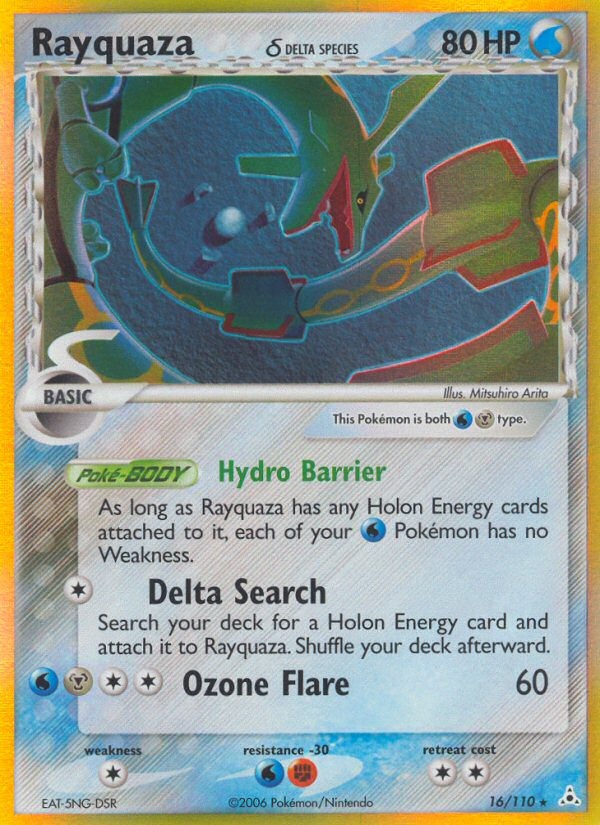
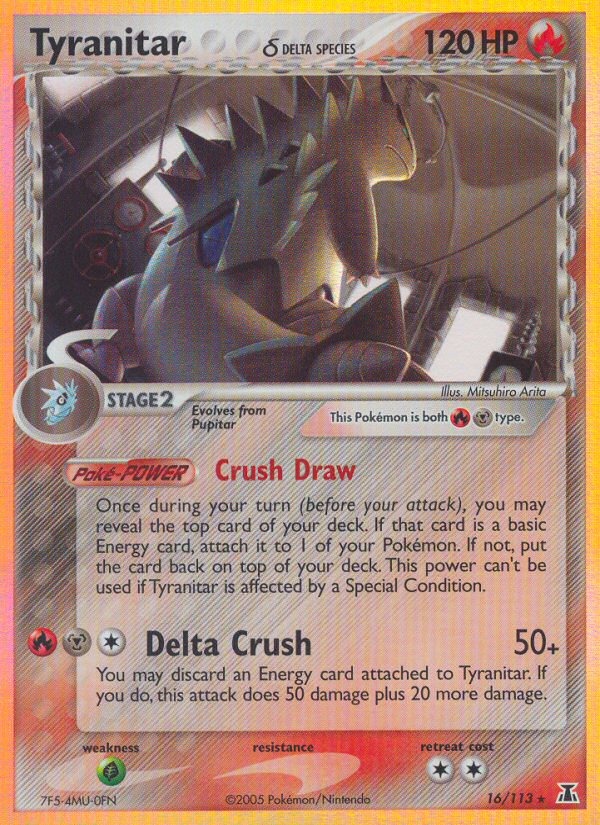
Image sources for this page: images.pokemontcg.io/ex14/4_hires.png (Charizard delta), ex13/16_hires.png (Rayquaza delta) and ex11/16_hires.png (Tyranitar delta). Served from /wp-content/uploads/2026/10/. Card names and artwork are trademarks of Nintendo, Creatures Inc. and GAME FREAK inc.; scans are used here for identification and commentary.
Frequently asked questions
What is a Delta Species Pokémon card?
A card printed between 2005 and 2006 with the Greek letter delta on its type line, marking a Pokémon whose type has been changed. Charizard as a Lightning type is the best-known example. The change is mechanical: a δ card uses different energy from the normal printing of the same Pokémon.
Why did Charizard become a Lightning type?
In the card game’s own fiction, because it was studied in Holon, a research region where an electromagnetic field alters Pokémon types. Holon exists only in the TCG — no main-series Pokémon game has ever shown it, which is why these sets have no video-game counterpart to collect alongside them.
How many Delta Species sets are there?
Five English sets: EX Delta Species (2005), EX Legend Maker (2006), EX Holon Phantoms (2006), EX Crystal Guardians (2006) and EX Dragon Frontiers (2006). Together they contain roughly five hundred δ cards.
Is Gold Star Charizard a Delta Species card?
It comes from EX Dragon Frontiers, the last set of the Delta era, but it does not carry a δ symbol — it is a gold star, which is the rarity tier introduced in 2004. It is the era’s most valuable card and its most commonly misdescribed one.
What is clouding on a Pokémon card?
A faint milky haze that develops in the foil layer of 2005–2006 holos, usually where the surface was touched. It is not a scratch and cannot be cleaned off, because the haze is inside the foil rather than on top of it. Do not wipe it; store the card flat and sleeved.
Sources
Sources and further reading
- The Pokémon Company — set records for EX Delta Species (October 2005) through EX Dragon Frontiers (November 2006).
- Official card flavour text from the Holon sets, which names the research region directly.
- PSA population reports — δ cards and the gold stars of EX Dragon Frontiers, by grade.
- Third-party graded price trackers — gold star and delta Charizard sales, 2026.
- CardSpicy — Era 3 — EX, 2003 to 2004, for the gold star mechanic this era inherited.
Related reading
- All twelve Pokémon card eras — the timeline this page belongs to.
- Era 3 — EX, 2003 to 2004 — where the gold star and the lowercase
exbegan. - Era 5 — Diamond & Pearl, 2006 to 2009 — the reset that removed δ entirely.
- Era 2 — e-Card, 2001 to 2003 — the other era that broke the type system on purpose.
- Storing sealed Pokémon boxes — for the Holon sets, which survive sealed in very small numbers.
Nothing on this page is investment advice, and no grade outcome is promised for any card. Prices quoted are published third-party figures as of 2026 and are reference ranges, not offers.
Where to go next
- The CardSpicy card index — every card we track, with its PSA 10 population and market history (195 cards).
- The illustrator index — every artist behind those cards, card by card (110 artists).