

Grading companion to Era 4, the Delta Species era. Part of the twelve-era timeline. This page quotes no prices and no population figures; it explains the structure that decides whether a submission makes sense.
Quick answer
Delta Species cards carry a laminate layer that can migrate over time, and the symptom is a milky white haze across the foil that cannot be cleaned, polished or reversed — so a δ card has to be self-checked for clouding before it is submitted, because sending one that has started to cloud is a guaranteed surface deduction you paid for. The haze is not on the surface. It is inside the card, between the foil and the clear layer above it, which is why every remedy that works on a surface mark makes it worse.
This is the only era in the series where the check has to happen before the card is even considered as a candidate, rather than as one step in a condition assessment. On other eras a defect is a reason not to submit. Here the defect is silent, it develops while the card sits in a box, and it is the thing most likely to make an otherwise excellent card grade badly.
What δ actually is, and why it matters for the raw pool
Delta Species is a card-face attribute, not a product line. The δ symbol and the altered type are printed on the card; nothing on a booster box, a theme deck or a pack wrapper tells you whether the cards inside are δ. That has a practical consequence for grading: you cannot filter the raw pool by product. The δ cards are scattered through the print run at whatever rate the sheet dictated, and a collection built from sealed product in this era contains them without the owner necessarily having noticed.
The treatment itself is the reason for the problem. A δ card is built like the other foil cards of the period — a printed layer, a foil layer, and a clear laminate over the top — and in this era the laminate and the adhesive beneath it are the parts that behave least predictably across two decades. Cards from the same box, stored in the same place, can end up in different states.
What clouding looks like, and what it is not
The description collectors use is accurate: a milky, slightly blue-white film that sits over the foil and looks, at first glance, like a smudge of grease or a light scuff. It is easiest to see at an angle of about fifteen to twenty degrees, and it is often patchy rather than even — one corner, or a band across the middle, or the whole card.
What separates it from the things it resembles is that it does not move relative to the card. A fingerprint sits on top of the gloss and disappears under a dry microfibre pass. A scuff is directional and has edges. Clouding has no edges, follows the foil rather than the artwork, and stays exactly where it is whatever you do to it. The one test that settles it is the comparison test: hold the card beside a δ card you know is clean, under the same light at the same angle. The difference between a slightly dull foil and a clouded one is obvious in comparison and almost impossible to judge in isolation.
The usual explanation is moisture and heat cycling. The laminate and the adhesive under it expand and contract at different rates, and over enough cycles the interface between them changes, which is what produces the haze. That is an explanation rather than a measurement, but it is consistent with the pattern: cards from humid storage cloud more often than cards from dry storage, and cards that have been through a hot loft cloud more often than cards that have not.
Sorting a δ card before it goes anywhere
The table is a decision list. Work down it and stop at the first row that matches.
| What you see | What it probably is | Does it clean? | Submit? |
|---|---|---|---|
| Greasy patch with a visible edge, often a print | Skin oil on the gloss | Yes, dry microfibre | Yes, once clean |
| Bright directional lines that appear at one angle | Surface scratches in the laminate | No | Only if faint and few |
| Even milky film with no edges, following the foil | Clouding | No | No |
| Patchy white bloom along one edge or corner | Early clouding, usually moisture-driven | No | No |
| Fine mottling visible from every angle, present since purchase | Print mottle from the sheet | No | Yes, but expect a surface deduction |
| Haze that disappears when the card is moved away from the light | Reflection from the sleeve, not the card | Not applicable | Check again out of the sleeve |
The last row is not a joke. A noticeable share of the clouding reported in this era turns out to be the sleeve: a matte sleeve diffuses light in a way that reads as haze at exactly the angle where you would look for it. Always take the card out before deciding, and always put it back in a different sleeve afterwards.
Five checks before a δ card is submitted
- Take it out of the sleeve, then look at it at fifteen to twenty degrees. Clouding is an angle-dependent defect and a sleeve adds its own angle-dependent effect.
- Compare it against a δ card you are certain about. Hold both under the same lamp at the same angle. Judgement in isolation is unreliable, and comparison takes ten seconds.
- Check whether the haze follows the foil or the printing. Clouding follows the foil field and crosses the artwork and text box without changing. A print defect stays inside the printed area.
- Try one dry pass and stop. If a microfibre pass does not lift it, it is not on the surface, and further attempts add scratches to a card that already has a problem.
- Look at the whole card, not the corner you noticed. Clouding is often patchy, and a card with one bloomed corner usually has a fainter bloom on the opposite side that is easier to see once you know to look.
Why the loss is asymmetric
The reason this defect matters more than its size suggests is that it lands on the subgrade with the least tolerance for ambiguity. Surface is judged by how the card reflects light, and clouding is a change in how the card reflects light across its whole face. There is no reading of it that is not a deduction.
Compare it with edge wear, which is local: a worn corner costs something and the rest of the card can still carry the grade. Clouding is global, so even a light case affects the whole face. That asymmetry is the argument for checking before deciding — the check costs ten seconds, the fee does not come back.
Storing δ cards so the laminate stays stable
The physical problem is not contact damage, it is the environment. Clouding is driven by cycling — heat, humidity, and the expansion and contraction that follows — so the storage question is about stability rather than padding.
That changes the priority order. A cool, dry, stable interior room matters more than the holder. A loft, a garage and a room with a dehumidifier running intermittently are all worse than a cupboard in a living space, because the cycle is the mechanism. A sealed plastic bin without desiccant is the worst of both: it traps the moisture already in the cards and then lets the temperature move.
For the holder itself, the requirement is that it does not add pressure or movement. A matte premium sleeve gives a clean inner surface with no plasticiser to migrate, which matters on a card whose failure mode is migration. A press-fit rigid case holds the card flat and still, so the laminate is not flexed by handling, and the flexing is one of the small contributors to the interface breaking down. For a stack of δ cards kept together, a rigid 3×4 toploader per card inside a rigid box is adequate, provided the box is not in a room that swings in temperature.
If the card is a display piece, a display slab keeps the face visible and the card still, which is the best combination available for this era. What no holder can do is reverse a haze that has already formed, and that is the honest limit of the whole section.
Where this sits
This page follows the EX era grading page, where the failure was mechanical, and precedes the Diamond & Pearl grading page, where the failure moves back to the card’s design — a borderless frame that removes the buffer edge wear used to have. Between them, this is the only page in the sequence where the defect is chemical rather than physical. For the card-level story, see Era 4; for the full sequence, the twelve-era timeline.
Frequently asked questions
Can clouding be removed with a polish or a cloth?
No. The haze is at an interface inside the card, not on the surface, so anything abrasive removes the gloss and leaves the haze. Polishing a clouded δ card produces a clouded card with a polished, inconsistent surface, which is worse on both counts.
Do all δ cards eventually cloud?
No, and the variance is the point: cards from the same box and the same storage can differ. What the pattern suggests is that cycling drives it, so a card kept cool and dry is far less likely to develop it than one that has been through a loft.
Is clouding counted as surface or as damage?
As surface. It is a change in how the face reflects light rather than a structural break, which is exactly why it is so costly — it applies to the whole face rather than to a point.
Does a clouded card still have a grade?
It is encapsulated and graded, and the grade records the haze. The question is whether the number is worth paying to have printed, and for a card with a visible bloom the answer is usually no.
Is a δ card from this era harder to identify than the others?
The card is easy — the δ symbol and the altered type are printed on the face. What is hard is knowing whether a given collection contains one, because nothing on the packaging of this era indicates it.
What the cards in this era actually look like
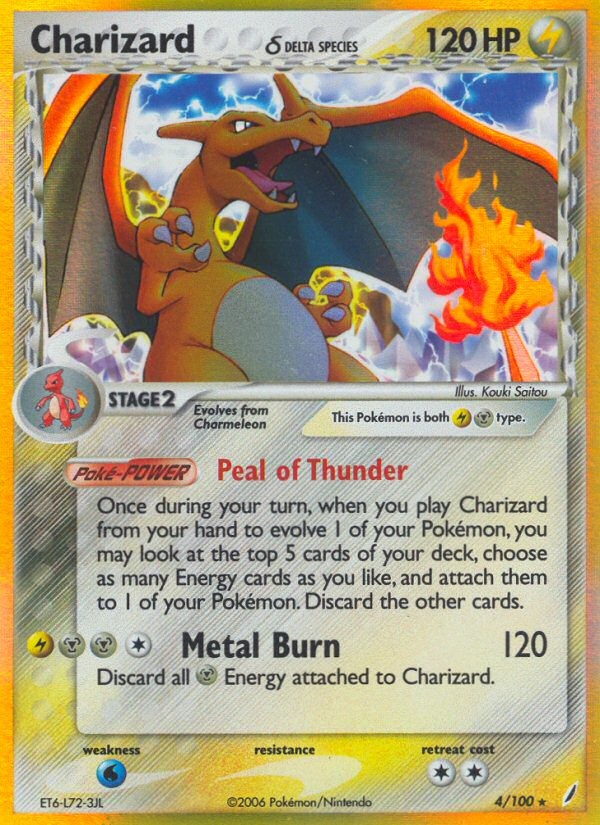
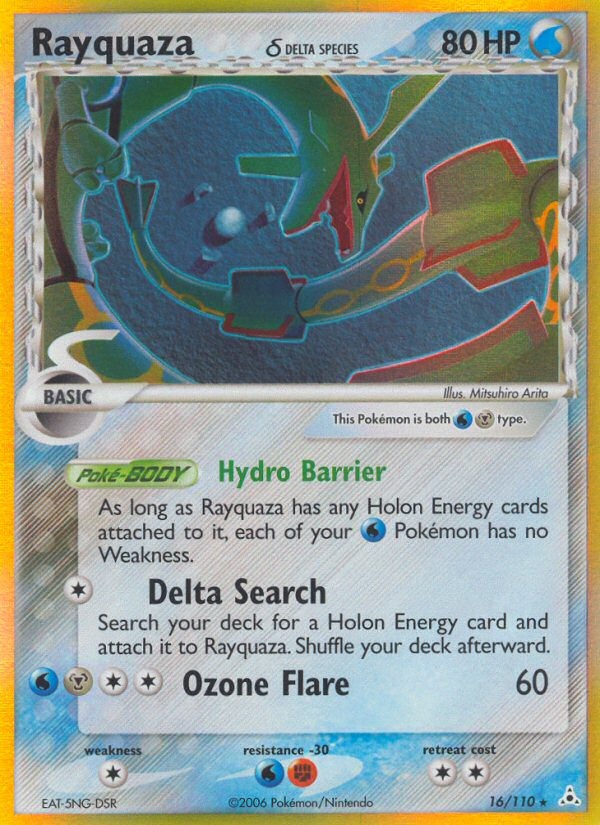
The three cards below all carry a foil field across the whole face, which is why a haze has nowhere to hide on them.

Sources
Sources and further reading
- The Pokémon Company — the Delta Species card class, introduced in the EX series and identified by the δ symbol on the card face.
- The Pokémon Company — EX Delta Species, EX Holon Phantoms, EX Crystal Guardians and EX Dragon Frontiers, the four sets in which δ cards appear.
- The Pokémon Company — card construction of the period: printed layer, foil layer, clear laminate.
- CardSpicy — Humidity and card storage, for the cycling mechanism described here.
- CardSpicy — The seven types of card damage, for how a laminate defect differs from a surface defect.
- CardSpicy — Era 4 — Delta Species, 2004 to 2006, for the card-level history this page assumes.
Related reading
- Era 4 — Delta Species, 2004 to 2006 — the δ class in full.
- Grading EX era cards — the previous era, where the edge decides.
- Grading Diamond & Pearl era cards — the next era, and the borderless design.
- All twelve Pokémon card eras — the timeline.
- Humidity and card storage — the mechanism behind clouding.
- Sealed Delta Species product — why the raw pool is unfiltered.
Nothing on this page is investment advice, and no card or grading service is offered for sale here. Grades are assigned by third-party companies; the descriptions of laminate behaviour and storage are structural, are not population figures or prices, and the mechanism described is the usual explanation rather than a laboratory measurement.
Where to go next
- The CardSpicy card index — every card we track, with its PSA 10 population and market history (195 cards).
- The illustrator index — every artist behind those cards, card by card (110 artists).
Leave a Reply