

Grading companion to Era 5, the Diamond & Pearl era. Part of the twelve-era timeline. This page quotes no prices and no population figures; it explains the structure that decides whether a submission makes sense.
Quick answer
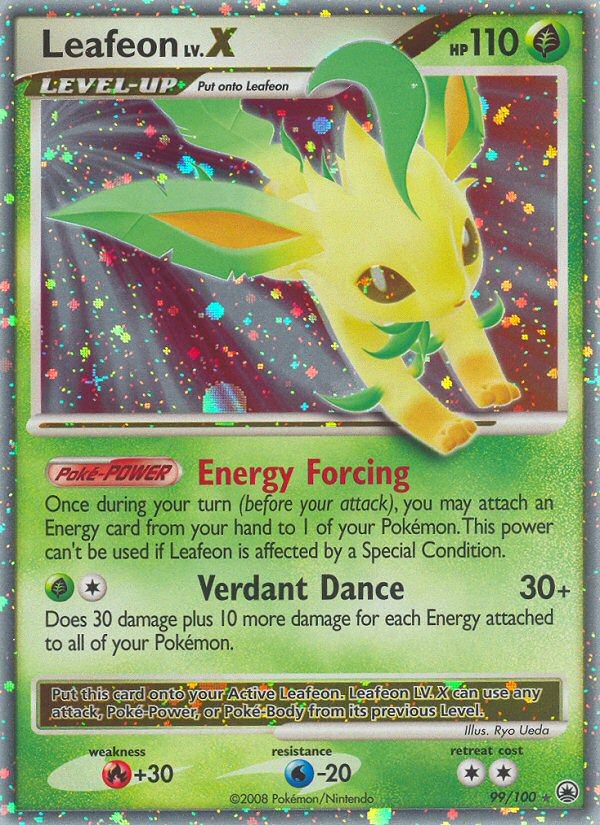
LV.X is a borderless design, and the border was always the buffer — so on this era a light rub that would have landed in dead yellow on an older card lands on the printed face instead, which is why surface is the subgrade most often lost here. Every era before this one gave the card a margin. A rub at the rim of a Base Set card sat in a band of flat colour that nobody was assessing as artwork; a rub at the rim of an LV.X sits in the image. The defect is the same size. What changed is where it landed.
That single design decision makes this the first era in which the four sub-assessments stop behaving independently. On an older card you could describe a defect as either an edge problem or a surface problem. Here the rim is both, and a grader looking at a full-bleed face has no clean way to separate them.
What the design change actually did
An LV.X card is printed with the artwork running to the cut edge, separated from it only by a thin keyline. There is no printed frame in the sense the earlier eras used the word. Three things follow.
The first is that the area under assessment as surface grows to almost the whole card. On a standard holo the foil is a window and the rest of the face is flat colour; on an LV.X the reflective field and the artwork occupy the same space, so every part of the face is a surface that shows contact.
The second is that edge wear becomes visible immediately. On a wide-margin card, wear has to travel inwards before it reaches anything anyone is looking at. On this design there is nothing to travel through: a rub of a fraction of a millimetre is already in the image.
The third is that the back is now the only place with a margin. The reverse of an LV.X keeps the standard blue back, which means a card can have a perfectly clean front and a back that shows every shuffle. That asymmetry is common in this era and it is routinely missed.
There is a fourth, smaller consequence. The rule text on an LV.X — the level-up box and the small print that governs how the card is played — is printed over the image rather than inside a frame. Small type over a busy field is the least legible thing on the card and the most sensitive to a scuff, because a mark through a line of text interrupts something the eye is already working to read.
Where the damage on this era comes from
This was the era in which sealed product diversified — tins, blisters, theme decks and collector boxes arrived in numbers the hobby had not seen. That is good for sealed collectors and bad for singles, because a tin is not a storage container. It is a moulded plastic tray with a card sitting in it, and a card sitting loose against a hard moulded edge for fifteen years acquires a mark exactly where the tray touches it.
| Class | Printed buffer | Typical damage | Submit? |
|---|---|---|---|
| LV.X | None — artwork to the cut | Rim rubs, tray marks, shuffle wear reaching the image | Only if the perimeter is clean all the way round |
| Standard holo | Wide frame | Frame whitening, which the margin absorbs | Yes, this is the safer class in the era |
| Reverse holo | Narrow frame | Pattern scuffing across the whole face | Rarely |
| Non-holo rare | Wide frame | Little, which is the problem | No |
| Promo from a tin | Varies | Tray contact on one edge, often the top | Only after checking the edge the tray touched |
Two of those rows are worth dwelling on. The LV.X row is the obvious one. The promo row is the one people miss: a card that lived in a tin for a decade does not have random wear, it has wear in one place, and that place is predictable enough to check first.
Five checks before a Diamond & Pearl card is submitted
- Walk the perimeter with the card tilted. Move the card rather than your eye, so the rim passes under the same light all the way round. On a borderless design this is the only way to compare one edge against another.
- Look for the tray mark. On a card that came out of a tin, expect a single scuff or a faint indentation along one long edge. It is usually shallow and always in the same place.
- Check the keyline. The thin line at the rim is the only printed element separating the image from the cut, and any break in it is both an edge defect and a surface defect at once.
- Turn it over. The back is the only part of the card with a margin, and on this era it is where shuffle wear accumulates. A clean front and a worn back is a mid-grade card.
- Decide before you handle it again. Every subsequent handling is a chance to add a rim mark to a card that has no margin to absorb one.
Why “near mint” is a narrower band here
On a wide-margin card, near mint tolerates a certain amount of handling because the handling shows up in a place that carries little weight. On a borderless card the same handling shows up in the place that carries the most. The practical result is that the distance between a card that looks untouched and a card that will grade at the top is smaller in this era than in any era before it.
This is also why raw listings from this period are unusually hard to judge. A photograph that shows the artwork clearly shows the least informative part of the card, because the artwork is large and the defects are at its edge. Ask for a rim shot of all four sides, and treat a listing without one as a listing that has not been checked.
Storing borderless cards
The problem is that there is no margin, so the storage question becomes a question about the perimeter rather than the face.
A sleeve is still the first layer, but on this era it should be a sleeve the card settles into rather than one it is pushed through, because the push is what touches the rim. A matte premium sleeve with a little slack does that job; a tight sleeve abrades exactly the band that decides the grade.
The second layer should not be a tin. A tin is a display object that happens to hold a card, and the card it holds is in contact with a hard moulded edge. If a card came out of one, the tin has done its work and should not be used again. A press-fit rigid case holds the card without touching the rim during closure and keeps it flat, which matters on a card whose face is entirely image. For cards in transit, a rigid 3×4 toploader with the card in a sleeve first is the standard and is adequate, provided the card is not being cycled in and out.
If the card is on display, a display slab gives the face an unobstructed view, which is the whole reason this design exists. What none of these fix is humidity, which on this era is a secondary concern: the stock is laminated and the failure it produces is the faint ripple rather than the bloom seen on the previous era’s cards.
Where this sits
This page follows the Delta Species grading page, where the defect was chemical and invisible until you looked for it, and precedes the LEGEND / HGSS grading page, where the object being graded stops being a single card. This is the last page in the sequence where the card is one piece of card stock with one face. For the card-level story, see Era 5; for the full sequence, the twelve-era timeline.
Frequently asked questions
Is an LV.X card harder to grade highly than a holo from the same set?
Yes, and for a structural reason rather than a printing one. The same amount of handling produces a defect in the image rather than in a margin, so the condition band that reaches the top of the scale is narrower.
Can a rim rub on an LV.X be removed?
No. A rub removes or compresses the printed layer at the edge, and there is no process that restores it. Any attempt to disguise it adds a surface change that is easier to detect than the original.
Do cards that came out of tins grade worse?
They have a predictable defect rather than a random one. If the tray contact point is clean, the card is a normal submission; if it is not, the defect is on an edge with no margin behind it.
Does the back of an LV.X matter as much as the front?
It counts the same and it is the only part of the card with a printed margin, so it is where shuffle wear shows first. Check it before the front, not after.
Is the whole Diamond & Pearl era borderless?
No. The borderless treatment is specific to the LV.X class. The rest of the era’s cards keep a frame, which is why the standard holos from these sets are the more reliable submissions.
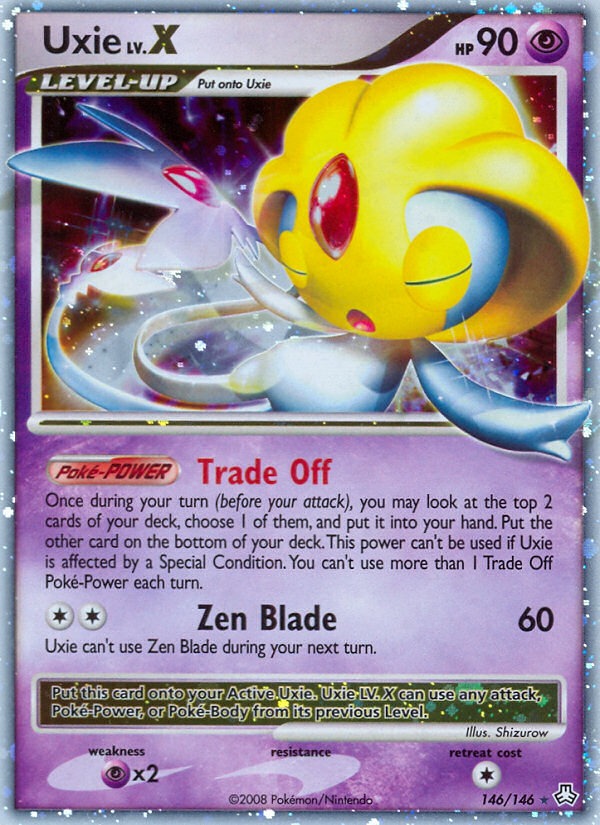
What the cards in this era actually look like
Each of the three cards below runs its artwork to the cut edge. Look at the perimeter in every case, because that is where the assessment now begins.

Sources
Sources and further reading
- The Pokémon Company — the Diamond & Pearl series, 2006 to 2009.
- The Pokémon Company — the LV.X card class, printed with artwork running to the cut edge and a keyline in place of a full frame.
- The Pokémon Company — the expansion of sealed product formats in this era: tins, blisters, theme decks and collector boxes.
- CardSpicy — PSA vs BGS vs CGC, for how surface is weighted when the face is entirely artwork.
- CardSpicy — The seven types of card damage, for the wear mechanisms described here.
- CardSpicy — Era 5 — Diamond & Pearl, 2006 to 2009, for the card-level history this page assumes.
Related reading
- Era 5 — Diamond & Pearl, 2006 to 2009 — LV.X and the era’s product range.
- Grading Delta Species cards — the previous era, and the laminate that clouds.
- Grading LEGEND and HGSS cards — the next era, where one card becomes two.
- All twelve Pokémon card eras — the timeline.
- The seven types of card damage — what a rim rub actually is.
- Sealed Diamond & Pearl product — tins, blisters and where the tray marks come from.
Nothing on this page is investment advice, and no card or grading service is offered for sale here. Grades are assigned by third-party companies; the descriptions of design, wear and storage are structural and are not population figures or prices.
Where to go next
- The CardSpicy card index — every card we track, with its PSA 10 population and market history (195 cards).
- The illustrator index — every artist behind those cards, card by card (110 artists).
Leave a Reply