

Era 5 of 12 in our timeline of Pokémon card eras. This is the point where the card game stopped illustrating an adventure and started illustrating a cosmology.
Companion pages: Sealed Diamond & Pearl product · grading LV.X cards.
Quick answer
The Diamond & Pearl era ran from late 2006 to 2009 and introduced LV.X, the first card design with no printed border. The mechanic let a Pokémon level up from its normal card, and the design change was more consequential than the mechanic: a borderless card has nothing to absorb edge wear, so the era’s gem-mint populations are thinner than its print runs suggest.
Thematically, this is the era of the Sinnoh creation myth — Dialga for time, Palkia for space, Giratina for the reverse world, Arceus for the origin of everything. The cards stopped asking “is this Pokémon strong” and started asking “where did this world come from.”
The first era with a cosmology
Every era before this one adapted a region. Kanto, Johto, Hoenn — the cards illustrated places you could walk through in a game, with gym leaders you could beat.
Sinnoh did something different. Its legendary trio are not powerful animals; they are the physical principles the world runs on. Time, space, and the space between them. Arceus is explicitly the creator. The card sets of this era reflect that: the art direction moves from landscapes to abstract geometry, the legendary cards are printed with a metallic or crystalline treatment, and the set names stop referring to places — Legends Awakened, Secret Wonders, Mysterious Treasures — and start referring to cosmology.
This is the era where Pokémon cards acquired a mythology, and the hobby has never fully gone back. Every generation since has had a creation-level legendary, and the pattern starts here.
The eleven sets
| Set | Release | Note |
|---|---|---|
| Diamond & Pearl | May 2007 | Two-prize LV.X era begins; the base set establishes the new frame |
| Mysterious Treasures | August 2007 | Sinnoh legendaries in number |
| Secret Wonders | November 2007 | Charizard and the Kanto starters reintroduced |
| Great Encounters | February 2008 | The set that made LV.X competitive rather than decorative |
| Majestic Dawn | May 2008 | Eeveelution LV.X debuts |
| Legends Awakened | August 2008 | The mythic peak: Arceus, Uxie, and the strongest LV.X of the era |
| Stormfront | November 2008 | Charizard reprint era; the last DP-set before Platinum |
| Platinum | February 2009 | Sub-era begins; Giratina and the reverse world |
| Rising Rivals | May 2009 | Competitive staples; heavily played |
| Supreme Victors | August 2009 | The era’s last Chase Charizard |
| Arceus | November 2009 | Closes the era with the creation Pokémon itself |
What LV.X actually changed
LV.X is a card you place on top of a Pokémon that is already in play. It is not a separate Pokémon; it is an upgrade, and the upgrade is printed on a card with no border at all.
That design decision is the part that matters for collectors, because it created a permanent condition problem:
- No border, no buffer. Every card from 1996 to 2006 had a printed border that absorbed handling. An LV.X card’s illustration runs to the die cut. A single nick on the edge is now a flaw in the artwork rather than in the frame.
- The card is thinner. LV.X cards were printed on a slightly lighter stock because they were designed to sit on top of another card in a stack, and players did not want the deck to thicken.
- It was a player’s card. LV.X cards were the strongest things in the format for three years. They were played, in sleeves, in decks, shuffled repeatedly. A gem-mint LV.X is a card that was pulled and never used, which is a small subset of a small set.
That combination — borderless artwork, thin stock, competitive play — is why this era’s PSA 10 population is structurally lower than the era before it, despite a comparable print run.
Where the money actually is in this era
This is the first era where the answer is counter-intuitive, and it is worth stating plainly: the most valuable cards of the Diamond & Pearl era are not the cards the era is remembered for.
The LV.X legendaries — Dialga, Palkia, Giratina, Arceus — are the era’s identity. They are also relatively available, because they were printed as the headline cards of their sets and collectors kept them carefully. The expensive material sits elsewhere:
| Category | What it is | Why it is expensive |
|---|---|---|
| Tournament prizes | Cards awarded at organised play events during the era, printed in tiny numbers and never sold in a pack | Population set by attendance, not by print run |
| Japanese promos | Event and magazine distribution cards from the same period | Never released in English; supply is in Japan and mostly ungraded |
| Played competitive staples | Uxie LV.X, Luxray GL LV.X and similar | Nearly every copy was shuffled to death; high grades are rare precisely because the cards were good |
| Sealed DP-era boxes | Particularly Legends Awakened and Majestic Dawn | The era is when a large cohort returned to the hobby and opened everything |
The lesson generalises across this timeline: when a card is good at the game, it is bad at surviving. The strongest cards of any competitive era are the ones with the worst gem-mint populations, and the market takes years to notice.
The quiet value in this era
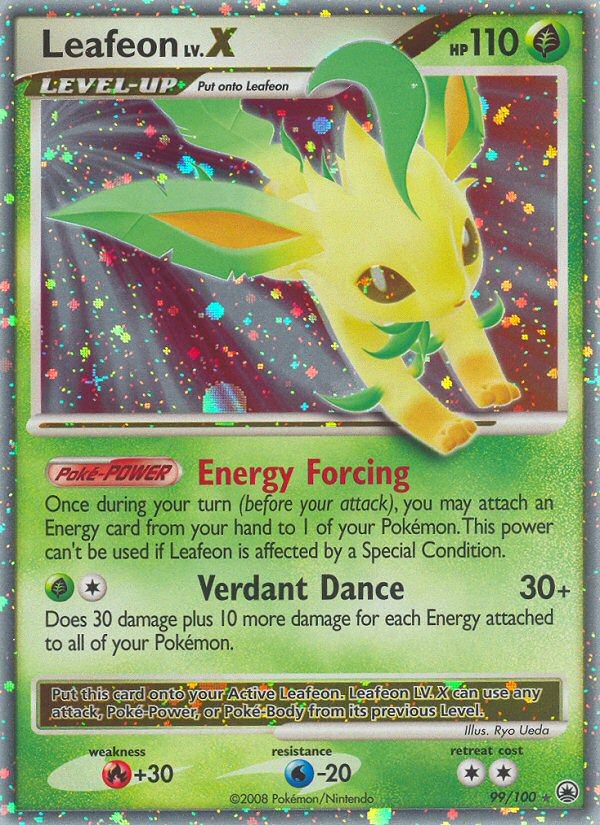
- Eeveelution LV.X cards. Majestic Dawn and Legends Awakened printed Leafeon, Glaceon, and eventually Umbreon and Espeon as LV.X. The Eeveelution collector base is the most durable in the hobby, and these cards predate the modern alt-art era that gets all the attention.
- Non-headline LV.X cards. Fifty-two LV.X cards exist across the era. The market prices perhaps eight. The rest are borderless, thin-stock, low-population cards from a mythic-themed era, trading at the price of a mid-era holo.
- Platinum sub-era. The 2009 sets are treated as transitional, released just before the LEGEND redesign. Giratina’s origin form and the reverse-world art direction are the best of the era and the cheapest.
- Japanese DP promos. Ungraded, in Japan, and structurally scarcer than their English equivalents. This is the era’s least efficient market.
How to identify a Diamond & Pearl card
LV.Xprinted after the Pokémon’s name, and a “LEVEL UP” rule box on the card. There is no rarity symbol in the usual position.- No border. The artwork runs to the edge of the card. If you can see a yellow or silver frame, it is not an LV.X.
- The set symbol in the bottom-right, and a copyright year of 2007, 2008 or 2009 credited to Nintendo, Creatures and Game Freak.
- The reverse holo pattern. DP-era reverse holos carry the set name stamped into the foil, which is the fastest way to identify the set once the symbol is worn.
Edge wear on a borderless card
A borderless card fails at the edge, and it fails invisibly until you look at it from the side.
Three checks before you buy, in this order. First, hold the card at eye level and look along each of the four edges — a borderless card that has been handled shows a thin bright line where the print layer has chipped. Second, check the top edge specifically; it is the edge that takes the most contact when a card is pushed into a sleeve. Third, check the back, because a borderless front on a standard back means the back is where centring errors show most clearly.
For storage, the era needs the same three layers as everything else but with one addition: this is the era where a rigid holder is not optional. A borderless card in a soft sleeve alone will flex at the edge every time it is picked up, and flexing is what chips the print layer. Our acid-free penny sleeves protect the face; the 3×4 rigid toploader stops the flex; and for an LV.X you want on display, the Pro-Grade Display Slab holds the card flat without pressure on the borderless edge.
Where this era sits on the timeline
The Diamond & Pearl era follows the Delta Species era, whose Holon setting and type changes it abandoned entirely. It is followed by the LEGEND era, which replaced LV.X with a two-card panel and went back to Johto. The full timeline puts all twelve in order.
What these cards actually look like
The LV.X design is the first one where you cannot see where the card ends.
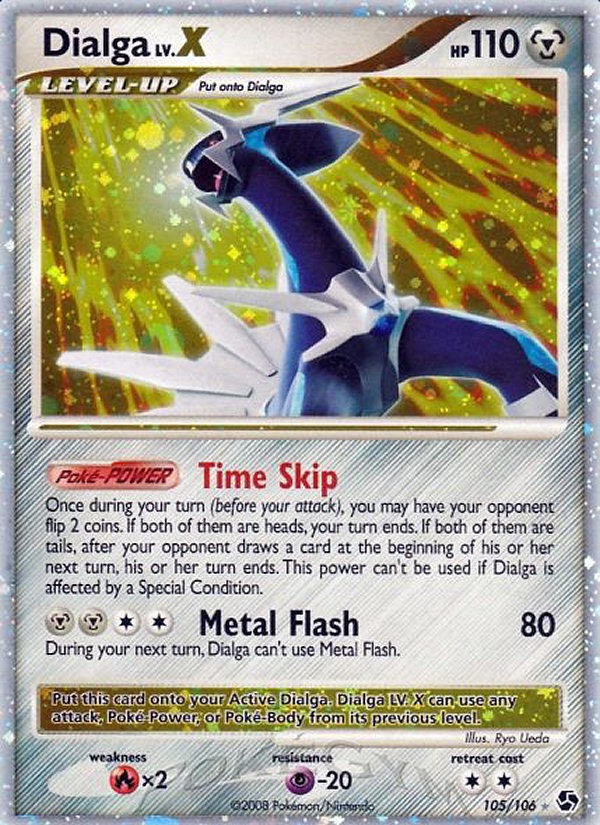
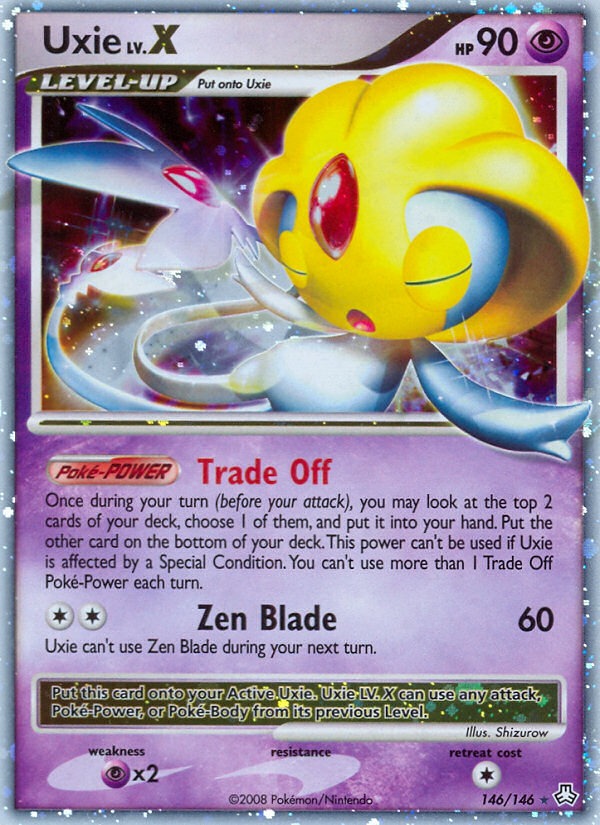
Image sources for this page: images.pokemontcg.io/dp5/99_hires.png (Leafeon LV.X), dp4/105_hires.png (Dialga LV.X) and dp6/146_hires.png (Uxie LV.X). Served from /wp-content/uploads/2026/10/. Card names and artwork are trademarks of Nintendo, Creatures Inc. and GAME FREAK inc.; scans are used here for identification and commentary.
Frequently asked questions
What is an LV.X Pokémon card?
A card from the 2006–2009 era that is placed on top of a Pokémon already in play to level it up. LV.X cards have no printed border — the artwork runs to the edge of the card — and they were printed on slightly lighter stock because they were designed to stack.
Why are LV.X cards hard to find in PSA 10?
Three reasons at once: the borderless design means edge wear lands on the artwork rather than a frame, the lighter stock flexes more, and the cards were the strongest in the format for three years so almost every copy was played. A gem-mint LV.X is a card that was pulled and never used.
Which Diamond & Pearl cards are the most valuable?
Not the legendaries the era is known for. Tournament prize cards and Japanese event promos from 2006 to 2009 carry the highest prices, because their populations were set by attendance rather than print run. Among set cards, the heavily played competitive LV.X cards — Uxie, Luxray GL — are the scarcest in high grade for the opposite reason: they were too good to survive.
What is the mythic turn in Pokémon cards?
The shift, beginning with the Sinnoh sets, from illustrating a region and its gyms to illustrating a creation story. Dialga is time, Palkia is space, Giratina is the reverse world, Arceus is the origin. Every generation since has repeated the structure, which is why this era reads as the template rather than as an outlier.
Are Diamond & Pearl era cards worth grading?
The LV.X cards yes, particularly the playable ones, because the grade spread is wide and the high-grade population is genuinely thin. Commons and uncommons from the era do not justify the cost, and the era’s non-holo rares are usually worth less graded than the grading fee.
Sources
Sources and further reading
- The Pokémon Company — set records for Diamond & Pearl (May 2007) through Arceus (November 2009).
- Official card text — the LEVEL UP rule box printed on every LV.X card.
- PSA population reports — LV.X cards by grade, including the competitive staples.
- Third-party graded price trackers — Diamond & Pearl era sales, 2026.
- CardSpicy — Era 4 — Delta Species, the era immediately before this one.
Related reading
- All twelve Pokémon card eras — the timeline this page belongs to.
- Era 4 — Delta Species, 2004 to 2006 — the Holon setting that this era replaced.
- Era 6 — LEGEND, 2009 to 2010 — the two-card panel, and the shortest era in the timeline.
- Era 7 — Black & White, 2010 to 2013 — where the full-art card begins.
- Open or keep sealed — particularly relevant to Legends Awakened and Majestic Dawn.
Nothing on this page is investment advice, and no grade outcome is promised for any card. Prices quoted are published third-party figures as of 2026 and are reference ranges, not offers.
Where to go next
- The CardSpicy card index — every card we track, with its PSA 10 population and market history (195 cards).
- The illustrator index — every artist behind those cards, card by card (110 artists).