


Era 7 of 12 in our timeline of Pokémon card eras. If you have ever described a card as a full art, you are using this era’s vocabulary — and it was invented here, almost by accident.
Companion pages: Sealed Black & White product · grading full arts.
Quick answer
The Black & White era ran from 2010 to 2013 across eleven sets, and it introduced the full-art card: an illustration that extends across the entire card face with no printed frame. It also brought back the uppercase EX as a basic Pokémon that gives up two prize cards when knocked out.
The mechanic matters to players. The layout matters to everyone, because the borderless full-art design introduced here is the template that every card from 2019 onwards still uses.
The era that made modern cards look modern
Put a 2009 card and a 2012 card side by side and the difference is not subtle. The 2009 card has a silver frame, a small art window, and text boxes arranged in bands. The 2012 full art has no frame at all — the illustration runs corner to corner, the text sits directly on the image in translucent panels, and the card reads as a picture that happens to have rules on it.
Every element of that design is now standard. The 2023 Art Rare, the 2021 alternate art, the 2019 full-art trainer — all of them are descendants of the Black & White full art. This is the hinge point of the entire timeline.
It was also the solution to a commercial problem. By 2011 the hobby had been through three years of a shrinking player base, and the cards needed a reason to be looked at again. Making the best cards visually different rather than mechanically stronger was the move, and it worked well enough that the company has never gone back.
The eleven sets
| Set | Release | Note |
|---|---|---|
| Black & White | April 2011 | New frame, new generation, no EX yet |
| Emerging Powers | August 2011 | The smallest set of the era |
| Noble Victories | November 2011 | N full art — the first full-art supporter that mattered |
| Next Destinies | February 2012 | Uppercase EX returns, with full-art versions from day one |
| Dark Explorers | May 2012 | Darkrai EX; the era’s defining competitive card |
| Dragons Exalted | August 2012 | Rayquaza EX; the era’s most collected dragon |
| Boundaries Crossed | November 2012 | Charizard returns; the era’s best-selling set |
| Plasma Storm | February 2013 | Team Plasma sub-theme begins |
| Plasma Freeze | May 2013 | Strongest competitive cards of the era |
| Plasma Blast | August 2013 | Genesect-focused; small print |
| Legendary Treasures | November 2013 | Closes the era with a reprint-heavy set, including gold cards |
Reshiram, Zekrom, and what an EX actually is here
The first two EX cards of the returning tier are Reshiram EX and Zekrom EX from Next Destinies — the black-and-white mascots, printed as basic Pokémon with high HP and a two-prize penalty. They are the visible face of the era and the cards most often used to represent it.
Three things distinguish a Black & White EX from the lowercase ex of 2003:
- Case. Uppercase
EXafter the name. Lowercaseexis the 2003–2007 tier; they are not the same mechanic and not the same era. - Basic, not evolved. BW
EXcards are played directly from hand as basics, which is what made them format-defining. - Printed twice. Every BW
EXexists as a standard art and a full art. The full art is the scarce one, and the pair is the collecting unit.
The full-art premium, and why it survived
The full-art version of a Black & White EX is not a reprint with different art. It is a separate card in the set list, printed at a much lower rate, with the same rules and a completely different illustration treatment.
That structure — same card, two printings, one of them borderless — is now the standard shape of every modern chase card. The alt art of 2019, the Special Art Rare of 2023, and the Mega Hyper Rare of 2025 are all refinements of the Black & White full art.
It is also where the era’s value sits. Standard-art EX cards from this period are affordable and widely available. The full arts are not, and the gap between them is the widest of any era before 2019.
Where the quiet value sits
- Full-art supporters. N, Cheren, Bianca and Skyla were printed as full arts in this era, at low rates, before the modern trainer-collecting boom. They are the direct ancestors of the trainer portraits that now sell for four figures.
- Plasma Freeze and Plasma Blast. The two smallest print runs of the era, released at the end of the cycle when the player base was smallest, and priced as mid-era sets.
- Legendary Treasures gold cards. The era’s final set introduced gold secret rares with a border treatment that has never been repeated. They are cheap relative to the equivalent modern gold cards.
- Japanese BW sets. The Japanese releases of this era have different set divisions and much smaller print runs, and they are almost entirely ungraded outside Japan.
How to identify a Black & White card
- Uppercase
EXafter the name, or a full-art layout with no frame. Those two markers place a card in this era faster than anything else. - The border treatment. Standard BW cards use a silver-and-black frame with a rounded corner cut that is visibly different from the DP era’s frame.
- The set symbol in the bottom-right, and a copyright year of 2011, 2012 or 2013.
- The reverse holo pattern. BW reverse holos carry the set symbol stamped into the foil, which identifies the set even when the corner symbol is worn.
Print lines: the invisible flaw that caps this era
Black & White era holos are the era most affected by print lines — thin horizontal or vertical streaks in the foil that are present from the factory rather than from handling.
They are easy to miss in a photograph and easy to see under a raking light. A print line does not necessarily reduce a grade below a 9, but it very often prevents a 10, which is why this era’s gem-mint populations are smaller than the print runs would suggest and why the gap between a 9 and a 10 is unusually wide.
Two practical consequences. First, when buying a full art from this era, ask for a photo under angled light, not a straight-on scan. Second, when storing, keep the card flat and free of pressure — a print line is in the foil, and pressure makes it more visible over time.
The full-art cards are borderless, so they have the same edge problem as the LV.X cards before them. Our acid-free penny sleeves are the first layer, the rigid 3×4 toploader stops the flex that chips a borderless edge, and a Pro-Grade Display Slab is the right holder for a full art you intend to keep visible, because the whole point of the card is the surface.
Where this era sits on the timeline
The Black & White era follows the one-year LEGEND era, whose two-card panel it abandoned. It is followed by the XY era, which kept the full-art layout and added Mega Evolution on top of it. The full timeline puts all twelve in order.
What these cards actually look like
Put a 2009 card next to a 2012 full art and the hinge in this timeline becomes obvious in one glance.
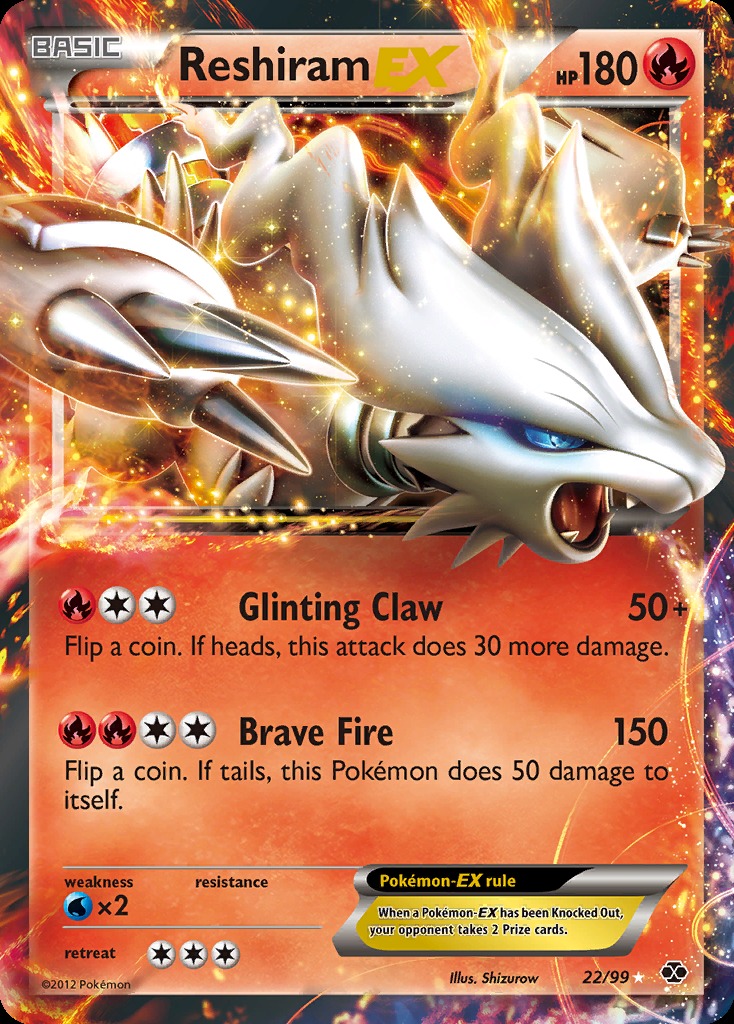
EX sits after the name in a bold face, visually much heavier than the lowercase ex of 2003.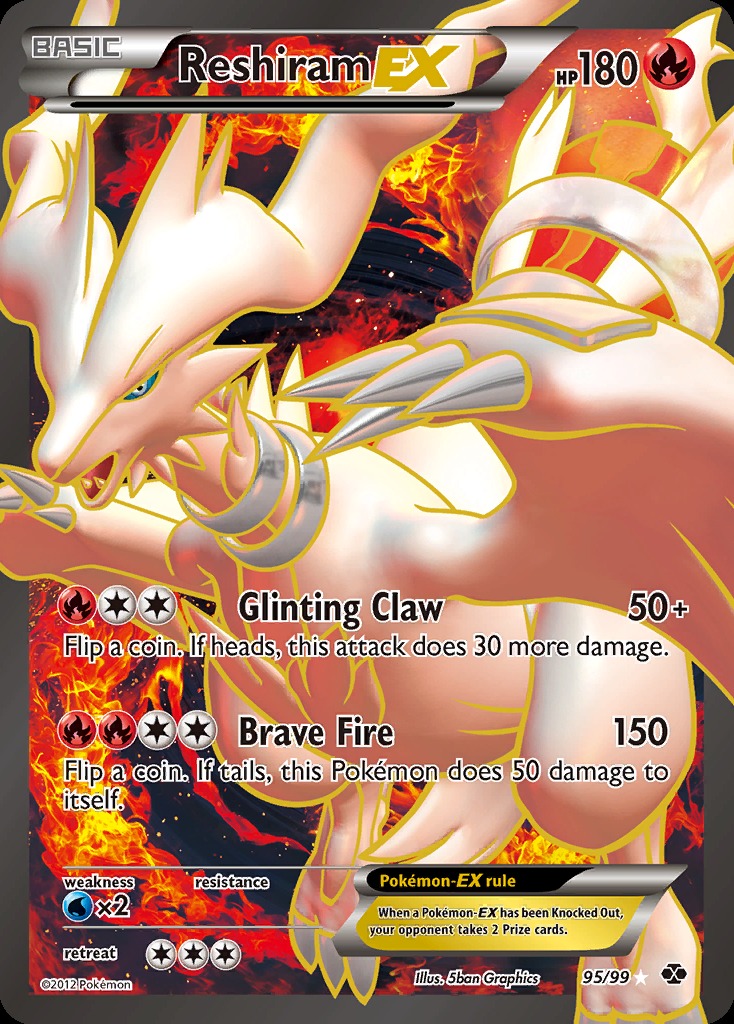

Image sources for this page: images.pokemontcg.io/bw4/22_hires.png (Reshiram-EX, standard art), bw4/95_hires.png (the same card in full art) and bw3/101_hires.png (N, full-art supporter). Served from /wp-content/uploads/2026/10/. Card names and artwork are trademarks of Nintendo, Creatures Inc. and GAME FREAK inc.; scans are used here for identification and commentary.
Frequently asked questions
What is a full art Pokémon card?
A card where the illustration extends across the entire card face with no printed frame, and the text sits on the image in translucent panels. The design was introduced in the Black & White era from 2010 to 2013 and is the template every modern card still uses.
What is the difference between EX and ex?
Case and era. Uppercase EX is the 2010–2016 tier: a basic Pokémon with high HP that gives up two prize cards. Lowercase ex is the 2003–2007 tier and then returns in 2023. They are three different mechanics from three different parts of the timeline.
Why are full-art cards worth more than the same card in standard art?
Because they are separate cards in the set list, printed at a much lower rate, with a different illustration treatment. The rules are identical; the supply is not. That structure was established in this era and has been the shape of every chase card since.
What are print lines on a Pokémon card?
Thin streaks in the foil that come from the printing process rather than from handling. They appear mostly in the 2010–2013 era and are visible only under angled light. They frequently prevent a gem-mint grade without being visible in a straight-on scan.
Which Black & White set is the most valuable?
Boundaries Crossed, because Charizard appears in it, and Legendary Treasures, because of its gold secret rares and its position as the era’s final set. Plasma Freeze and Plasma Blast are the scarcest in sealed form, having shipped into the smallest player base of the cycle.
Sources
Sources and further reading
- The Pokémon Company — set records for Black & White (April 2011) through Legendary Treasures (November 2013).
- Official card text — the
EXrule and the full-art layout, both printed on the cards. - PSA population reports — Black & White
EXcards and full arts, by grade. - Third-party graded price trackers — full-art and standard-art splits for the era, 2026.
- CardSpicy — Era 6 — LEGEND, the one-year era immediately before this one.
Related reading
- All twelve Pokémon card eras — the timeline this page belongs to.
- Era 6 — LEGEND, 2009 to 2010 — the two-card panel that came before.
- Era 8 — XY, 2013 to 2016 — Mega Evolution, and the licensed promo.
- Era 9 — Sun & Moon, 2016 to 2019 — where the trainer portrait takes over.
- Open or keep sealed — relevant to the era’s smallest print runs.
Nothing on this page is investment advice, and no grade outcome is promised for any card. Prices quoted are published third-party figures as of 2026 and are reference ranges, not offers.
Where to go next
- The CardSpicy card index — every card we track, with its PSA 10 population and market history (195 cards).
- The illustrator index — every artist behind those cards, card by card (110 artists).