

Era 12 of 12 in our timeline of Pokémon card eras. This is the only era on the timeline whose outcome is unknown, which makes it the only one where the honest answer is a list of what the data does and does not show.
Companion pages: Sealed Mega Evolution product · grading Mega Evolution cards.
Quick answer
The Mega Evolution era began in September 2025 and is defined by the return of Mega Evolution after eleven years, a three-prize rule for Mega Pokémon, and a new rarity tier — the Mega Hyper Rare, a gold treatment above the Special Illustration Rare. The first two English sets are Mega Evolution (me1) and Phantasmal Flames (me2, released 14 November 2025).
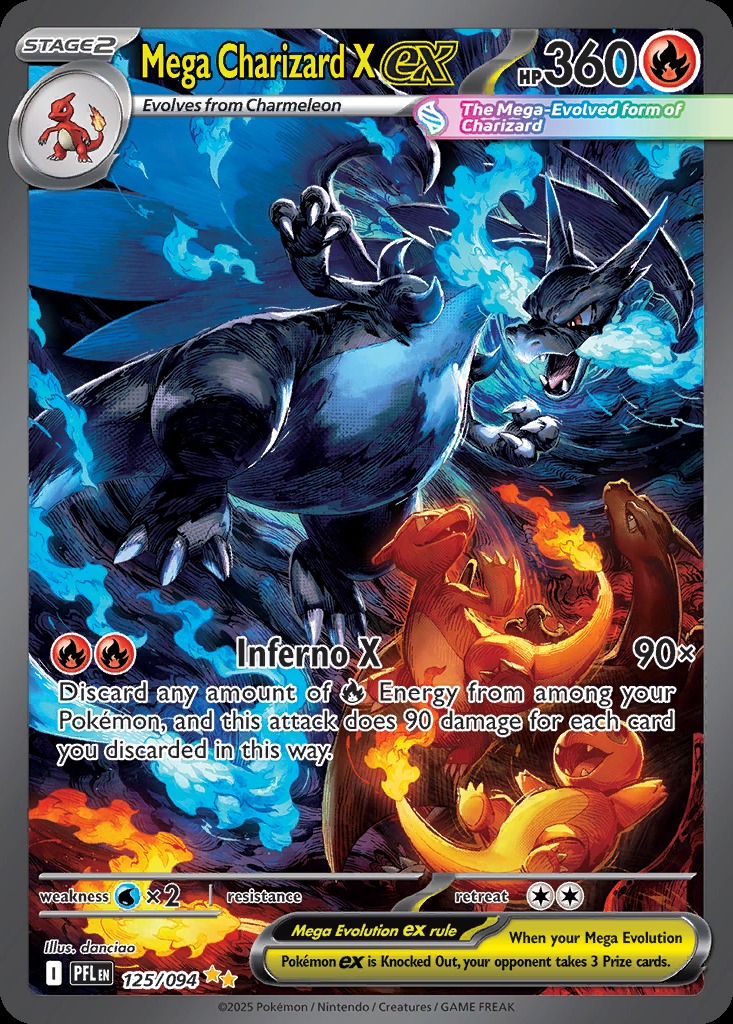
The defining card is Mega Charizard X ex, Special Illustration Rare #125 from Phantasmal Flames. It has traded in a rough band of $670 to $780 raw and roughly $2,100 to $2,300 in PSA 10 through 2026, after a launch spike and a correction. A BGS 10 Black Label copy sold for $54,100 in March 2026.
What actually came back
Mega Evolution first ran in the XY era from 2013 to 2016, printed on landscape cards that gave up two prize cards. The 2025 version is not a reprint of that mechanic; it is a rebuild with three changes that matter.
- Three prizes, not two. A Mega Evolution Pokémon ex gives up three prize cards when knocked out, which makes it a considerably riskier object than the 2013 version. The rule is printed on the card.
- Portrait, not landscape. The landscape layout that defined the XY era is gone. The new Mega cards are printed in the standard orientation, which is the single biggest visual difference between the two Mega eras.
- A new rarity above everything else. The Mega Hyper Rare is a gold treatment that sits above the Special Illustration Rare in the set list. It is the first new rarity tier since the Art Rare and Special Art Rare were introduced in 2023.
Three prizes and a gold tier above the top chase are both attempts to solve the same problem: how to make a card feel scarce in an era where print runs are enormous and gem rates are high.
The first two sets
| Set | Release | Composition |
|---|---|---|
| Mega Evolution (me1) | September 2025 | Introduces the mechanic and the Mega Hyper Rare; Mega Charizard, Mega Lucario, Mega Gardevoir and Mega Alakazam headline |
| Phantasmal Flames (me2) | 14 November 2025 | 130 cards — 94 in the main set plus 36 secrets numbered 095 to 130; six Mega Evolution ex cards |
Phantasmal Flames is worth understanding structurally because it is unusually concentrated. Every card in the set trading above roughly $25 is a printing of Mega Charizard X ex. The best non-Charizard card in the set is a Supporter at around $24. That is a set with one card and a supporting cast, which is a design decision rather than an accident.
The set is also a merge rather than a translation: its card pool comes from the Japanese Inferno X expansion plus the two MEGA Starter Sets released in September 2025, which is where Mega Gengar ex and Mega Diancie ex originate.
The price history of Mega Charizard X ex, stated plainly
This is the cleanest way to read the era, because the card is the era’s index.
| Period | What happened |
|---|---|
| Launch, late 2025 | PSA 10 copies reported near $2,750 — launch-hype pricing while graded supply was thinnest |
| January 2026 | Settled into a roughly $1,800 to $2,025 band as graded supply arrived |
| Mid to late 2026 | Recovered into the low-to-mid $2,000s; raw in a $670 to $780 band |
| March 2026 | A BGS 10 Black Label copy sold for $54,100 — a grade-population outlier, not a market level |
Two things about that table are more useful than the numbers. The first is the shape: spike, correction, floor, partial recovery. That is the standard arc of a modern Charizard, and it has now repeated often enough to be treated as a pattern rather than a surprise.
The second is the grade spread. A raw copy at roughly $700, a PSA 9 near $840 and a PSA 10 above $2,100 means the entire economic case for the card depends on the top grade. That is a narrow margin if you are buying raw to grade: after the grading fee, shipping and insurance, a PSA 9 is close to a loss.
The pull rate, and why it matters more than the price
The widely cited pull rate for Mega Charizard X ex #125 is roughly one in four hundred packs. For a thirty-six-pack booster box, that is one copy per eleven boxes.
That figure is the honest answer to the most common question about this era. Opening sealed product to chase the card is not a strategy; at one in four hundred, the expected value of a box is dominated by everything except the card you want. If you want the card, buy the card. If you want to open boxes, accept that the card is not the reason.
Where the quiet value sits, with the caveat that this is early
Any list of undervalued cards in a thirteen-month-old era is a guess. What can be said with more confidence is where the structure is repeating.
- Mega cards that are not Charizard. Mega Lucario, Mega Gengar, Mega Gardevoir and Mega Diancie are the other five Mega Evolution ex cards of the first two sets. In every previous era, the non-Charizard members of a defining mechanic were the last to be repriced.
- Illustration Rares in a Charizard-concentrated set. Phantasmal Flames has one card above $25 that is not a Charizard — and a spread of Illustration Rares below it. A set with one dominant chase suppresses everything else in it.
- Mega Hyper Rares. The new gold tier is the scarcest printing in the set and trades well below the Special Illustration Rare, which is the inverse of the usual relationship between scarcity and price. That inversion is either a mispricing or a statement about what collectors value; it is too early to say which.
- Sealed product at the end of a print cycle. The era is young and still being printed. The structural opportunity in any new era appears when printing stops, not before.
How to identify a Mega Evolution era card
Megabefore the name, in portrait orientation. A landscape Mega card is from 2013–2016, not this era.- Three-prize rule printed on the card — the rule text distinguishes the 2025 version from the 2013 version immediately.
- Mega Hyper Rare is gold and sits above the Special Illustration Rare in the set list; the card face carries a PFL EN marking for Phantasmal Flames.
- Set numbering — Phantasmal Flames cards read out of /094 with secrets numbered 095 to 130.
What twelve eras teach, in five lines
That is the whole timeline. Five patterns held across all of it, and they are the reason this series is organised by era rather than by year.
- Failed mechanics become scarce cards. The e-Reader, the LEGEND panel, the Prime tier and the Delta type change all failed commercially, and all four are the scarce material of their eras.
- Cards that are good at the game are bad at surviving. The strongest cards of every competitive era have the worst gem-mint populations, because they were played.
- Distribution beats print run. A promo with a small distribution has a population set by attendance or by an event, which cannot be increased. Nothing printed in a pack has that property.
- When population stops predicting price, demand is doing the work. Sword & Shield onwards, a twenty-thousand-copy population can still be a four-figure card. That changes the risk, not the appeal.
- Every era is cheap while it is current. The cards that later define a period are, without exception, available at ordinary prices during it.
Storing cards from a live era
The specific risk in a current era is different from the vintage risk. Nothing is fragile yet; everything is numerous. The damage happens in the first two years, when cards are handled casually because they are new.
Three rules. Sleeve on opening, before anything else — a penny sleeve costs cents and the card it protects may be worth four figures in three years. Put anything above the ordinary in a rigid holder immediately; a 3×4 rigid toploader is the difference between a 9 and a 10 on a modern card, because the whole grade is edge and surface. And for a card you want to keep visible, the Pro-Grade Display Slab holds it without contact.
For the sealed side, a booster box from this era will be judged in ten years on its corners and its wrap. Storing sealed Pokémon boxes is the checklist; the short version is dark, stable, upright, and never re-wrapped.
Where this era sits on the timeline
The Mega Evolution era follows the Scarlet & Violet era, whose Art Rare and Special Art Rare tiers it kept and extended with a gold tier above them. It is not yet followed by anything, which is the whole difference between this page and the eleven before it.
If you want the map, start at the era timeline and work backwards. If you want the comparison that matters most, read the XY era — the first Mega era, and the only direct precedent for this one.
What these cards actually look like
The new Mega cards are portrait, and that single fact separates them from the 2013 version on sight.
PFL EN marking and reads out of /094, with the secret portion numbered 095 to 130.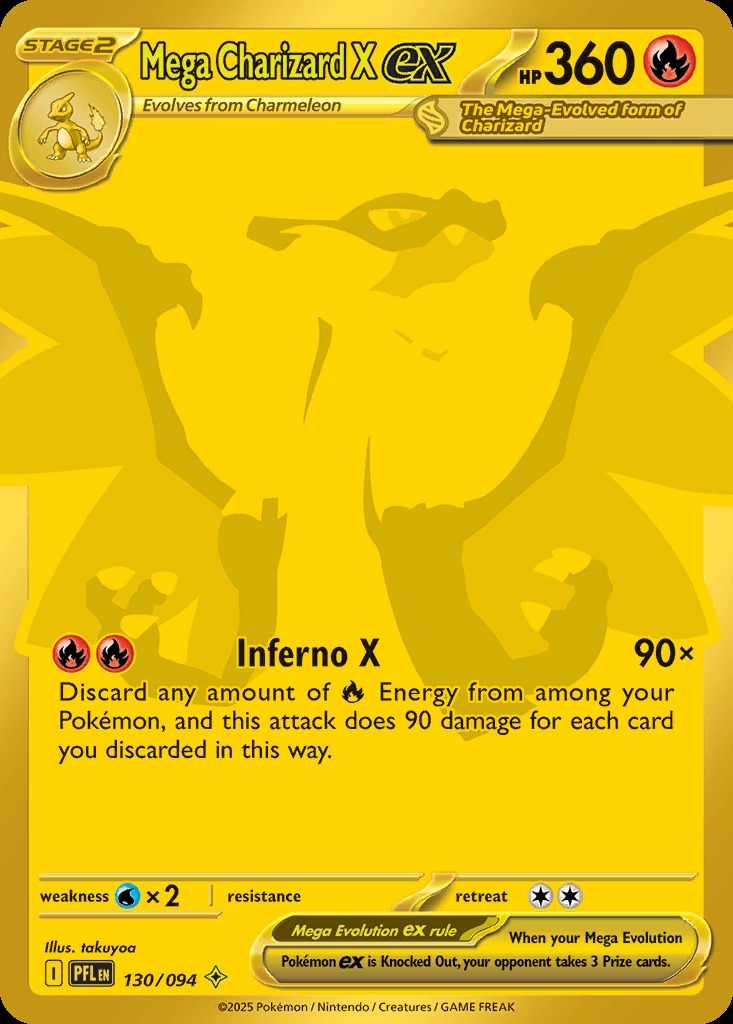
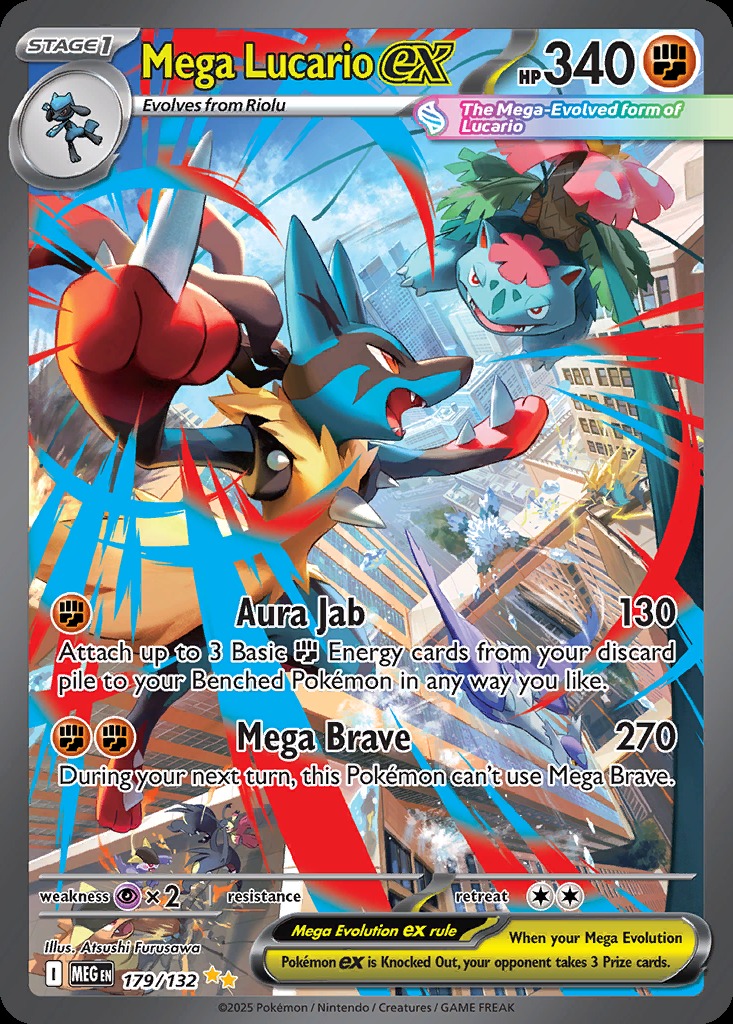
Image sources for this page: images.pokemontcg.io/me2/125_hires.png (Mega Charizard X ex, Special Illustration Rare), me2/130_hires.png (the same card as a Mega Hyper Rare) and me1/179_hires.png (Mega Lucario ex, Special Illustration Rare). Served from /wp-content/uploads/2026/10/. Card names and artwork are trademarks of Nintendo, Creatures Inc. and GAME FREAK inc.; scans are used here for identification and commentary.
Frequently asked questions
Is Mega Evolution back in the Pokémon TCG?
Yes, since September 2025. The mechanic returned after an eleven-year absence — Mega Charizard X ex had last appeared in the Flashfire set in 2014. The new version gives up three prize cards rather than two and is printed in portrait orientation rather than landscape.
What is a Mega Hyper Rare?
The gold rarity tier introduced with the Mega Evolution era, sitting above the Special Illustration Rare in the set list. It is the scarcest printing in a set and, unusually, currently trades below the Special Illustration Rare, which is the inverse of the historical relationship between scarcity and price.
How rare is Mega Charizard X ex?
The widely cited pull rate for the Special Illustration Rare #125 is roughly one in four hundred packs, which is about one per eleven booster boxes. A BGS 10 Black Label copy sold for $54,100 in March 2026, which reflects grade population rather than the ordinary market level.
Should I collect the new Mega era now or wait?
If you want the cards, buy them; sealed product still being printed is not scarce. If you are buying for scarcity, the structural opportunity in any era appears when printing stops, and this one has not stopped. That is a statement about supply, not a prediction about price.
Which era of Pokémon cards is the best investment?
Any answer to that is a judgement rather than a fact, and this page will not make one. What the timeline does show is which structures have historically produced scarcity: failed mechanics, small distribution, played competitive cards, and the window immediately after a set goes out of print.
Sources
Sources and further reading
- The Pokémon Company — Mega Evolution (me1, September 2025) and Phantasmal Flames (me2, 14 November 2025) set records.
- Phantasmal Flames set data — 130 cards, 94 main plus 36 secrets numbered 095 to 130, card faces reading PFL EN out of /094.
- The Pokémon Company Japan — Inferno X and the September 2025 MEGA Starter Sets, the source pools for Phantasmal Flames.
- Official card text — the three-prize Mega Evolution rule.
- Third-party market trackers — Mega Charizard X ex raw and PSA 10 ranges through 2026, including the March 2026 BGS 10 Black Label sale at $54,100.
- PSA population reports — Mega Evolution era cards by grade.
Related reading
- All twelve Pokémon card eras — the timeline this page closes.
- Era 8 — XY, 2013 to 2016 — the first Mega era, and the direct precedent.
- Era 11 — Scarlet & Violet, 2023 to 2025 — where the Art Rare tier came from.
- Era 10 — Sword & Shield, 2019 to 2023 — alternate art, and the modern price structure.
- Open or keep sealed — especially relevant at one chase card per eleven boxes.
- Storing sealed Pokémon boxes — corners, light and the wrap.
Nothing on this page is investment advice, and no outcome is promised for any card, era or product. This era is in progress: prices quoted are published third-party figures as of 2026 and are reference ranges, not offers, and the conclusions drawn from a thirteen-month record should be treated as provisional.
Where to go next
- The CardSpicy card index — every card we track, with its PSA 10 population and market history (195 cards).
- The illustrator index — every artist behind those cards, card by card (110 artists).