

Ace is the clearest teaching case in the One Piece Card Game for one rule: a second colour costs you life. He has four Leaders and their printed life totals run 5, 5, 4, 3 — each time the colour count grows, the life drops. That is not a coincidence of design, it is the trade the game offers, and Ace is where you can see it on four cards side by side. Here is our top 10, in rank order.
Quick answer
The ten Portgas.D.Ace cards that define the character are his four Leaders followed by the six Character cards at the top of his power curve. Ace has 22 Character cards and 4 Leaders across 21 products, 26 in total. Two Leaders are single-colour Red at 5 life; one is Blue/Yellow at 4; one is Red/Blue at 3. On the Character side the run is a single peak and a plateau: one card at 10,000 power, then nothing above 7,000.
This page does not rank by price. Our asking prices live on the product pages and move with the market; what is below is what the cards themselves state.
How this list was built
- Leader cards first. Four Leaders is enough to show the character’s whole structural range, and the life totals tell the story better than any Character card can.
- Leaders ranked by life, then first printing. That puts the two 5-life Red Leaders at the top, then the 4-life two-colour, then the 3-life two-colour.
- Character cards ranked by power, then cost. Ace’s curve is flat enough that the order is decided by the single 10,000-power card, then by cost within the 7,000 group.
Cards that name Ace alongside another character appear on this page and on the other character’s page. Playmats, don cards and sealed product are out of scope.
The top 10, ranked
1. OP03-001 — Red — Leader — 5 life — OP-03
The first Ace Leader, and the only one at full life with a single colour. If you want the card that represents Ace as a deck rather than as a supporting piece, this is it: everything later in the run is either a repeat of this shape or a trade against it.
2. OP16-001 — Red — Leader — 5 life — OP-16
The second single-colour Red Leader, thirteen main sets after the first. Two Red Leaders at identical life and identical power means the difference between them is text, not numbers — which is exactly the kind of decision a Leader slot forces on a deck builder.
3. ST13-002 — Blue/Yellow — Leader — 4 life — ST-13
The first two-colour Ace Leader, and the first life drop on this list: 4 instead of 5. It is also the only Ace Leader that pairs two colours without Red in either — Blue and Yellow, from a starter deck, and the only card in the run that ignores his primary colour entirely.
4. OP13-002 — Red/Blue — Leader — 3 life — OP-13
The second two-colour Leader and the lowest life total in the Ace run at 3. It is also the only Ace Leader printed at 6,000 power rather than 5,000 — the character’s one exception to the standard Leader frame. Three life for 6,000 power is the most aggressive trade in the index, and it is a single card.
5. OP07-119 — Yellow — 10 cost — 10,000 power — OP-07
The only Ace Character card above 7,000 power, and the only one at 10 cost. This card is the whole top of the character’s curve on its own: everything else Ace has printed sits three thousand power below it.
6. OP02-013 — Red — 7 cost — 7,000 power — OP-02
The earliest 7,000-power Ace card, from the second main set. With the peak out of the way, the rest of this list is the plateau — and the plateau starts here.
7. OP13-119 — Blue — 6 cost — 7,000 power — OP-13
A 6-cost 7,000 in Blue, which is one of the two colours the character is most printed in. Blue and Red both appear ten times across the 26 cards, and this is the first Blue entry on the list.
8. ST09-010 — Yellow — 6 cost — 7,000 power — ST-09
The second 6-cost 7,000 and the first Yellow Character card here. Yellow is the third-most-common Ace colour with six cards, and it supplies the 10,000-power outlier as well as this one.
9. ST13-011 — Yellow — 5 cost — 7,000 power — ST-13
A 7,000 at 5 cost, from the same starter deck as the 4-life Leader. Three of the ten cards on this page come from starter decks, which is a high share for a character with only 22 Characters in total.
10. PRB02-018 — Yellow — 5 cost — 7,000 power — PRB-02
The reprint-set entry. A card from PRB-02 is the same card as its original printing and differs only in which product it arrived in — same card number, different product is the page for that distinction, and it matters more here than the numbers do.
What the ten show
| What was counted | Result |
|---|---|
| Portgas.D.Ace Character cards | 22 |
| Portgas.D.Ace Leader cards | 4 |
| Total, across products | 26 in 21 products |
| Leader life totals | 5, 5, 4, 3 |
| Character cards above 7,000 power | 1 |
| Highest printed cost | 10 |
| Colours across all 26 | Red 10, Blue 10, Yellow 6, Green 1, Black 1 |
The Leader column is the useful one. A single-colour Ace Leader starts at 5 life. Add a second colour and it becomes 4. The other two-colour Leader drops to 3, with the power rising to 6,000 to compensate. Four cards, three different trades, one clear rule.
The Character column is nearly the opposite: no such gradation, just one card at 10,000 and twenty-one at 7,000 or below. Ace is a character whose deck-building is varied and whose card bodies are not.
Where these cards were printed
| Product | Card | Type | Colour | Cost / Life | Power |
|---|---|---|---|---|---|
| OP-03 | 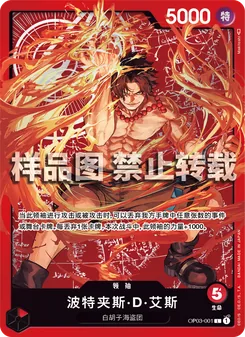 OP03-001 |
Leader | Red | 5 life | 5,000 |
| OP-16 | 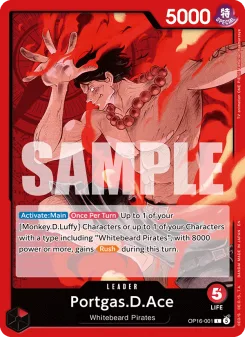 OP16-001 |
Leader | Red | 5 life | 5,000 |
| ST-13 | 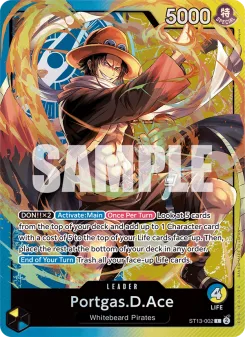 ST13-002 |
Leader | Blue/Yellow | 4 life | 5,000 |
| OP-13 | 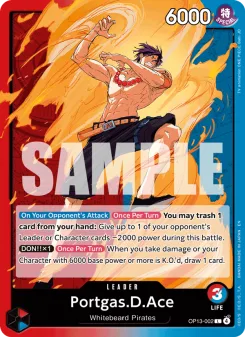 OP13-002 |
Leader | Red/Blue | 3 life | 6,000 |
| OP-07 | 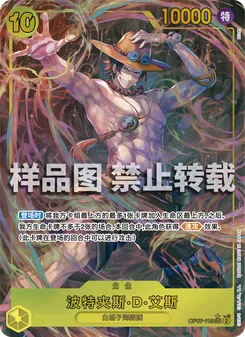 OP07-119 |
Character | Yellow | 10 | 10,000 |
| OP-02 | 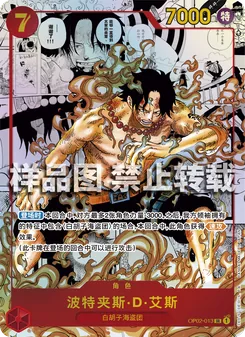 OP02-013 |
Character | Red | 7 | 7,000 |
| OP-13 | 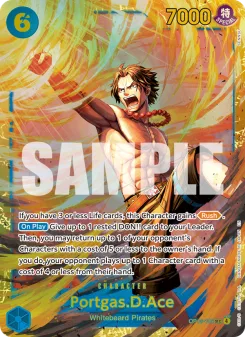 OP13-119 |
Character | Blue | 6 | 7,000 |
| ST-09 | 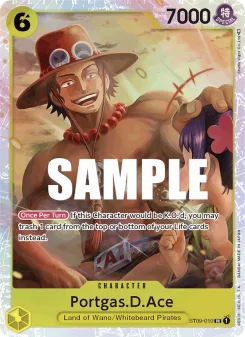 ST09-010 |
Character | Yellow | 6 | 7,000 |
| ST-13 | 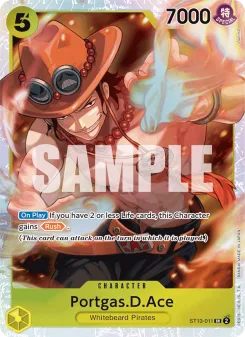 ST13-011 |
Character | Yellow | 5 | 7,000 |
| PRB-02 | 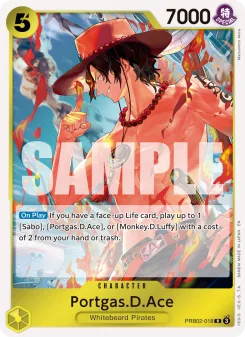 PRB02-018 |
Character | Yellow | 5 | 7,000 |
Five different main sets appear here — OP-02, OP-03, OP-07, OP-13 and OP-16 — plus two starter decks and a premium reprint set. That is a normal spread for a supporting character, and it is the reason a complete Ace run is harder to assemble than the card count suggests.
If you want one card
Take OP03-001. It is the first Ace Leader, the only one at full life in a single colour, and the cleanest statement of the character as a deck. If you want the outlier instead, take OP13-002 — 3 life, 6,000 power, the only Ace Leader with either of those numbers and the most aggressive card in the run.
Where to go next
- The full list — all 22 Character cards and four Leaders, with colour, cost, power and counter, is on Every Portgas.D.Ace card in the One Piece Card Game.
- Why the second colour costs life — Multicoloured Leaders covers the rule across all fifteen colour pairs.
- Protecting what you buy — One Piece cards are 63 × 88 mm. Sleeves and holders for One Piece cards has the sizes.
Frequently asked questions
How many Portgas.D.Ace cards are there?
Bandai lists 22 Portgas.D.Ace Character cards and 4 Leader cards, 26 in total, spread across 21 products.
Why do the Ace Leaders have different life totals?
Because a second colour costs life. His two single-colour Red Leaders print at 5 life, the Blue/Yellow Leader prints at 4, and the Red/Blue Leader prints at 3 — with power rising to 6,000 on that last one to offset it. Four Leaders, three different trades.
What is the highest power Portgas.D.Ace card?
10,000, on OP07-119, a 10-cost Yellow Character card. It is the only Ace card above 7,000 power; every other Character card in the run sits at 7,000 or below, which makes the character a single peak rather than a curve.
Which colours is Portgas.D.Ace printed in?
Red and Blue are the two main colours, with 10 cards each across the 26, followed by Yellow on 6. Green and Black appear once each. His four Leaders span Red, Blue and Yellow between them.
Sources
Sources and further reading
- CardSpicy — Every Portgas.D.Ace card in the One Piece Card Game, the source of every card number, colour, cost, life and power on this page.
- Bandai — the official One Piece Card Game card database, for card numbers and printed values.
- CardSpicy — Multicoloured Leaders, for what a second colour costs.
- CardSpicy — Same card number, different product, for the PRB reprint distinction.
- CardSpicy — One Piece card index, for leaders, rarities and the set list in one place.
Other character rankings
- Monkey.D.Luffy — seventeen Leaders, the widest structural run in the game.
- Roronoa Zoro — two Leaders and eight Characters.
- Shanks — three Leaders and five cards at 12,000 power.
- Trafalgar Law — four Leaders, one of them single-colour Red.
- Nami — three Leaders, all Blue or Blue-based.
- Sanji — three Leaders and the highest-cost Character in the crew.
Related reading
- Multicoloured Leaders — all fifteen colour pairs and their life totals.
- Character traits on One Piece cards — where Ace sits in the trait system.
- How to start a One Piece card collection — the character route.
- One Piece card set codes — every prefix used above.
- Grading One Piece cards — what a grade does to a Leader.
- The Collector’s Index — storage for everything on this page.
Card numbers, colours, life totals, costs and power values are quoted from Bandai’s published card database as indexed on our own character page at the date shown. Prices are not quoted on this page: our asking prices for what we hold are on each product page, and they move with the market.
Where to go next
- The CardSpicy card index — every card we track, with its PSA 10 population and market history (195 cards).
- The illustrator index — every artist behind those cards, card by card (110 artists).
Leave a Reply