

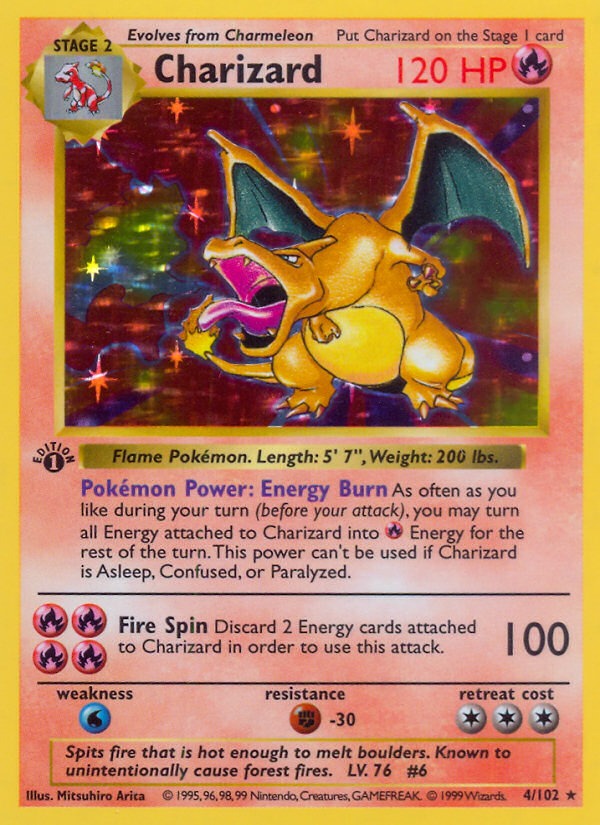
Grading companion to Era 1, the Base Set era. Part of the twelve-era timeline. This page quotes no prices or population figures; it explains the structure that decides whether a submission makes sense.
Quick answer
The gem-mint population on old-back cards is fixed, because nobody is opening 1999 boxes to make more of them, and that is why the step from a 9 to a 10 here behaves like a multiple rather than a percentage. Grading is a supply question before it is a condition question. On a modern card, every box opened adds fresh candidates, so the number of top grades keeps growing while you hold the slab. On a Base Set card the pool closed years ago: the only route to a new gem-mint copy is for an existing raw card to be submitted, and every one that goes in leaves the raw pool a card smaller.
That is the whole structure, and it is the only era where the arithmetic of a submission does not rest on a forecast, because one side of the equation cannot move. The rest of this page is about the other side — which raw cards are worth the fee, and which are a donation.
What a closed population actually changes
A grade is four sub-assessments: centring, corners, edges and surface. On old-back stock three of those are decided by how the card was manufactured rather than how it was kept, and the fourth by how it was handled in a period when almost nobody used a sleeve.
The printer’s centring tolerance was wider then than it is now. A card that left the factory with a visibly heavier left margin was not a defect in 1999; it was Tuesday. The cut edge is the second problem: old-back stock is a white core with printed layers on either side, so any wear exposes white, and one rub at a corner reads as a bright spot against a dark border. The third is the foil, laminated in as a separate sheet and scratched by a single slide across a table. Those scratches are directional — visible at one angle, gone at another — which is why they are near-invisible in a photograph and unmissable under a grading lamp.
Put together, the era is a large raw population, a small clean population, and a top grade that can only be enlarged by consuming the clean cards.
What decides the outcome on an old-back card
The table is the submission decision compressed. Read the third column first: almost nothing here is fixable, and the one thing that sometimes is carries more risk than the defect.
| Factor | Where it shows | Fixable? | How much it decides |
|---|---|---|---|
| Centring | Uneven yellow margin, front and back | No | Sets the ceiling before surface is assessed; the era’s tolerance was wide |
| Edge whitening | White core along the cut edge, heaviest at corners | No | The usual reason a clean-looking card tops out mid-scale |
| Holo scratching | Faint directional lines inside the art window | No | Decisive under a lamp, invisible in most photographs |
| Print lines | Straight faint lines running with the grain of the foil | No | Present since manufacture and still counted as surface |
| Surface haze | Milkiness or a fingerprint ghost on the gloss | Rarely, and badly | Cleaning converts a small defect into a large one |
| Creases | A line that shows at one angle and vanishes at another | No | Ends the submission outright |
An old-back card is therefore not assessed the way a modern card is. You are looking for the absence of manufacturing variance, which is a far smaller population than “no damage” — and because the failures were decided in 1999, the population of the top grade does not move.
The three printings are three different submissions
1st Edition, Shadowless and Unlimited are three print runs, not three conditions, and they behave differently at the grading stage because their raw pools differ in size.
1st Edition is the earliest and most handled, and it has the widest condition spread: a large share were played, a thin share were put away by adults who treated them as collectibles. That bimodal pool leaves the middle of the scale crowded, so a mid-grade 1st Edition submission adds to the densest part of the population. Shadowless sits between the two — short run, identified by the missing drop shadow behind the art box, and fewer raw survivors. Its logic is closer to 1st Edition, with one caveat: identification has to be certain before the card goes in an envelope.
Unlimited is the deep pool, the printing most likely to turn up raw in a binder or a deck box, and the one where a mid-grade submission most often costs more than the grade it earns. A fourth variable cuts across all three: holo versus non-holo. A non-holo common, uncommon or rare is not a candidate below the top grade, because the top is not scarce enough to make the slab meaningfully different from the raw card.
Five checks before an old-back card goes in a submission
- Measure the border on all four sides, front and back. Centring is the only sub-assessment you can settle before spending anything. An offset on the back that was invisible in the listing is the most common surprise on a returned slab.
- Tilt the card under a single point light and look only at the foil window. A scratch appears and disappears as you rotate; a print line stays visible from every angle. Both cost surface, but only one is your fault, and knowing which tells you what the card can reach.
- Look at the cut edge against a dark background. Hold the card at a shallow angle so the edge catches light. Whitening reads as a bright, slightly fuzzy line rather than a scuff.
- Separate lines that move from lines that do not. A crease or a bend shows at one angle and vanishes at another, usually with a faint break in the gloss. If you find one, stop.
- Inspect the back as carefully as the front. The blue back border scuffs, and scuffing there counts exactly as much. A clean face with a scuffed back is a mid-grade card.
What should stay raw
A raw card in a sleeve is still the same card; a slab does not improve it, it changes who can see it. Played cards below the middle of the scale, non-holos from the Unlimited printing, and anything with a crease are straightforward passes. Duplicates are the quiet trap: three copies submitted in the hope of one high grade produce three slabs of the same card. The harder case is the card that looks clean and might not be — that is not a submission, it is a question, and the grader’s lamp is better than yours.
Storing old-back cards before and after grading
An old-back card has three physical weaknesses, and they pull against each other when you try to store it.
It is thin. The stock is lighter than modern card stock, so it takes a set — a curl along the short axis is normal after two decades in a stack — and it dents at the corner under pressure a modern card would shrug off. Storing it flat under weight does not remove an existing curl, and the risk to the corners is higher than the cosmetic gain.
The foil window scratches on contact, which is why the first layer has to be a sleeve rather than a rigid holder. A matte premium sleeve stops the surface touching anything else and stops the card sliding inside its holder. Matte rather than glossy matters here, because a glossy sleeve face and a scratched holo look similar at a glance.
The cut edge frays. Every insertion into a tight holder abrades the edge against the holder’s opening, and on old-back stock that shows as fresh white. A card you intend to keep raw is better served by a press-fit rigid case, which closes around the card instead of sliding over it. A rigid 3×4 toploader is the standard second layer and is fine mid-scale, but the insertion is the moment of risk. If the card is going on a shelf, a display slab does the same job while keeping the face visible.
None of these solve humidity. Old-back board has no barrier layer and takes moisture in and out with the seasons, which is the mechanism behind the wavy edge on an old box flap and the faint ripple you sometimes see across an old card. A stable interior room beats a garage, and a closed bin without desiccant is worse than an open shelf.
Where this sits
The Base Set era is the first of the twelve, so this line has no predecessor. Its nearest neighbour is the e-Card grading page, which covers the three sets printed between 2001 and 2003 and reaches almost the opposite conclusion about which cards deserve a submission. For the card-level story, start at Era 1; for the wider frame, the twelve-era timeline.
Frequently asked questions
If the population is closed, should every raw old-back card be graded?
No. A closed population describes supply across the era; it says nothing about the card in your hand. The binding constraint on most raw copies is a margin, an edge or a scratch that existed before you owned it.
Is a 9 on an old-back card a failed submission?
That depends on the printing. On a 1st Edition card the middle of the scale is crowded and a 9 is an ordinary result; on a card from a short run with few raw survivors, a 9 can be the realistic target. The number only means something next to the population it sits in.
Do the three printings grade differently?
The standard is identical; the pools are different sizes. The same condition produces the same grade in all three — what changes is what that grade is worth against the fee.
Can a creased card still be encapsulated?
It can, and the grade will reflect the crease. On this era a visible crease puts the card at the bottom of the scale however clean the rest of it is, so the slab adds a holder and not much else.
Is centring weighted more heavily on old-back cards?
Not by the standard; it is simply more often the binding constraint. The printer’s tolerance here was wide, so a larger share of survivors are held back by a margin rather than by wear.
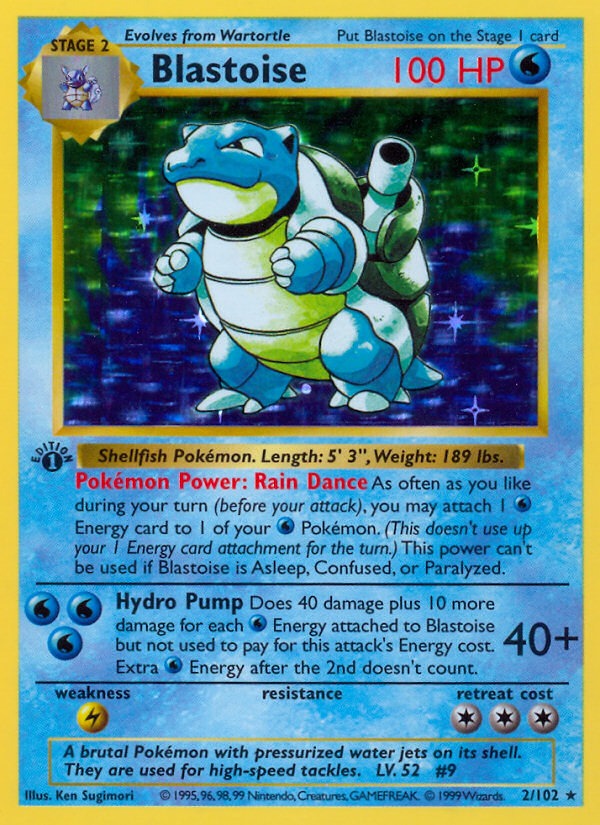
What the cards in this era actually look like
The defects that decide an old-back grade are all visible on the face, provided the light is at the right angle. These are the three surfaces to learn.

Sources
Sources and further reading
- The Pokémon Company — Japanese Expansion Pack, released 20 October 1996; the start of the old-back era.
- Wizards of the Coast — English Base Set, released 9 January 1999; 102 cards, eleven cards per pack, 36 packs per booster box.
- Wizards of the Coast — the 1st Edition, Shadowless and Unlimited print sequence, 1999–2000.
- CardSpicy — Reading a population report, for how a report is structured and what it does not tell you.
- CardSpicy — PSA vs BGS vs CGC, for how each company weights the four sub-assessments.
- CardSpicy — Era 1 — Base Set, 1996 to 2001, for the card-level history this page assumes.
Related reading
- Era 1 — Base Set, 1996 to 2001 — the card-level story and the three printings.
- Grading e-Card cards — the next era, and the opposite conclusion about which cards to send.
- All twelve Pokémon card eras — the timeline.
- Reading a population report — the document that makes this era legible.
- PSA vs BGS vs CGC — how the sub-assessments differ between companies.
- Sealed Base Set product — why the supply side of this era is closed.
Nothing on this page is investment advice, and no card or grading service is offered for sale here. Grades are assigned by third-party companies; the descriptions of wear, population structure and era printing are structural and are not population figures or prices.
Where to go next
- The CardSpicy card index — every card we track, with its PSA 10 population and market history (195 cards).
- The illustrator index — every artist behind those cards, card by card (110 artists).
Leave a Reply