

Grading companion to Era 8, the XY era. Part of the twelve-era timeline. This page quotes no prices and no population figures; it explains the structure that decides whether a submission makes sense.
Quick answer
This era contains both original cards and deliberate reprints of the oldest cards in the hobby — Evolutions restates Base Set — so the first question before any submission is which version you are holding, because a submission spent on the wrong one is a submission wasted at the same fee. The two prints share artwork and, at a glance, composition. They do not share a set, a print run, a population, or a reason to be in a slab. Identification is the whole decision here; condition comes second, which is true of no other era in this sequence.
The trap is not that the reprint is bad. It is that the reprint is convincing, and that the cards most likely to be submitted from this era are precisely the ones that were reprinted. A collector who knows the artwork well is the most exposed, because recognition is faster than verification and it is the thing that fails.
Why a reprint era behaves differently
Every era before this one had a single version of any given card. A Base Set Charizard was a Base Set Charizard; the only variables were which printing of the run it came from, and that is a question about supply within one card. Evolutions changed the shape of the question by producing a second card with the same picture, the same Pokémon and the same nostalgic purpose, printed sixteen years later for a different market.
Three things follow. The raw pool for the reprint is large and mostly pack-fresh, because it was opened by adults who bought it for exactly this reason. The raw pool for the original is small and mostly handled, for the reasons covered on the Base Set grading page. And the two pools are priced against different demand, so the same grade on the same artwork means two different things depending on which card carries it.
That is the structural point: identification is not a preliminary step before the real decision. Here it is the decision.
Telling the original from the reprint
The table uses features that are printed on the card and require no equipment. Work down it; the first three rows settle it in almost every case.
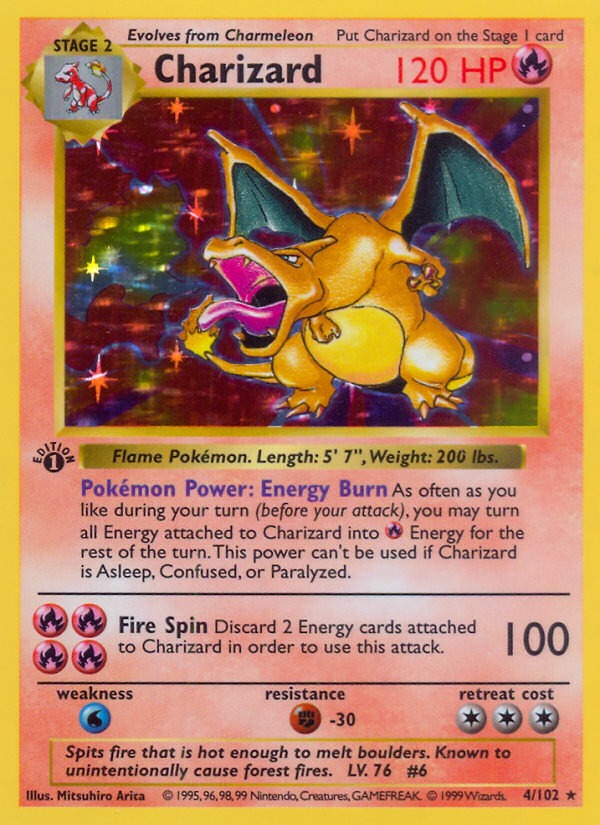
| Feature | Base Set original (1999) | Evolutions reprint (2016) |
|---|---|---|
| Set symbol | None — the set predates set symbols entirely | Present, printed beside the card number |
| Card number and total | Out of 102 | Out of a larger set total |
| Copyright strip | Names Wizards of the Coast | Names The Pokémon Company and a 2016 date |
| Reverse holo | Does not exist for the set | Exists, which makes a reverse copy obviously the reprint |
| Layout and type | Older layout: different HP placement, different body type | Modern layout applied to the old artwork |
| Stock and finish | Thinner, softer, foil window only | Stiffer, with the modern finish |
The set symbol row is the decisive one, and it is decisive in a way people do not expect: the original’s absence of a symbol is a feature, not a missing detail. If you are looking at a Base Set–style card and there is a symbol next to the number, you are not looking at a Base Set card, whatever the artwork says.
Five checks before an XY card is submitted
- Read the card number and the total. The total is the fastest identifier, because it belongs to the set rather than the card, and a set total that does not match the era’s original tells you what you have in one glance.
- Look for a set symbol at all. Absence is informative on the oldest sets. Presence is informative on everything after them.
- Read the copyright strip along the bottom. It names the company and the year, and it is printed small enough that most people never look at it.
- Check whether the card exists in reverse holo. If it does, it is from a modern set, because the older printings had no such thing.
- Check the same Pokémon at other card numbers in the same set. Modern sets often print one Pokémon at more than one number, and those are different cards rather than variants of one. Confirm the number you have, not the artwork you recognise.
What else this era asks of a submission
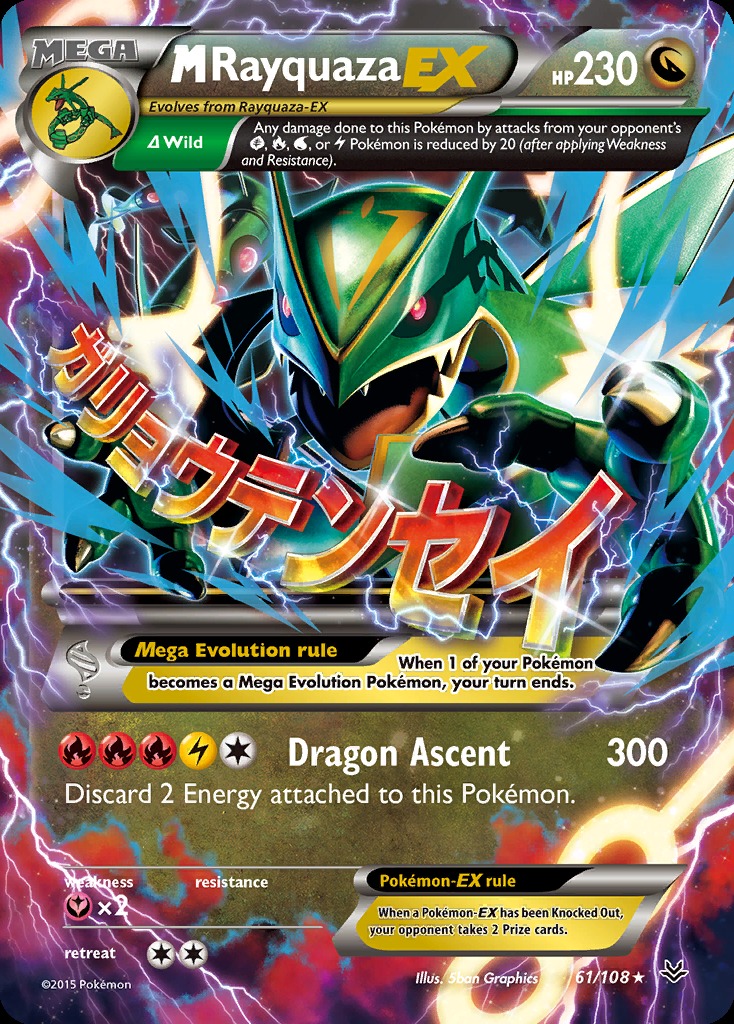
Beyond the reprint question, the XY era has one physical characteristic worth knowing: its full art and Mega Evolution cards use a deeper etched texture than the previous era’s foil. The texture is part of the design and it does two things at the grading stage.
It holds dust. The recesses in the pattern collect fibre and skin oil, and a wipe moves material along the surface rather than lifting it out, which is why a card that has been wiped repeatedly can look duller than one that has not been touched. It also makes a scuff legible: a mark that interrupts the texture is easier to see than a mark on a smooth foil, because the texture gives the eye a regular pattern to compare against.
Condition on this era is therefore mostly a story about contact. A card that went from pack to sleeve and stayed there is clean; a card that was taken out to be looked at a few times is not, and the difference is usually in the texture rather than in the corners.
Storing textured XY cards
The problem is that the texture is a trap for particles and the fix is not to rub it.
Once dust is in the texture, wiping redistributes it and can leave a directional sheen that reads as surface wear. The correct approach is to prevent it entering: keep the card in a clean sleeve from the start, handle it by the edges, and replace the sleeve if it has been open to the air for a long period. A matte premium sleeve is the right first layer, and the matte face makes the texture easier to see without a competing reflection.
For the holder, a press-fit rigid case is the better choice on a textured card than a slide-in holder, for two reasons: the card is not abraded on the way in, and the case holds it flat without pressing the texture against a plastic face. A rigid 3×4 toploader is the standard for a submission in transit and is fine for that purpose, provided the card is sleeved first.
If the card is going on show, a display slab keeps the texture visible, which is the only reason to own a card with this finish. And if the card is one of the older originals rather than a reprint, the storage advice changes: those want the cooler, drier, more stable treatment described on the Base Set page.
Where this sits
This page follows the Black & White grading page, where the assessed area grew to the whole face, and precedes the Sun & Moon grading page, where the information density of a single card reaches its peak and print defects become easier to see. This is the first page in the sequence where the card has to be identified before it can be assessed. For the card-level story, see Era 8; for the full sequence, the twelve-era timeline.
Frequently asked questions
Is an Evolutions card worth grading at all?
It can be, on its own terms, as a modern card in good condition. What it is not is a substitute for the original, and the fee is the same either way, so the decision has to be made about the card you actually hold.
How can I be certain which version I have?
Read the number and total, the copyright strip and the set symbol. Any one of the three settles it; all three together leave no room for a mistake.
Does a reprint affect the original’s population?
Not directly — a reprint is a different card and is counted separately. What it affects is demand, because buyers who want the artwork now have two ways to get it.
Are the Mega Evolution cards from this era hard to grade?
They are ordinary full-face foil cards with a deep texture, so the surface logic of the previous era applies. The texture makes a scuff easier to spot, which cuts both ways: easier for you to check, easier for a grader to find.
Can a card be re-slabbed if it was submitted as the wrong version?
The card is graded as what it is, not as what was claimed. A label error is correctable; a submission of the wrong card is simply a fee spent on a card you did not intend to grade.
What the cards in this era actually look like
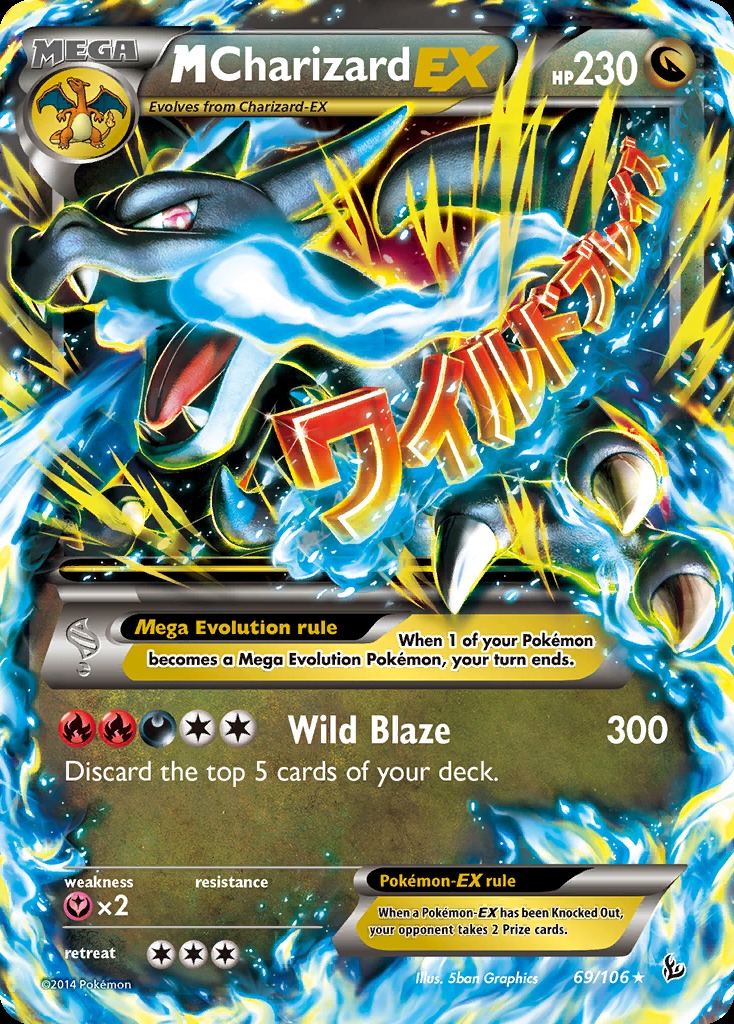
Two cards from the era, and the comparison that matters most: the original and the reprint of the same artwork.
Sources
Sources and further reading
- The Pokémon Company — the XY series, 2013 to 2016, including the Mega Evolution card class.
- The Pokémon Company — Evolutions, 2016, a deliberate restatement of Base Set within the XY series.
- Wizards of the Coast — English Base Set, 1999; 102 cards, printed before set symbols were introduced.
- CardSpicy — The Pokémon set code guide, for reading set symbols and card numbers.
- CardSpicy — PSA vs BGS vs CGC, for how a card is assessed once it is correctly identified.
- CardSpicy — Era 8 — XY, 2013 to 2016, for the card-level history this page assumes.
Related reading
- Era 8 — XY, 2013 to 2016 — Mega Evolution and the Evolutions reprint.
- Grading Black & White era cards — the previous era, where surface took over.
- Grading Sun & Moon era cards — the next era, and the densest text on a card.
- All twelve Pokémon card eras — the timeline.
- The Pokémon set code guide — reading the symbols that settle this question.
- Sealed XY product — where the reprint pool came from.
Nothing on this page is investment advice, and no card or grading service is offered for sale here. Grades are assigned by third-party companies; the descriptions of printing, identification and storage are structural and are not population figures or prices.
Where to go next
- The CardSpicy card index — every card we track, with its PSA 10 population and market history (195 cards).
- The illustrator index — every artist behind those cards, card by card (110 artists).
Leave a Reply