


Sealed companion to Era 6, LEGEND and HGSS. Part of the twelve-era timeline. Structural analysis only; no sealed prices quoted.
Quick answer
The LEGEND era has the worst combination of properties in the hobby’s sealed history: the weakest box construction and the strongest reason to open one. HeartGold & SoulSilver-era product shipped in thinner board with a tighter shrink wrap than anything before it, so the boxes deform under their own storage. At the same time, the era’s signature cards — LEGEND cards — require two specific halves to form a single card, which gives a buyer a reason to open multiple boxes that no previous era had given them.
So this is the era where sealed survival is depressed by two independent causes at once. Not because it was printed in small volume, and not because the market was weak. Because the boxes were easier to open and worse at surviving being kept.
The product line, and the two-half problem
The era ran five English sets from February 2010 to early 2011, plus the Call of Legends set at the end. The sealed line looks conventional, but the contents do not.
| Set | Release | Sealed formats | What makes it different |
|---|---|---|---|
| HeartGold & SoulSilver | February 2010 | 36-pack box; theme decks; tins; blisters | Introduces LEGEND cards, which are printed across two card numbers |
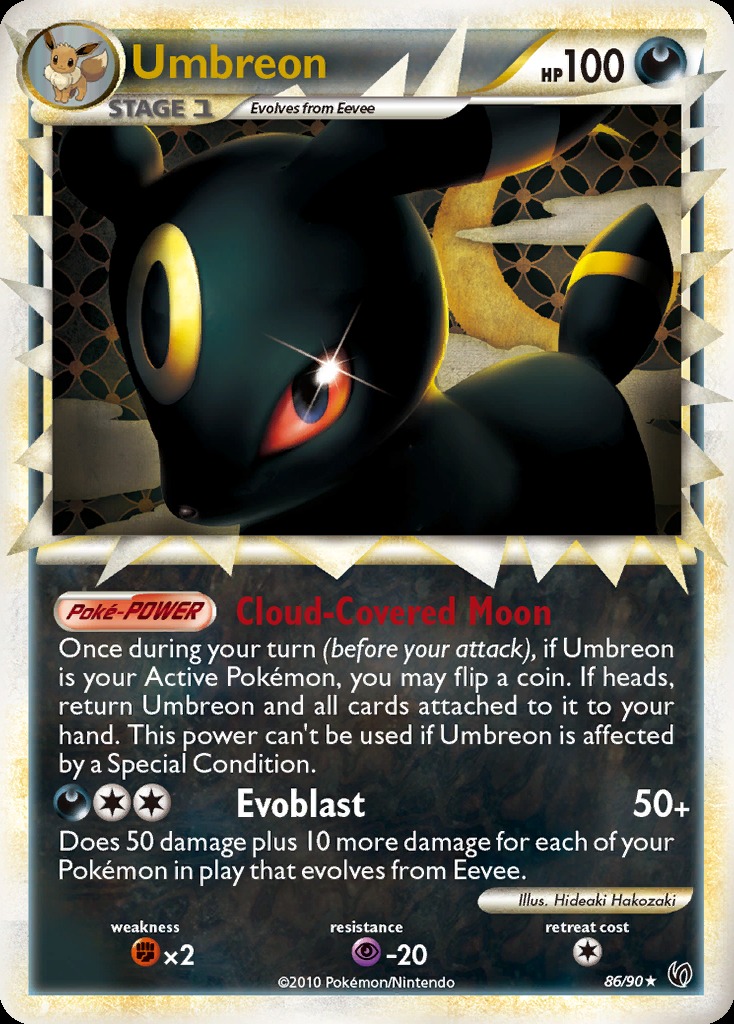
| Unleashed | May 2010 | 36-pack box; theme decks; tins | Continues the two-half structure; Prime cards debut |
| Undaunted | August 2010 | 36-pack box; theme decks | Prime cards at their densest |
| Triumphant | November 2010 | 36-pack box; theme decks | Last set of the main run |
| Call of Legends | February 2011 | 36-pack box | Reprint set with a foil treatment unique to it |
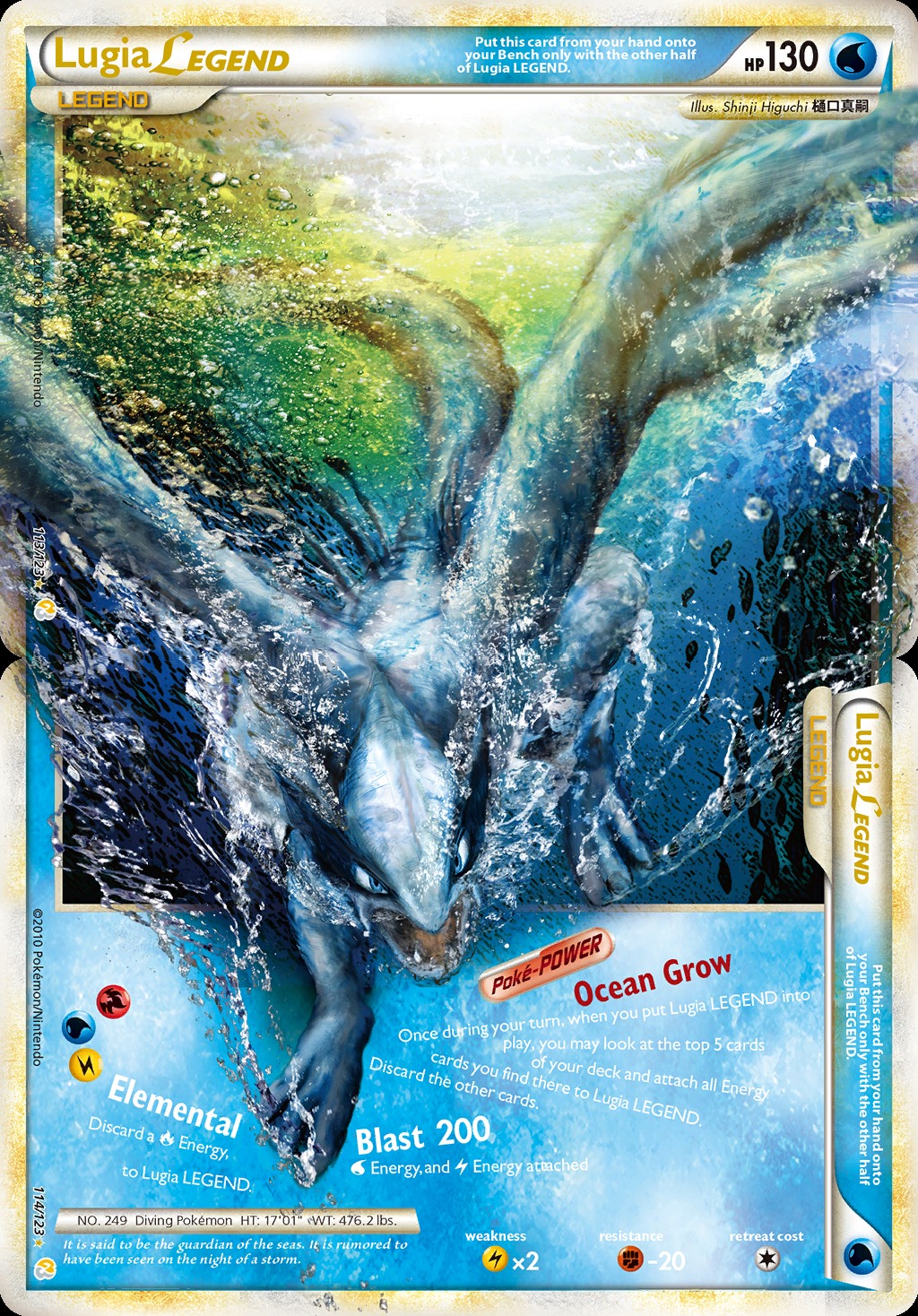
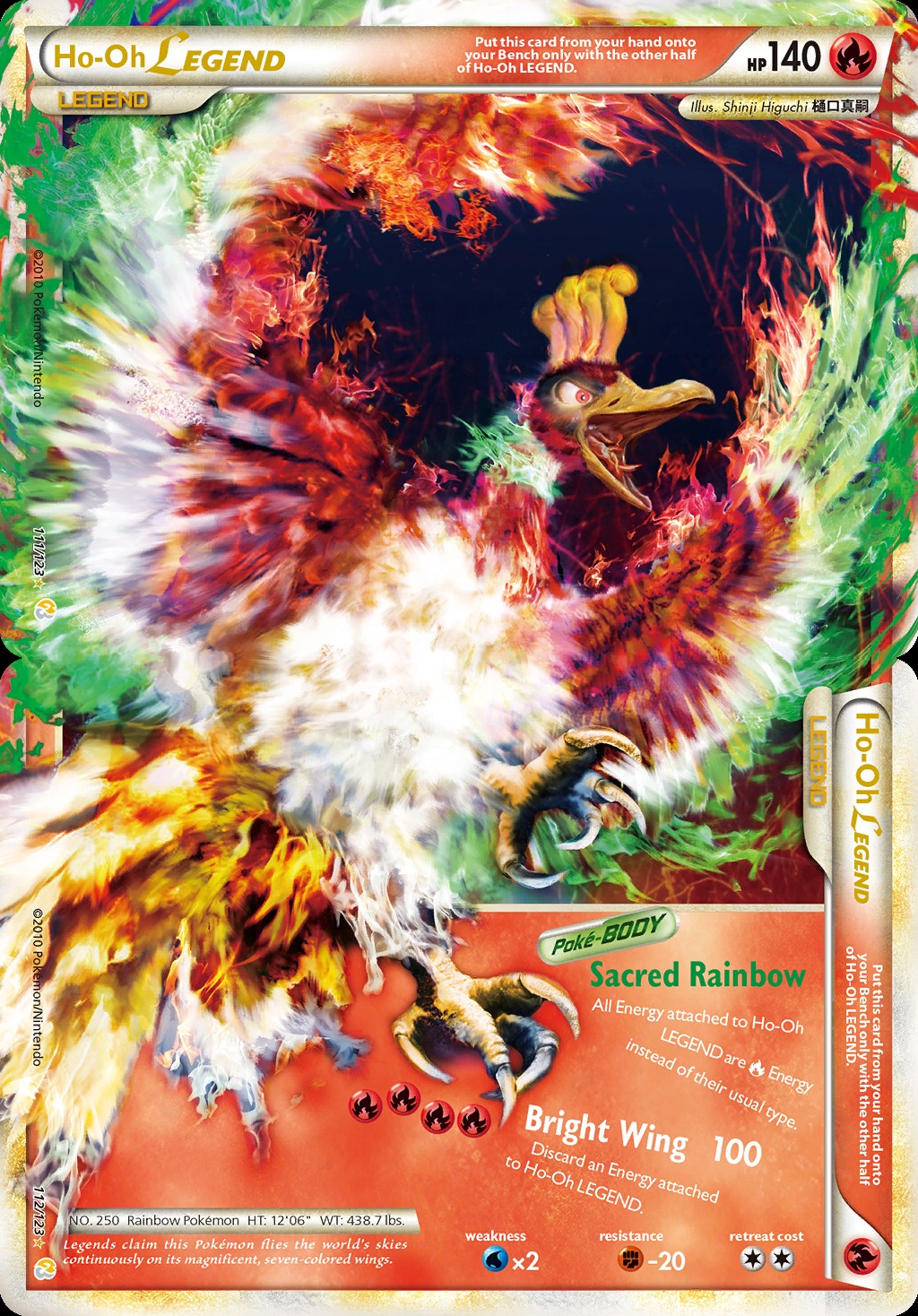
The two-half structure deserves a paragraph of its own, because it changes what a box is for. A LEGEND card is printed as two separate cards — for example, the two halves of Lugia LEGEND occupy numbers 113 and 114 of the same set. Each half is useless alone: the illustration only resolves when the two are stacked, and the card only functions in play when both are present.
That means a collector chasing one LEGEND card needs to pull two specific cards from the same set. The odds of pulling both from a single box are low, so the rational response is to open more boxes or to buy from the secondary market. Either way, boxes get opened. This is the first era where the card design itself created opening pressure.
Why these boxes are physically the weakest
Three construction choices from this era combine badly.
- Thinner board. The box stock is lighter than the Diamond & Pearl era. Lighter board deforms more under stacking and takes a permanent set faster.
- Tighter shrink wrap. The wrap was applied with more tension, which holds the box in shape while the wrap is intact but means the board is under continuous load. Once the wrap relaxes, the box relaxes with it.
- Larger display windows and cut-outs. The era used more die-cut openings in the front face, and every cut-out is a weak point where the board can delaminate.
The visible result is a box that looks fine in a photograph and feels soft in the hand. The characteristic failure is a belly: the long faces bow outward and the top flap no longer sits flush. On a stronger box this is cosmetic. Here it means the flap has lifted slightly and the wrap is under tension at the seam, which is exactly where it splits.
The second failure is delamination at the cut-outs. The printed layer separates from the board around the die-cut edges, and it starts as a white line that widens. It is not reversible and it does not indicate tampering — but it does mean the box cannot be described as sound.
How to assess one of these boxes
- Put it on a flat surface and look along the long edge. A belly is immediately visible and it tells you whether the flap is under tension.
- Check the wrap at the flap seam, not the corners. The corners split first on older eras; here the seam goes first because of the wrap tension.
- Look at the die-cut edges for a white line. That is delamination, and it should be disclosed rather than hidden.
- Weigh it. The thinner board makes the weight band narrower than on earlier eras, so this check is more precise here than elsewhere.
- Read the print code on the bottom. The five sets shipped in five windows across twelve months; an off-window code is a strong signal.
What is actually scarce here
Booster boxes from this era are available, and they are not expensive relative to the eras either side. The scarce units are different.
- Intact tins with the promo. The tins were bought for the promo and the packs, and the tin itself was discarded. An intact tin with its original insert is scarcer than a box.
- Blisters on their original card. These were retail-only and almost never kept. A blister whose cardboard is flat, uncreased and unpunched is genuinely hard to find.
- Call of Legends boxes. The set was a reprint set released late in the cycle, and it was not treated as a milestone at the time. It is the shortest-lived product of the era.
That is the recurring pattern across this whole series of pages: in every era, the scarce unit is not the box. It is whichever format had the least reason to be kept.
Storing this era’s product
Because the board is light and the wrap is tight, storage is about preventing deformation rather than preventing damage. Store these boxes flat with the weight distributed across the face, not resting on the flap edge. Do not stack more than two high, and do not put anything heavy on top, because the board will take a set and the set is permanent.
Humidity is a real concern here for the same reason as the base set era — plain board, no barrier — and the light board absorbs faster. A stable interior room is better than a garage, and a closed plastic bin with no desiccant is worse than an open shelf.
For the LEGEND cards themselves, the storage question is unusual: the two halves want to be kept together but they are two separate cards, and the illustration does not resolve unless they are stacked in the right order. Keep them as a pair, stacked in the correct orientation, in a single rigid toploader sized for one card — they are thin enough that two will fit without flexing — and then sleeve the pair in a matte sleeve. Do not store the halves separately; separated halves are how pairs get broken up and sold at a discount.
For a pair you want to display as one image, a display slab holds the pair as a single unit and keeps the seam aligned. That is the only format in the hobby where a display case solves a structural problem rather than a cosmetic one.
Prime cards are ordinary-thickness holos and take the standard two layers. Loose packs from this era crease easily because the wrapper is thin; a rigid pack holder or a metal pack storage box is the practical answer.
Where this sits
The LEGEND sealed line follows the Diamond & Pearl sealed page, where the format count exploded, and is followed by the Black & White sealed page, where collectors started keeping boxes on purpose and the survival rate jumped. For the card-level story see Era 6.
Frequently asked questions
What is a LEGEND card?
A card printed across two separate card numbers that only forms a complete illustration and a complete playable card when both halves are present. The two halves are stacked, not placed side by side.
Is a LEGEND card worth half as much if I only have one half?
Less than half, in practice. The half has no standalone use and no complete illustration, so the only buyer is someone who already holds the matching half. That is a much smaller market.
Why does this era’s packaging feel softer than the era before it?
The board stock is lighter and the wrap was applied with more tension. The box holds its shape while the wrap is intact and relaxes when it is not.
What is the scarcest sealed product from this era?
Intact tins with their original promo and flat blisters on their original card. Booster boxes are the common unit, contrary to what most people assume.
Does a bowed box mean it was opened?
No. A belly is a normal consequence of light board under a tight wrap. What matters is whether the wrap at the flap seam is continuous.
What this era’s product actually looks like
The LEGEND treatment is the only card in the hobby that is incomplete on its own, and the two halves read as one image only when stacked.
Sources
Sources and further reading
- Nintendo — HeartGold & SoulSilver, February 2010; Unleashed, May 2010; Undaunted, August 2010; Triumphant, November 2010; Call of Legends, February 2011.
- Nintendo — the LEGEND card type, printed across two card numbers, 2010.
- CardSpicy — Era 6, for the LEGEND and Prime tiers in full.
- CardSpicy — What is in a Pokémon booster box, for 36-pack configurations.
- CardSpicy — Gift box vs booster box, for the tin and collector-box formats.
- CardSpicy — How to spot a resealed box.
Related reading
- Era 6 — LEGEND and HGSS, 2009 to 2010 — two-card cards, and why half a card is not worth half a price.
- Sealed Diamond & Pearl product — the era before, and the format explosion.
- Sealed Black & White product — where keeping boxes became deliberate.
- All twelve Pokémon card eras.
- Gift box vs booster box — the format difference that decides what survives.
- Does a slab fit in a binder? — for storing a graded LEGEND pair.
Nothing on this page is investment advice, and no sealed product is offered for sale here. Release dates are as published by the manufacturer; construction descriptions are observational and are not manufacturing-defect claims.
Where to go next
- The CardSpicy card index — every card we track, with its PSA 10 population and market history (195 cards).
- The illustrator index — every artist behind those cards, card by card (110 artists).
Leave a Reply