


Grading companion to Era 3, the EX era. Part of the twelve-era timeline. This page quotes no prices and no population figures; it explains the structure that decides whether a submission makes sense.
Quick answer
The most fragile part of an ex card is the edge, not the face, so a card with a flawless front and frayed edges is not worth submitting — the grader will find the edge in the first minute and the face will not rescue it. This era’s cards were the competitive format’s staples, and competitive cards wear where a deck wears: along the cut edge and at the corners, from shuffling, from being pushed into a deck box, from being held by the rim. The face rarely touches anything. That is why the raw pool is full of cards that photograph beautifully and grade in the middle.
The practical consequence is an inspection order. On old-back product you look at centring first, then the foil. Here you look at the four edges first, and if they fail you stop, because nothing else about the card can move the result enough to justify the fee.
Why the edge is the binding constraint on this era
Three things make the edge matter more here than in the eras on either side.
The cards were played. This was the era in which the game’s competitive scene rebuilt itself under Nintendo, and the ex cards were the cards a deck was built around. A card that spent two seasons in a sleeved deck has been shuffled hundreds of times, and shuffling abrades the cut edge against the sleeve seam. The face of the same card, protected by the sleeve, can be untouched.
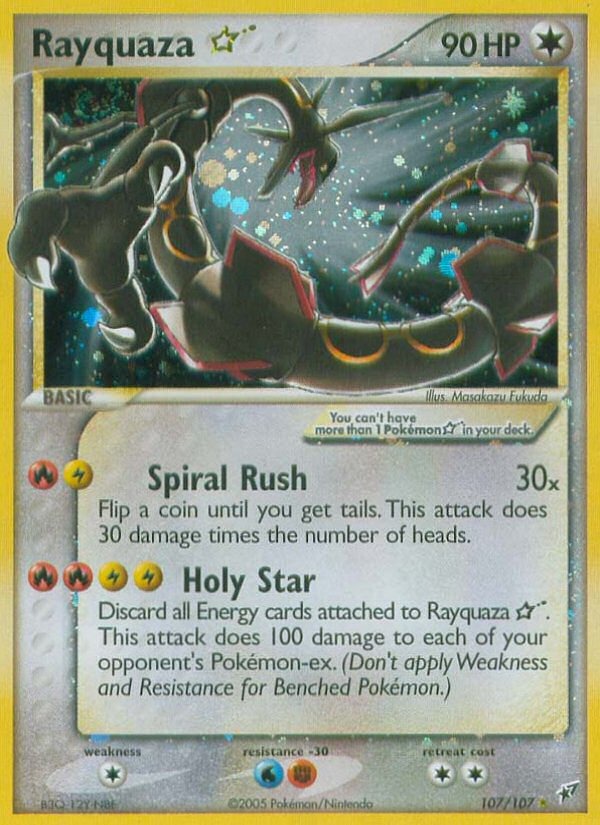
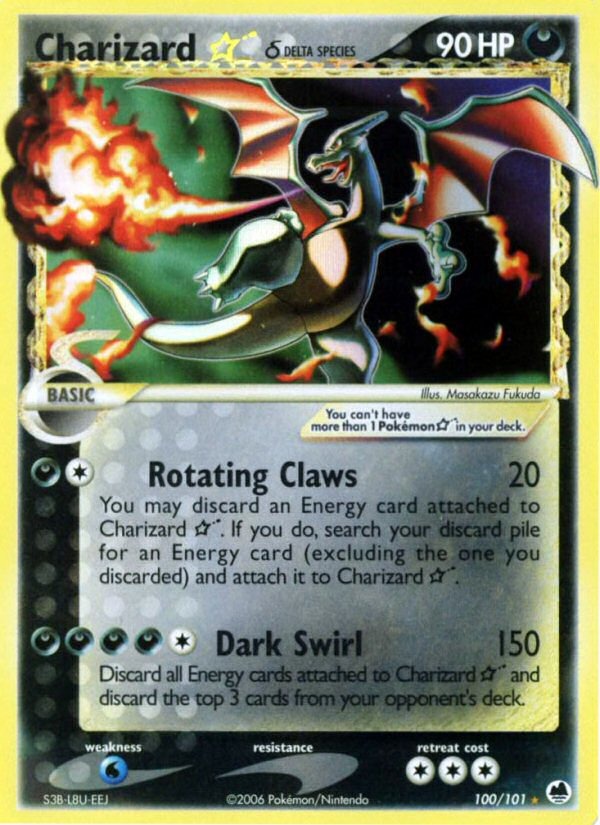
The border is narrow. An ex card’s frame is a thin band, not the wide yellow margin of the old-back era, so a given millimetre of wear occupies a much larger share of the visible frame. On a Base Set card a rub at the corner sits in dead yellow and is easy to forgive; on an ex card the same rub reaches the printed edge of the artwork.
And the wear is reflective. Much of the face is foil, and the foil terminates at the cut edge, so abrasion there produces a bright, silvered line rather than the soft white of exposed board. Silvering catches light the way the artwork does, which means it is visible at the same angles a photograph is taken from — the opposite of a scratch inside a holo window, which hides from the camera and appears under a lamp.
Where the grade actually dies on an ex card
The table is ordered by how often each defect is the deciding one, not by how bad it is.
| Location | How it appears | Caps the grade? | Visible in a photo? |
|---|---|---|---|
| Cut edge, long sides | A bright silvered line where the foil ends, usually uneven along its length | Yes, and it is the most common cause | Sometimes, if the light is raking |
| Corners | Rounded tip or a bright point where the foil has lifted | Yes | Rarely at listing resolution |
| Face, inside the artwork | Faint directional lines under angled light | Yes, but it is the rarer failure here | Almost never |
| Back edges | Whitening on the blue border, often heavier than the front | Yes, and routinely ignored by sellers | Rarely |
| Centring | Offset frame, front or back | Sets a ceiling rather than a penalty | Yes |
Read the last column as a warning. On this era the defects that decide the grade are the ones a photograph is least likely to show, and the defect a photograph shows most clearly — centring — is the one that matters least often. A listing that consists of a flat front scan tells you almost nothing about the card you are being shown.
Why a perfect face is not evidence of anything
A clean face on an ex card is the expected result, not the exception, because the face was the part the sleeve protected. Treating it as evidence of condition is the single most common error in this era.
The tell is in the wear pattern. A card that was stored in a binder and never played wears on the face and not the edge, because the binder’s friction is against the surface. A card that was played wears on the edge and not the face. The two patterns are almost mutually exclusive, and they produce very different grades from what looks like the same card in a photograph.
There is a quieter signal too: a card re-sleeved repeatedly shows a series of fine abrasions along the same edge, evenly distributed, because each insertion abraded the same path. That is not play wear, but it costs the same.
Five checks before an ex card goes in a submission
- Hold the card edge-on and look along each of the four sides in turn. Not at an angle — along the edge, so the cut face is a line rather than a surface. Wear shows as a change in the thickness of that line.
- Check the corners with the card against a dark background. Silvering at a corner reads as a bright point on a dark field. A rounded tip shows as a change in the curve, which is easier to see in silhouette than face-on.
- Turn the card over before you decide. The back edges are usually worse than the front, and a back that has been handled costs exactly as much as a front.
- Ask how the card was stored, and check whether the answer fits the wear. Binder storage produces face wear; deck play produces edge wear; a card that shows both has been through both.
- Stop at the first failed edge. On this era there is no combination of a clean face and a worn edge that reaches the top of the scale, so continuing the inspection only changes how you feel about the card, not what it will grade.
What this era does reward
The line in this era is drawn on edges rather than on rarity. A common with four clean edges is a better submission than a chase card with silvering, and the two cost the same to grade.
That does not make the common a good submission — a clean common is clean because millions were printed, not because it is scarce. It means the filter has to be applied before the card class is considered, and cards that pass the filter are the only ones where the class matters at all. In practice the pool that passes is small, because the era’s surviving cards are mostly played. When a card does pass, it tends to pass decisively: a collection that was assembled and then stored rather than played produces runs of cards with untouched edges, and those runs are where the era’s high grades come from.
Storing ex cards without touching the edge
The physical problem is narrow and specific: the edge is the failure point, and almost every storage action involves the edge.
Sliding a card into a sleeve abrades the two long edges against the sleeve’s opening. Sliding it out again does the same in reverse. This is not a large effect per insertion, but it is cumulative and it is irreversible, and on a card whose grade is decided by its edges it is the dominant risk in ownership. A matte premium sleeve reduces it by being smooth on the inside and slightly oversized relative to the card, so the card settles rather than scrapes.
A rigid 3×4 toploader protects the face and the corners well and is the right choice for anything being posted, but it is the wrong permanent home for an edge-sensitive card, because getting the card in and out is the risk. A press-fit rigid case closes on the card instead of sliding over it, which removes the abrasion entirely. On an era where the edge decides the grade, that difference is the whole argument.
Two habits matter as much as the holder. Do not keep a card you intend to grade in a deck, even a sleeved one, because a deck is a machine for abrading edges. And do not re-sleeve to check condition: decide once, then leave the card alone. If it is going on display, a display slab shows the face and holds the edges without further handling.
Humidity is the secondary issue rather than the primary one here. These cards are laminated and resist moisture better than old-back board, but a humid room still produces the faint ripple that reads as a surface defect, so a stable interior room remains the default.
Where this sits
This page follows the e-Card grading page, where the problem was a whole-face foil field, and precedes the Delta Species grading page, where the problem becomes a laminate that changes over time rather than wear that happens to it. The three pages together cover the whole span from 2001 to 2006, which is the period when the hobby’s card stock changed most often. For the card-level story, see Era 3; for the full sequence, the twelve-era timeline.
Frequently asked questions
Does a perfect face mean a high grade on an ex card?
No. A clean face is the normal state of a card that lived in a sleeve, so it carries almost no information. The edge carries the information, and it is where the subgrade is usually lost.
How much edge wear is acceptable before a card is not worth submitting?
Any silvering visible without magnification, on any of the four sides. On a narrow frame that is enough to hold the card below the top of the scale.
Are gold star cards more fragile than ordinary ex cards?
They share the stock and the cut, so the edges behave identically. What differs is that a gold star is the card in its set most likely to have been taken out and shown to people, which is exactly the handling that damages edges.
Does the back of the card matter as much as the front?
It counts the same. Back edges on this era often show more wear than the front because the back is what rests on a table, and a card with a clean front and a worn back is a mid-grade card however it is listed.
Can a sleeve hide edge wear?
It can hide it from a photograph, which is the reason buying raw cards from this era from a flat scan is unreliable. A sleeve does not change what the grader sees once the card is out of it.
What the cards in this era actually look like
All three cards below share the narrow frame that makes edge wear so visible. Look at the perimeter before the artwork in each case.
Sources
Sources and further reading
- Nintendo and Pokémon USA — the EX series, from July 2003, following the end of the Wizards of the Coast licence.
- The Pokémon Company — the lower-case ex card class, printed as a small suffix beside the card name.
- The Pokémon Company — the gold star subset, twenty-seven cards across the EX series.
- CardSpicy — PSA vs BGS vs CGC, for how edges and corners are weighted against surface.
- CardSpicy — The seven types of card damage, for the wear mechanisms summarised here.
- CardSpicy — Era 3 — EX, 2003 to 2004, for the card-level history this page assumes.
Related reading
- Era 3 — EX, 2003 to 2004 — ex cards and the gold star subset.
- Grading e-Card cards — the previous era, where the face was the problem.
- Grading Delta Species cards — the next era, and the laminate that clouds.
- All twelve Pokémon card eras — the timeline.
- The seven types of card damage — what edge wear actually is.
- Sealed EX product — where the unplayed copies come from.
Nothing on this page is investment advice, and no card or grading service is offered for sale here. Grades are assigned by third-party companies; the descriptions of wear patterns, stock and set composition are structural and are not population figures or prices.
Where to go next
- The CardSpicy card index — every card we track, with its PSA 10 population and market history (195 cards).
- The illustrator index — every artist behind those cards, card by card (110 artists).
Leave a Reply