


Grading companion to Era 11, the Scarlet & Violet era. Part of the twelve-era timeline. This page quotes no prices and no population figures; it explains the structure that decides whether a submission makes sense.
Quick answer
SAR supply is set by print volume rather than by rarity, because the special art slot is a fixed position on the sheet and every additional print run adds more of them — so a batch submission in this era is very likely negative expected value, and only specific cards by specific artists justify the fee. The reasoning is arithmetic rather than opinion. The fee is fixed, the grade is a distribution, and the population you are joining is still growing while your slabs sit in transit. A card whose population is rising during the time you own it is a different object from a card whose population closed before you bought it, and that is the difference between this era and the first one in the sequence.
The corollary is that the decision has to be made card by card, and for a reason that can be stated in a sentence. When the reason is “it is a special art rare and special art rares are good”, the submission is a batch decision wearing the clothes of an individual one.
Why supply never closes in this era
An old-back card has a closed supply because the factory stopped in 1999. A Scarlet & Violet card has an open supply for as long as the set is in print, and this era’s sets have been in print on a scale the hobby had not previously seen. Print volume of that size, combined with a fixed pull rate, produces a supply that scales roughly with demand — which is exactly the condition under which scarcity does not build.
Two mechanical details matter. The special art slot is a position in the sheet layout, not a limited edition; a reprint of the set reprints the slot. And the era’s chase cards sit in sets that were opened in enormous quantity because they were released into the strongest market the hobby has had, which means the raw pool of any given SAR is deep rather than thin.
That does not make the cards common in the way a common is common. It makes them plentiful relative to the number of people who want to own one in a slab, which is the comparison that decides a submission.
Which classes are worth the fee
The table is about supply structure rather than about taste. The last column is a screen, not a prediction.
| Class | Supply structure | Population trend | Submit? |
|---|---|---|---|
| SAR of the era’s most-wanted Pokémon | Fixed slot, very large print run | Rising while the set is open | Only on a specific card-level reason, not on class |
| SAR of a mid-demand Pokémon | Same slot, same run | Rising | Rarely; the fee usually exceeds what the grade changes |
| AR (illustration rare) | More frequent than SAR | Rising, and from a much larger base | No, unless the artwork has its own following |
| Base ex and double rare | Very frequent | Rising fast | No |
| Promo SAR | Distribution-limited rather than print-limited | Depends on the distribution channel | Check the channel before the card |
| Japanese 151 Master Ball mirror | Japanese-only foil, not printed in English | Separate pool entirely | Relevant only if the card is genuinely Japanese |
The last row is a warning about listings rather than about grading. The Master Ball mirror pattern is a Japanese 151 feature and does not exist on the English print; a listing that describes an English card that way is describing something that was never made.
Why a batch is a different decision from a card
A batch submission averages your outcomes. Every card in it pays the same fee, and the results are drawn from the same distribution, so the batch is a bet on the average of that distribution rather than on any individual card. In an era where the average result is ordinary, that is the worst shape of bet available.
Individual submissions are different because they can be selective. The case for a single card can rest on something the batch cannot see: an artist whose work has a following, a Pokémon appearing in a special art treatment for the first time, a card that is the visual signature of the set. Those are reasons, and they are the only kind of reason that survives a rising population.
Five gates before an SV batch goes out
- Name the reason for each card in one sentence. If the sentence is about the class rather than the card, take it out of the batch.
- Check whether the set is still being printed. If it is, the population will grow while your submission is in transit, and the number you get back will be competing with cards submitted later.
- Measure centring, because it is the remaining variable. On a pack-fresh population, centring and the occasional print line are all that separate one copy from another.
- Decide what a one-step-lower result would mean to you. If the answer is that the submission would have been a mistake, the submission is a bet on a single outcome and should be treated as one.
- Cut the batch down until every card passes the first four gates. The batch is not the unit of decision; the card is.
What this era does have going for it
The cards are well made. Print quality is consistent, centring is tighter than in several earlier eras, and the textured foil on a special art rare is applied evenly. That is good for the card and neutral for grading: when almost every copy is clean, a clean copy is not a distinction.
It is also why the era produces so many slabs with the same number. The distribution is narrow because the input is uniform, which is the opposite of the situation on old-back stock where the input was wildly variable and the top grade was therefore scarce. Two eras, two completely different relationships between condition and grade, and the submission logic follows the relationship rather than the card.
Storing Scarlet & Violet cards
The physical issues here are bulk and pressure rather than any exotic failure mode. This is the era most likely to be stored in quantity, and quantity is what damages cards.
Bulk storage means stacks, and stacks mean weight transmitted through faces. A card at the bottom of a stack of three hundred is being pressed by three hundred cards, and on textured stock the pressure shows as a flattening of the texture in a band rather than as a visible crease. The fix is not a stronger box; it is fewer cards per stack. A matte premium sleeve on anything worth keeping separates the faces, but it does not remove the weight.
For the cards that are candidates for a slab, a press-fit rigid case takes them out of the stack entirely, which is the point: a card in a case is not bearing load. A rigid 3×4 toploader does the same for cards in transit and is the practical choice for a submission, provided the card is sleeved first so the texture is not abraded on the way in.
Humidity matters less on this stock than on the old-back era, but a room that swings in temperature still produces the faint ripple that reads as surface. A stable interior room is the default, as it has been throughout this sequence.
Where this sits
This page follows the Sword & Shield grading page, where the population was large but demand was broad enough to carry it, and precedes the Mega Evolution grading page, where the population has not formed at all and the question becomes whether a grading economy exists yet. This is the page where the supply side is open in both directions. For the card-level story, see Era 11; for the full sequence, the twelve-era timeline.
Frequently asked questions
Is every SAR from this era a bad submission?
No, but the class alone is not a reason. The case has to be about the specific card — its artwork, its following, its place in the set — because the supply structure is the same for all of them.
Why is a batch worse than the same cards submitted one at a time?
Because a batch pays the fee on the average of a distribution rather than on the cards that pass a filter. The fee is identical either way, so selectivity is free and a batch gives it up.
Does a rising population matter if I am not selling?
It matters to the decision, not to the ownership. If the point is the slab rather than the number, the population is irrelevant and the case for submitting is about the card.
Is the Master Ball mirror available in English?
No. The Master Ball mirror pattern is a Japanese 151 feature, and an English card described that way is being described incorrectly.
Are print defects common on this era’s cards?
Less common than in earlier eras, which is part of the problem: when the input is uniform, a clean copy is not a distinction and the grade stops separating one submission from another.
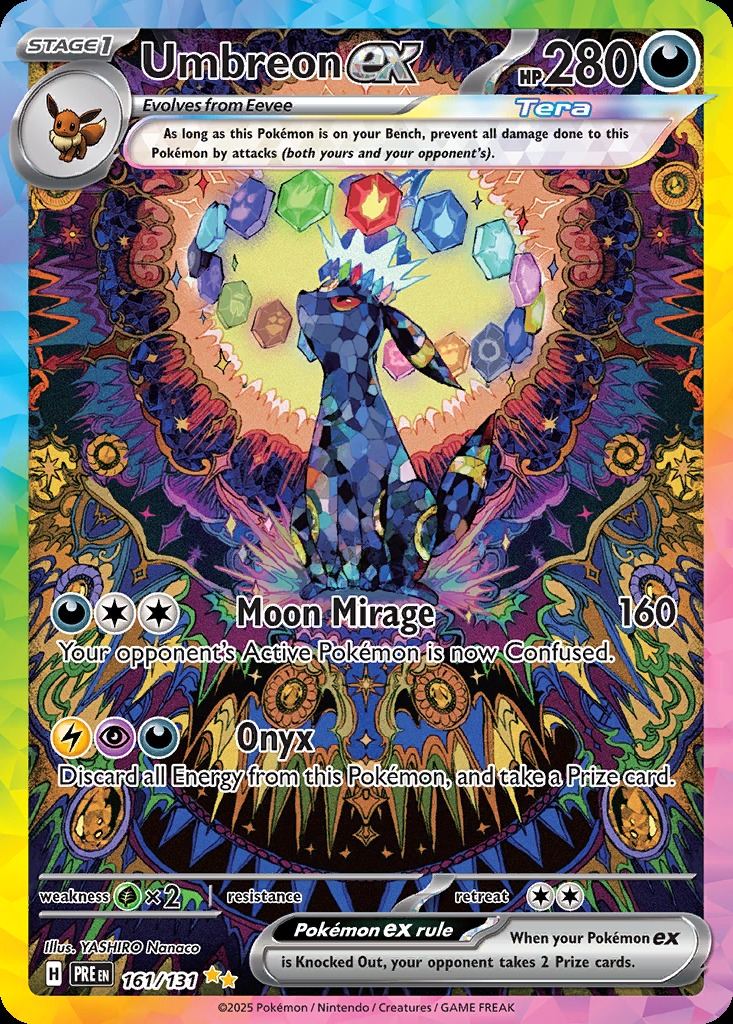
What the cards in this era actually look like
The special art treatment is consistent across the era, which is the point: the finish is uniform and the differences between cards are in the artwork rather than the printing.

Sources
Sources and further reading
- The Pokémon Company — the Scarlet & Violet series, 2023 to 2025.
- The Pokémon Company — the AR and SAR classes, printed in fixed slots within each set’s sheet layout.
- The Pokémon Company — Japanese 151 and the Master Ball mirror pattern, which is not present on the English print.
- CardSpicy — Reading a population report, for why a rising population behaves differently from a settled one.
- CardSpicy — Simplified Chinese Pokémon set codes, for reading set and language markings on modern cards.
- CardSpicy — Era 11 — Scarlet & Violet, 2023 to 2025, for the card-level history this page assumes.
Related reading
- Era 11 — Scarlet & Violet, 2023 to 2025 — AR, SAR and the era’s sets.
- Grading Sword & Shield era cards — the previous era, and the population paradox.
- Grading Mega Evolution era cards — the next era, where no population exists yet.
- All twelve Pokémon card eras — the timeline.
- Reading a population report — why a growing population is a different risk.
- Sealed Scarlet & Violet product — the print volume behind the supply.
Nothing on this page is investment advice, and no card or grading service is offered for sale here. Grades are assigned by third-party companies; the descriptions of supply structure, print volume and storage are structural and are not population figures or prices.
Where to go next
- The CardSpicy card index — every card we track, with its PSA 10 population and market history (195 cards).
- The illustrator index — every artist behind those cards, card by card (110 artists).
Leave a Reply