

Sealed companion to Era 8, XY. Part of the twelve-era timeline. No sealed prices quoted.
Quick answer
XY is the era where reprints entered the sealed market, and where a box’s identity started depending on what it does not contain. The set Evolutions, released in November 2016, reprinted the 1999 Base Set card list with modern card frames. That created something the hobby had never had: two sealed products with the same artwork in the display, the same evocative name, and a twenty-seven-year gap in what the cards actually are.
The practical consequence is that XY-era sealed product has to be identified by set and date before it can be valued at all. Anyone holding an unopened box with a Charizard on the front from this period is holding one of two objects that are not comparable, and the box alone is not enough to tell which.
The line, and where the reprint sits in it
XY runs eleven English sets across three years. The sealed line is conventional by this point; what is not conventional is one set’s relationship to the past.
| Set | Release | Sealed significance |
|---|---|---|
| XY | February 2014 | First set of the era; introduces the XY frame |
| Flashfire | May 2014 | Mega Charizard-EX; the era’s highest-opening box |
| Furious Fists | August 2014 | Fighting-type focus; modest sealed interest |
| Phantom Forces | November 2014 | Playable-heavy set; high opening rate |
| Primal Clash | February 2015 | Primal reversion cards; large print run |
| Roaring Skies | May 2015 | M Rayquaza-EX; strong collector demand |
| Ancient Origins | August 2015 | Small set, short retail life |
| BREAKthrough / BREAKpoint | 2015–2016 | BREAK card tier; the era’s structural dead zone |
| Generations | February 2016 | Anniversary set; small, retail-exclusive distribution |
| Fates Collide | May 2016 | Standard release, modest following |
| Steam Siege | August 2016 | Standard release, the era’s least collected box |
| Evolutions | November 2016 | The reprint set, and the reason this era needs its own page |
Two sets in that list behave differently from the rest. Generations had a genuinely restricted distribution — it was sold through promotional channels rather than general retail — which makes it the era’s scarcest sealed product by construction rather than by survival. And Evolutions is the one that created the identification problem.
What Evolutions actually did
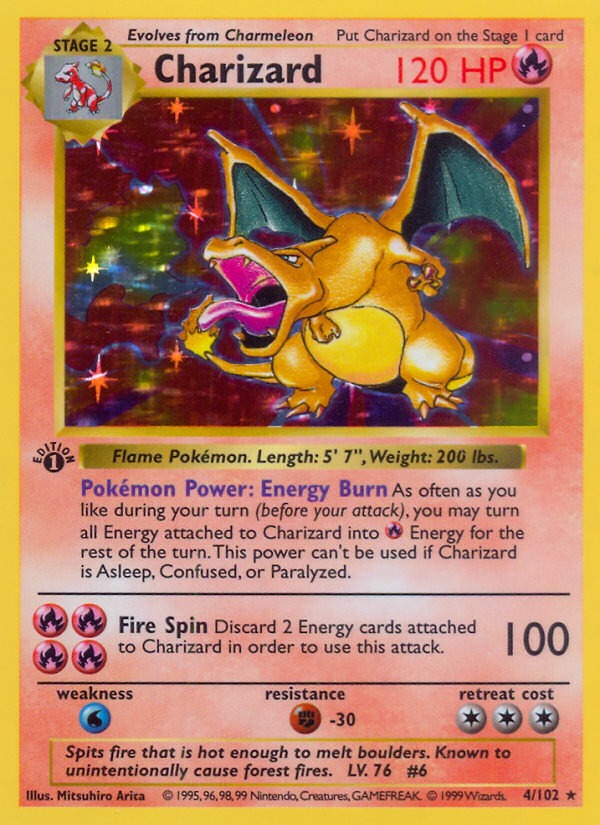
Evolutions reprinted the Base Set card list: the same Pokémon, the same names, the same illustrations in many cases, printed on the modern card frame with modern rules text and a modern copyright line.
It was not a reprint of the cards. It was a reprint of the set list. The distinction matters because the cards are not interchangeable: a 1999 Charizard and a 2016 Charizard from Evolutions share artwork and name and nothing else. Different frame, different border, different stock, different print process, different value by orders of magnitude.
For sealed product the effect is more subtle and more damaging. A 2016 Evolutions booster box has Charizard on the display face, a yellow border, and a design language lifted from 1999. At a glance, and in a photograph, it reads as vintage. The identifying features are all small: the set logo, the copyright year, the absence of the Edition 1 mark, and the modern frame visible on the display card.
This is what makes XY the era where sealed identity became a research task rather than a glance.
How the era’s boxes fail
XY-era construction is the most robust so far, and the failures are correspondingly minor — but two are worth knowing.
The first is the corner fold. These boxes use a thicker board with a tighter fold at the corners, and the fold line is where the printed surface cracks. A hairline white line at a corner fold is normal and is not damage in any meaningful sense; a crack that opens and shows board underneath is.
The second is the display card ghost. Many of these boxes carried a printed insert behind the front face. Over years the insert’s ink can transfer a faint image onto the inside of the front panel, which is invisible from outside until the box is tilted in raking light. It is harmless but it is often mistaken for water damage.
The era did not introduce a new environmental failure. The coated board and heavier wrap from the Black & White era carry over, which is why a 2014 box in a cupboard has aged better than a 2010 one.
Identifying what you have
- Read the set logo, not the artwork. The display image is the least reliable identifier in the entire hobby from this era onward. The set logo is printed small and consistently.
- Check the copyright year on the box. This is the fastest single check and it distinguishes a 2016 reprint box from anything from 1999 at a glance.
- Look for the Edition 1 mark and expect not to find one. No set after 1999 carries it. Its absence is normal, not suspicious.
- Check the frame on the display card. A modern frame with a rounded inner border reads as post-2013; the old frame reads as 1999–2002.
- For Generations, expect a promotional-channel box. That set did not go through general retail, so its packaging carries the channel’s branding rather than a standard retail layout.
Storing this era’s product
The main risk here is the corner fold, and the fix is to stop putting weight on corners. Store boxes flat, not standing on an edge, and do not stack more than three high. A corner crack that opens is the only meaningful damage this era is prone to.
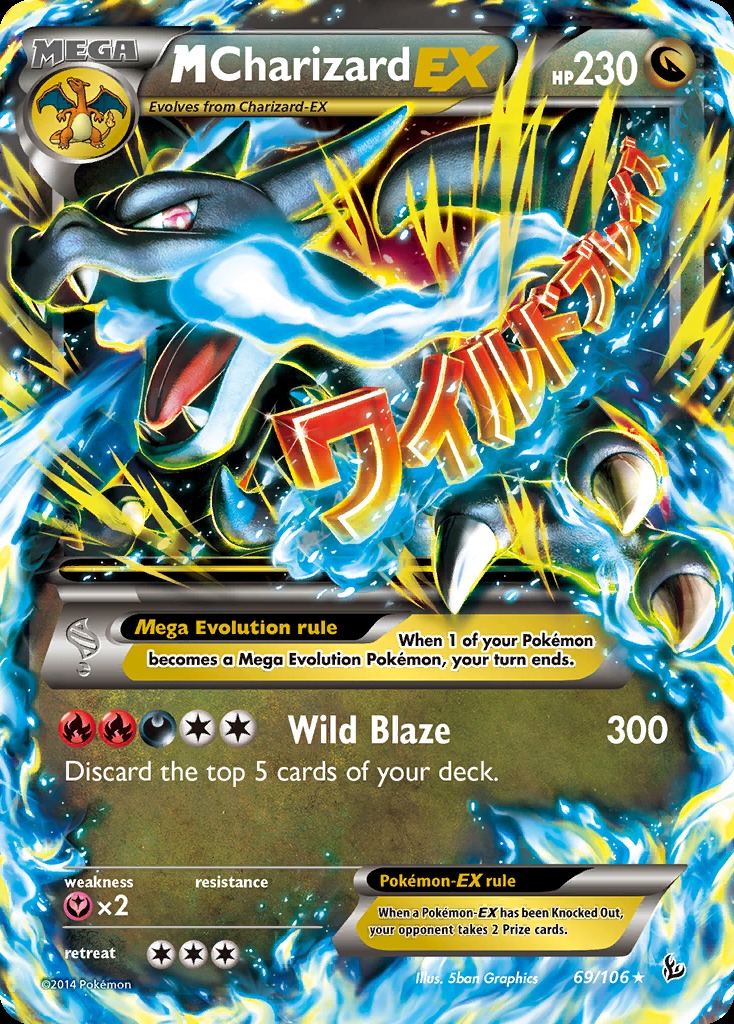
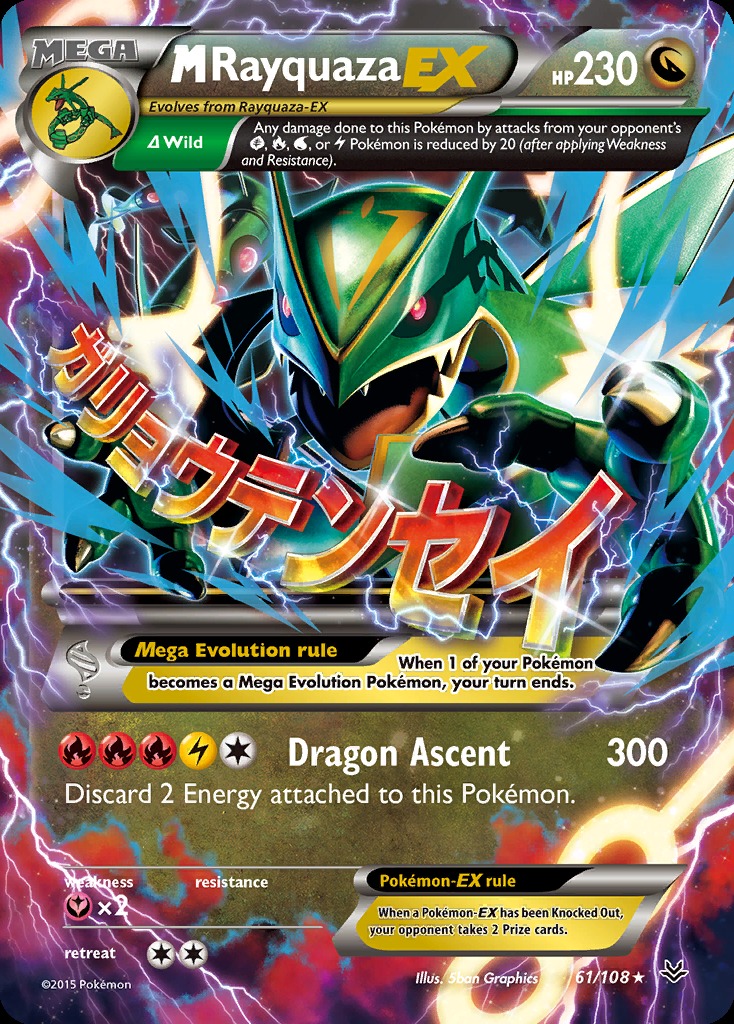
For the singles, the era’s defining cards are Mega Evolution cards, which are the first cards in the hobby printed in a landscape orientation rather than portrait. That single design decision breaks almost every storage assumption in the hobby.
A landscape card does not fit a portrait holder, a portrait binder page, or a standard graded slab without being rotated. Rotating it means the card’s own edges are no longer parallel to the holder’s edges, which is where insertion damage comes from. The practical approach is a sleeve plus a rigid toploader that the card enters without rotation — insert it landscape into a holder sized for a landscape card — rather than forcing it into a portrait holder. A press-fit case avoids the problem entirely because there is no insertion path.
For display, a display slab holding a landscape card reads better than any other format, because the card’s proportions match the visual weight of a horizontal case.
Where this sits
The XY sealed line follows the Black & White sealed page, where keeping boxes became deliberate, and is followed by the Sun & Moon sealed page, where the box itself started being graded. For the card-level story see Era 8.
Frequently asked questions
Is an Evolutions booster box from 2016 a Base Set box?
No. Evolutions reprinted the Base Set card list on the modern card frame. The artwork is familiar, the cards are not the same cards, and the sealed product is not comparable in value.
Why are some Pokémon cards printed horizontally?
Mega Evolution cards were printed in landscape orientation, starting in the XY era. It is a design decision tied to the Mega Evolution mechanic and it is the only regular landscape printing in the hobby.
Which XY set is scarcest sealed?
Generations, because it was distributed through promotional channels rather than general retail. Its scarcity is in the distribution, not in how many were kept.
Does a hairline crack at a box corner matter?
Only if it opens and shows board. A surface crack in the printed layer at the fold is normal for this construction and does not indicate the box was opened.
Were the XY sets reprinted heavily?
Several were, and the reprint practice is why sealed survival from this era is comparatively good. Only Evolutions reprinted an earlier set list rather than itself.
What this era’s product actually looks like
The landscape Mega Evolution card and the modern frame are the two visual facts that decide what you are holding.
Sources
Sources and further reading
- Nintendo — XY, February 2014, and the eleven English sets through Evolutions, November 2016.
- Nintendo — Generations, February 2016, distributed through promotional channels.
- Nintendo — Mega Evolution cards, printed in landscape orientation from the XY era.
- CardSpicy — Era 8, for the Mega Evolution tier and the Evolutions reprint.
- CardSpicy — How to read a set code, for confirming a printing from the code.
- CardSpicy — How to spot a resealed box.
Related reading
- Era 8 — XY, 2013 to 2016 — landscape cards, Mega Evolution and the Evolutions reprint.
- Sealed Black & White product — the era before, when keeping boxes became deliberate.
- Sealed Sun & Moon product — where the box itself got graded.
- All twelve Pokémon card eras.
- How to read a set code — the check that separates a reprint from an original.
- What is in a booster box.
Nothing on this page is investment advice, and no sealed product is offered for sale here. Release dates are as published by the manufacturer; the Evolutions set list is a reprint of names and artworks, not of the original cards.
Where to go next
- The CardSpicy card index — every card we track, with its PSA 10 population and market history (195 cards).
- The illustrator index — every artist behind those cards, card by card (110 artists).
Leave a Reply