

Sealed companion to Era 10, Sword & Shield. Part of the twelve-era timeline. No sealed prices quoted.
Quick answer
Sword & Shield is the era where asking “how much sealed product exists” stopped being useful, because the answer varies by a factor across sets printed months apart. This is the largest print run in the hobby’s history by a wide margin. It is also the era where one set became a deliberate storage asset while its neighbours were opened to nothing.
The right question for this era is not volume. It is: which sets had a reason to be kept? A set that contains a card everyone wants is a set that gets bought twice — once to open and once to hold. A set that contains nothing notable is bought once and opened immediately. Both were printed in enormous quantity. Only one survives sealed.
The line, and its internal split
Sword & Shield runs seventeen English sets from February 2020 to early 2023, plus the special sets. The sealed behaviour splits along one line: whether the set has a defining alternate-art card.
| Group | Sets | Sealed behaviour |
|---|---|---|
| Defining alt arts | Evolving Skies, Chilling Reign, Brilliant Stars, Lost Origin | Bought to keep; sealed supply comparatively deep |
| Playable-heavy | Rebel Clash, Battle Styles, Fusion Strike | Opened by players; sealed supply thinner than volume suggests |
| Special sets | Champion’s Path, Shining Fates, Celebrations, Crown Zenith | Restricted channels or limited windows; supply shaped by distribution |
| Early base sets | Sword & Shield base, Darkness Ablaze, Vivid Voltage | Very large print runs, heavily opened, still widely available |
| Late sets | Astral Radiance, Silver Tempest | End-of-era fatigue; lower retention than the alt-art group |
Two of these groups deserve comment. The alternate-art sets are the ones people mean when they talk about “Sword & Shield sealed” — Evolving Skies in particular, because a single card in it became the era’s price anchor. The playable-heavy sets are the opposite case: enormous print runs and a player base that opened them as fast as they were printed.
Why alternate art changed retention
Alternate art was not new in this era — it existed in Sun & Moon — but the ratio changed. In Sun & Moon, an alternate art was an exception. In Sword & Shield, every major set had a defined set of them, and collectors began treating the set as a list of alternate arts to complete rather than a set of cards to collect.
That shift has a direct effect on sealed product. When the reason to own a card is the specific artwork, the card cannot be substituted. You cannot complete an alternate-art collection with a standard print of the same card. So the demand concentrates on a small number of specific printings, and the only way to obtain one with certainty is to buy it — which means the packs get opened, and the boxes get held by people who intend to hold them.
This is the first era where the sealed market and the single market are driven by the same small set of cards, rather than the sealed market trailing the single market.
The physical character of these boxes
Sword & Shield packaging is the most damage-resistant in the hobby up to this point, and the failures are minor.
The gloss scuffs. The board carries a high-gloss laminate, which is excellent for print fidelity and terrible for abrasion. A box that has slid across a shelf shows a network of fine dull scratches that are only visible at an angle. This is the era’s most common condition complaint and it is purely cosmetic.
The wrap is thinner than it looks. Despite the heavy board, the film is a light gauge, and it tears rather than stretches. A tear along a fold is common and is not evidence of tampering.
The box is dimensionally rigid. Unlike the eras that bowed, these boxes hold their shape, which means they transmit impact straight to the corners. A drop produces a sharp corner deformation rather than an absorbed dent.
What is actually scarce
- Special sets with restricted channels. Champion’s Path and Crown Zenith were distributed through narrower retail programmes, so the unit count was set by channel rather than by demand.
- Playable-heavy boxes that were not kept. Battle Styles and Fusion Strike were opened hard. Sealed examples exist but the ratio of opened to kept is worse than for the alt-art sets.
- Blisters and single-pack formats. The same structural gap as every era before this one.
- Nothing else. This is the honest answer. Most Sword & Shield sealed product is abundant, and describing it as scarce would be inaccurate.
Storing this era’s product
The gloss scuffing is the thing to prevent, and it is caused by sliding. Do not store these boxes in a container where they can move against each other; a rigid box with dividers is better than a loose one, and acid-free paper between boxes stops the abrasion entirely.
Because the boxes are dimensionally rigid, drops transmit to corners. Keep them low, not on a high shelf, and do not stack them in a way that a collapse would put a corner onto a hard floor.
For the singles, this era’s cards are the hardest in the hobby to grade well, because alternate art covers the entire card face with continuous foil and a full-bleed illustration. Any surface mark sits on a reflective field where it is immediately visible, and there is no border to absorb it. That makes the storage layer more important than for any earlier era.
A matte sleeve first, and it must be a smooth-interior sleeve — a textured interior will burnish continuous foil. Then a press-fit case rather than a toploader, because insertion abrasion across a full-bleed foil is exactly the damage that costs a grade. If the card is going on display, a display slab is the format that shows an alternate art the way it is meant to be seen, and the encasement removes the handling risk entirely.
For loose packs, a metal pack storage box keeps them from being compressed, which is how most loose packs from this era lose their shape.
Where this sits
The Sword & Shield sealed line follows the Sun & Moon sealed page, where the box itself started being graded, and is followed by the Scarlet & Violet sealed page, where opening a box became negative expected value as a matter of routine. For the card-level story see Era 10.
Frequently asked questions
Is Sword & Shield sealed product rare?
No, as a category. It is the largest print run in the hobby’s history. Individual formats and individual sets vary enormously, and the scarce units are the small retail formats rather than the booster boxes.
Why is Evolving Skies treated differently from its neighbours?
Because it contains the era’s price anchor card in alternate art. A set with a card everyone wants is bought twice — once to open and once to hold — and the second purchase is what creates sealed supply.
What is alternate art?
A second printing of a card with different artwork, usually at a lower pull rate than the standard version. It is a distinct card, not a variant of the same card, and it cannot be substituted for one in a collection.
Why do these boxes scuff so easily?
The board carries a high-gloss laminate. Gloss shows abrasion as dull patches that are only visible at an angle, so boxes that have slid against each other show visible wear even when nothing has been dropped.
Which Sword & Shield sets were opened the most?
The playable-heavy sets. Players open product to build decks and do not keep boxes, so a set defined by competitive cards loses sealed supply faster than a set defined by artwork.
What this era’s product actually looks like
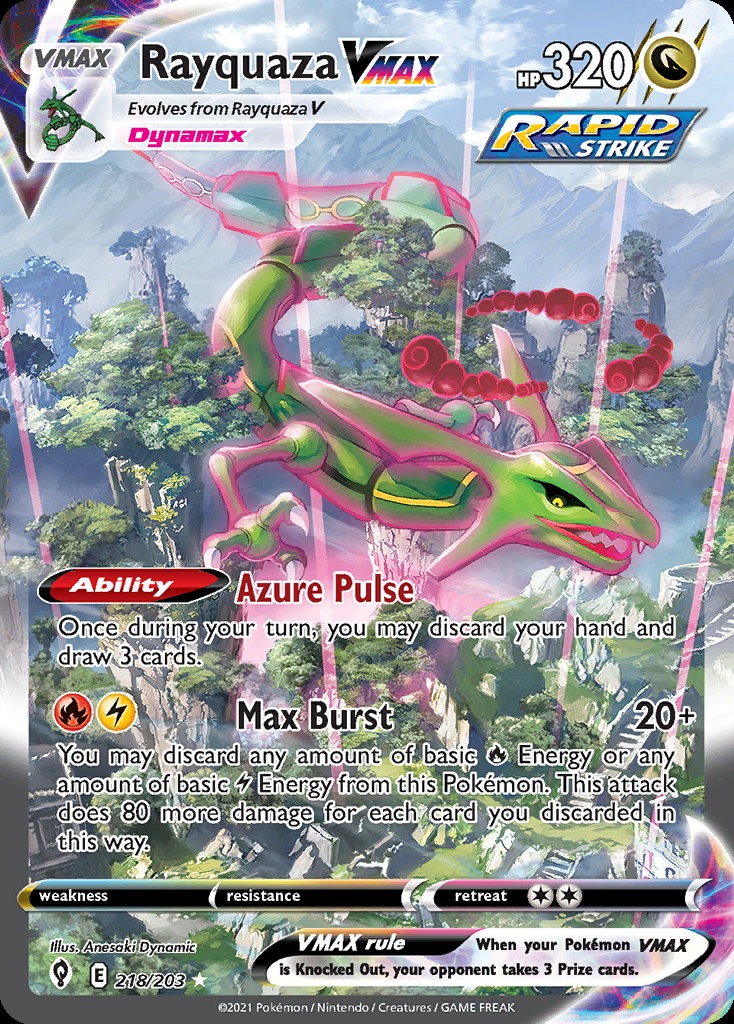
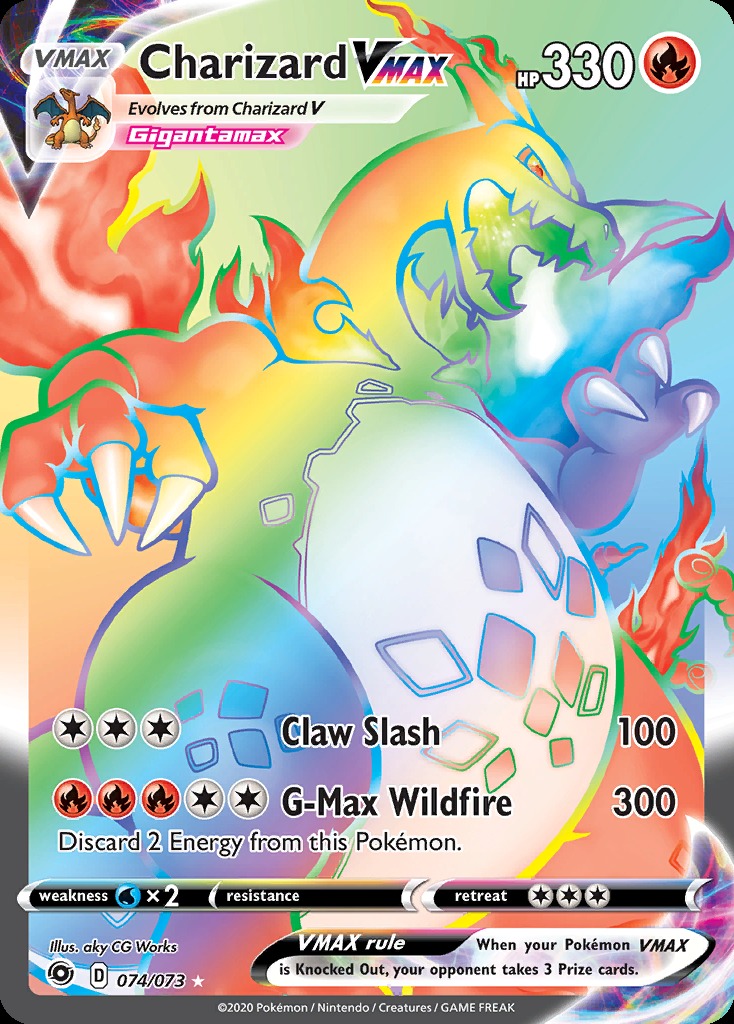
Alternate art is the whole reason this era behaves the way it does, and the difference from a standard print is visible immediately.
Sources
Sources and further reading
- Nintendo — Sword & Shield base set, February 2020, and the seventeen English sets through 2023.
- Nintendo — Champion’s Path, September 2020; Shining Fates, February 2021; Celebrations, October 2021; Crown Zenith, January 2023.
- CardSpicy — Era 10, for alternate art and the era’s price structure.
- CardSpicy — Blown film vs cast film, for why sleeve construction matters on continuous foil.
- CardSpicy — Storing sealed Pokémon boxes.
- CardSpicy — Booster boxes or singles.
Related reading
- Era 10 — Sword & Shield, 2019 to 2023 — alternate art and the population paradox.
- Sealed Sun & Moon product — the era before, when boxes got graded.
- Sealed Scarlet & Violet product — where opening became negative expected value.
- All twelve Pokémon card eras.
- Blown film vs cast film — sleeve construction on foil-heavy cards.
- Humidity and long-term storage.
Nothing on this page is investment advice, and no sealed product is offered for sale here. Release dates are as published by the manufacturer; survival descriptions are structural and are not population figures.
Where to go next
- The CardSpicy card index — every card we track, with its PSA 10 population and market history (195 cards).
- The illustrator index — every artist behind those cards, card by card (110 artists).
Leave a Reply