

Sealed companion to Era 12, Mega Evolution. Part of the twelve-era timeline. No sealed prices quoted.
Quick answer
Mega Evolution is the first era in this timeline that cannot be analysed as sealed product, because it has not yet developed the two conditions that create a sealed market. Those conditions are a set leaving print and a settled consensus on which cards matter. Neither has happened. The boxes exist, they are being sold, and there is no meaningful second price for them.
This is not a criticism of the era. Every era in this timeline passed through this stage — some for two years, some for ten. The useful thing about looking at the newest era is that it makes visible a process you otherwise only see the end of: how a box becomes a sealed asset, and what has to happen first.
What “no sealed market” actually means
It does not mean nobody is selling boxes. It means four specific things are absent, and each one is a precondition rather than a symptom.
- No settled ceiling. A set’s sealed value is anchored by its most valuable card. Until a consensus forms on which card that is, there is nothing to anchor against, so boxes only trade at their purchase price plus a spread.
- No print exit. While a set is available at retail, no rational buyer pays a premium for a sealed box, because they can buy a fresh one. A sealed market requires scarcity, and scarcity requires the set to be gone.
- No population divergence. The distinction between “opened” and “kept” has not had time to develop. Right now almost everything printed is either opened or sitting in a shop, and the two populations are not yet separated.
- No grading precedent. Sealed grading requires a reference population of graded examples before a grade carries information. That population does not exist for an era this young.
All four resolve with time, and the order in which they resolve is the same every era: exit from print, then consensus on the ceiling, then population divergence, then grading. Mega Evolution is at step zero.
What the era’s product line looks like so far
The era began in 2025 and is early enough that its product line is still being defined. What can be said with confidence is structural rather than specific.
| Aspect | What is established | What is not yet |
|---|---|---|
| Pack and box configuration | Standard English booster box remains the primary format | Whether the era will add new format types |
| Premium tiers | Continuation of illustration-led tiers from the previous era | Whether a new top tier will be introduced mid-era |
| Game rules | A three-prize rule for Mega Evolution cards changes the play structure | How that affects which cards become competitive staples |
| Print behaviour | Mass retail distribution | Whether the era will see reprint cycles like its predecessor |
| Sealed premium | None established | Everything |
The three-prize rule is worth flagging because it is a genuinely new mechanic rather than a re-skin. In the previous era, a two-prize card was the standard cost for a powerful card. A three-prize card changes the risk calculation in a deck, which changes which cards are playable, which in turn changes which cards are in demand. Playability is one of the two demand drivers for a premium card, so a change in the rules changes the ceiling.
Why buying this era’s sealed product is a different decision
In an era with a sealed market, the decision is about price: is this box cheap relative to its contents. In an era without one, the decision is about time, and the questions are different.
The first is whether the era will be collected at all. Some eras are. Every era in this timeline is collected now, but they were not always, and the ones that were collected earliest are the ones with the best survival. An era that is not collected while it is in print has no sealed supply later, regardless of how much was printed.
The second is whether the specific set will be the era’s anchor. In every era, one or two sets carry the sealed market and the rest do not. Picking the anchor set while the era is current is the only way to buy at retail price, and it is also the decision most likely to be wrong.
The third is storage life. A box bought now will sit somewhere for a decade before the question of its value becomes meaningful. That is a decade of humidity cycles, moves, and handling, and the storage decision made in the first month determines whether the box is still a box at the end of it.
Storing product you intend to keep for a decade
This is the one part of this page that is useful immediately, because the answer does not depend on the era’s future.
Keep it out of the light. Not dim — out. Ultraviolet degrades the printed surface and the wrap, and the degradation is not visible until it is advanced. A closed cupboard is better than a shelf, and a shelf is better than a windowsill. This is the single highest-value storage decision and it costs nothing.
Keep it at a stable humidity, not a low one. Cardboard equilibrates with the air around it. A box that cycles between damp and dry expands and contracts, and the visible result is a wavy flap edge. Stability matters more than dryness, which is why a sealed plastic bin with no desiccant is worse than an open shelf in a stable room.
Do not stack. The weight is the enemy. Two boxes high is acceptable; ten is not, and a box at the bottom of a stack of ten will be visibly deformed within a few years.
Keep the wrap intact and do not tape it. Tape residue is worse than a tear and marks the box as repaired.
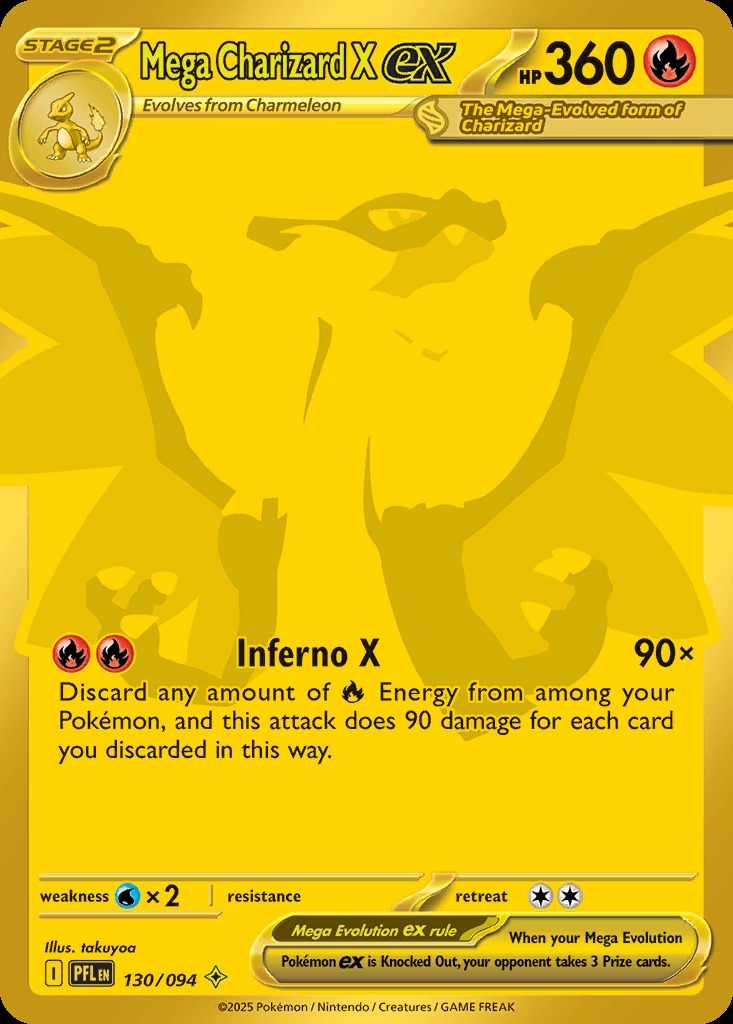
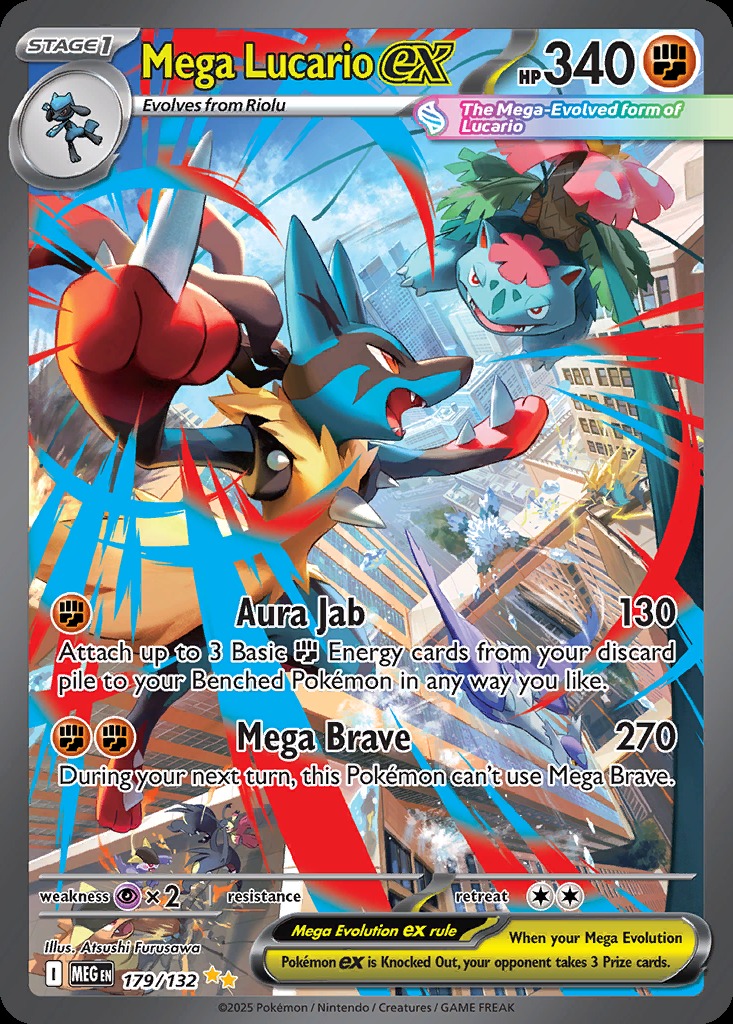
For the singles from this era, the premium cards are illustration-led and full-bleed, which is the hardest format to keep clean. A smooth-interior matte sleeve first, then a press-fit case rather than a toploader, because a full-bleed foil has no border to absorb insertion abrasion. A display slab is the right choice for a card whose value is the artwork.
Where this sits
Mega Evolution is the last of the twelve eras and follows the Scarlet & Violet sealed page, which is the first era where opening a box was routinely negative expected value. There is no successor yet. For the full map, start at the era timeline; for the card-level story, see Era 12.
Frequently asked questions
Should I buy Mega Evolution boxes sealed?
That is a decision about time rather than price, and this page does not make it for you. What can be said is that the era has none of the four preconditions for a sealed market, so any premium you pay now is a bet on the era being collected later.
Why do new sets not have a sealed premium?
Because they are available at retail. A sealed premium requires the set to be out of print, and while a buyer can purchase a fresh box at retail price there is no reason to pay more for an older one.
What is the three-prize rule?
A rule change in this era that makes Mega Evolution cards cost three prizes when knocked out, rather than the two that powerful cards cost in the previous era. It changes deck-building risk and therefore which cards become playable.
How long does it take a set to develop a sealed market?
It varies by era and depends on when the set leaves print and when consensus forms on its ceiling. This page does not forecast a timeline, because the previous eras took anywhere from two years to a decade.
Does a sealed box protect cards from humidity?
No. The board is permeable and equilibrates with the room. A sealed box protects against handling and light, not moisture.
What this era’s product actually looks like
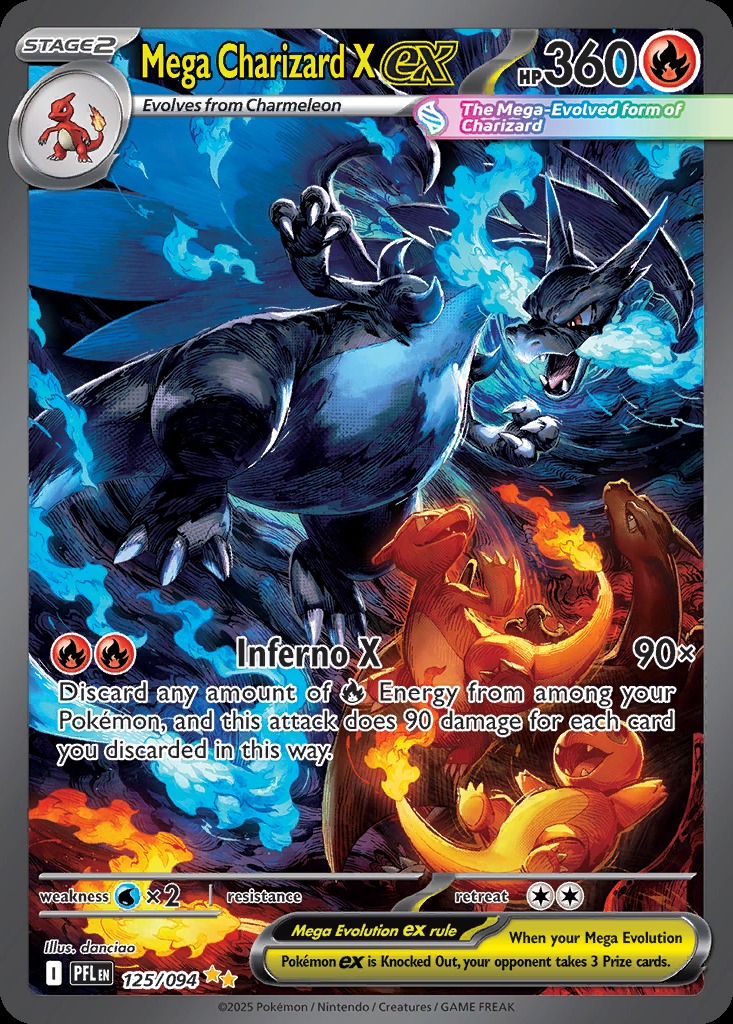
The era’s premium cards continue the full-bleed illustration approach, and the Mega Evolution treatment is the distinguishing feature.
Sources
Sources and further reading
- Nintendo — Mega Evolution era, first sets from 2025, and the three-prize rule for Mega Evolution cards.
- CardSpicy — Era 12, for the era’s card structure and the three-prize rule.
- CardSpicy — Era 11, for the tier structure this era continues.
- CardSpicy — Storing sealed Pokémon boxes, for the decade-scale storage guidance.
- CardSpicy — Humidity, light and long-term card storage.
- CardSpicy — Booster boxes or singles.
Related reading
- Era 12 — Mega Evolution, 2025 onward — the three-prize rule and what the twelve eras teach.
- Sealed Scarlet & Violet product — the era before, and negative expected value.
- Sealed Base Set product — what an era looks like thirty years later.
- All twelve Pokémon card eras.
- Storing sealed boxes.
- Humidity and long-term storage.
Nothing on this page is investment advice, and no sealed product is offered for sale here. The era is current at the time of writing and its product line is still developing; statements about absent market conditions describe the present, not a forecast.
Where to go next
- The CardSpicy card index — every card we track, with its PSA 10 population and market history (195 cards).
- The illustrator index — every artist behind those cards, card by card (110 artists).
Leave a Reply