

Era 9 of 12 in our timeline of Pokémon card eras. For twenty years the most expensive card in a set was a Pokémon. In this era, for the first time, it was a person.
Companion pages: Sealed Sun & Moon product · grading Tag Team cards.
Quick answer
The Sun & Moon era ran from 2016 to 2019 across fifteen English sets and introduced two mechanics — GX, a once-per-game attack, and Tag Team GX, a single card depicting two Pokémon — plus one structural change that matters far more: the full-art trainer became a headline chase card.
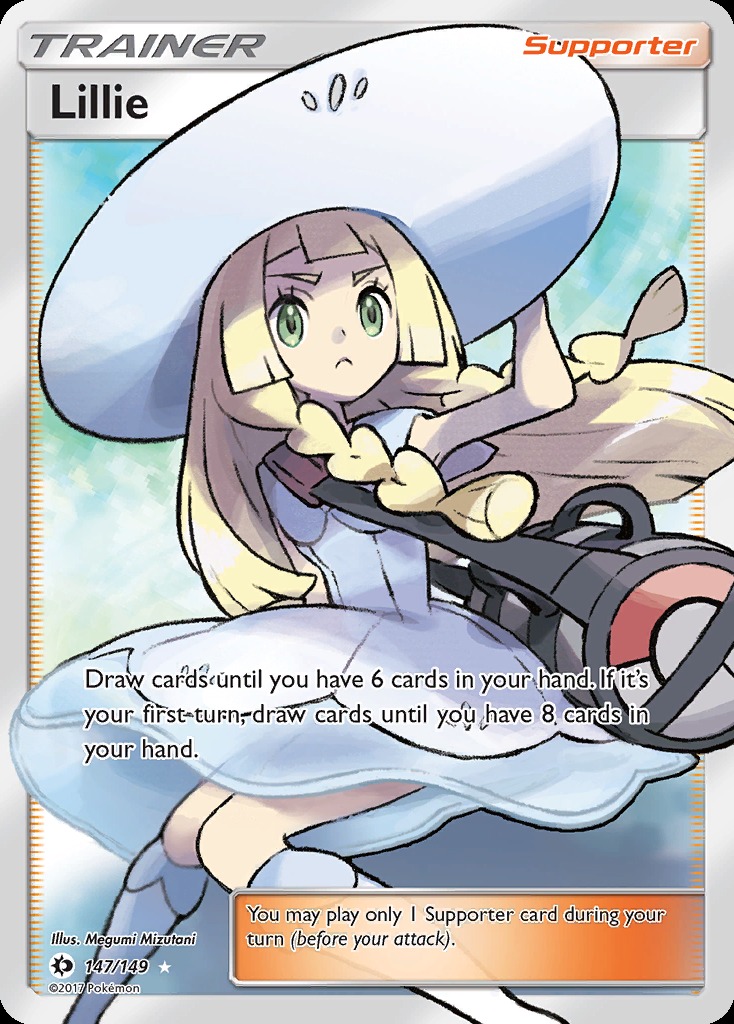
The trainer portraits from this era, led by Lillie, are the direct ancestors of the character cards that now dominate the modern market. This is where the hobby’s centre of gravity moved from the creature to the cast.
The era that made people the product
Trainer cards have existed since 1999. For most of that time they were utility: a supporter that let you draw cards, printed with a stock illustration of a person who was not really the point.
Sun & Moon changed that in two steps. First, the full-art treatment — no frame, the character rendered as a portrait against a background — arrived for supporters as well as Pokémon. Second, the game’s story gave those characters relationships: Lillie is a named character with a narrative arc, and the cards of her are pictures of her rather than depictions of a mechanic.
The consequence is a market structure that had not existed before. A card with no competitive value at all, depicting a person, at a rarity tier that has nothing to do with play strength, became the most expensive card in its set. The trade calls the resulting premium a character premium; whatever you call it, it is the defining economic fact of the era.
The fifteen sets
| Set | Release | Note |
|---|---|---|
| Sun & Moon | February 2017 | GX debuts; Lillie full art is in the base set |
| Guardians Rising | May 2017 | Tapu Lele GX; the era’s most played card |
| Burning Shadows | August 2017 | Charizard GX; the era’s best-selling set |
| Shining Legends | October 2017 | Shining reprint tier returns after fifteen years |
| Crimson Invasion | November 2017 | Ultra Beast focus |
| Ultra Prism | February 2018 | Cynthia full art; the era’s second defining trainer |
| Forbidden Light | May 2018 | Small print; strong competitive cards |
| Celestial Storm | August 2018 | Rayquaza GX |
| Dragon Majesty | September 2018 | Small special set; dragon focus |
| Lost Thunder | November 2018 | Largest set of the era |
| Team Up | February 2019 | Tag Team GX debuts; two Pokémon on one card |
| Unbroken Bonds | May 2019 | Reshiram & Charizard GX; the era’s ceiling |
| Unified Minds | August 2019 | Mewtwo & Mew GX |
| Hidden Fates | August 2019 | Shiny Vault; the era’s most opened special set |
| Cosmic Eclipse | November 2019 | Closes the era; the last GX set before V |
GX and Tag Team, in plain terms
A GX card carries one GX attack, usable once per game. That is the whole mechanic: a single high-impact move that you cannot repeat, which made GX cards about timing rather than raw strength.
Tag Team GX is the more interesting design. One card depicts two Pokémon, counts as both for deck-building purposes, and gives up three prize cards when knocked out. The art is the reason collectors care: a Tag Team card is a scene with two characters in it, which is a completely different composition from a portrait.
Four properties define the tier:
- GX appears after the name. Not before, not in a rule box.
- Tag Team cards carry both names joined by an ampersand, and the three-prize rule is printed on the card.
- Every GX has a full-art and a rainbow version. The rainbow tier, introduced here, is a foil pattern that recolours the whole card.
- Full-art trainers have no border and no mechanic, which is exactly why they are collected.
Lillie, Cynthia, and the character premium
The two defining characters of the era are not Pokémon. Lillie appears in the Sun & Moon base set as a supporter with a full-art printing, and Cynthia appears in Ultra Prism in the same structure. Both are among the most expensive cards in their respective sets, and neither has any competitive reason to be.
Three factors sustain the premium, and they are worth understanding because they apply to every character card printed since:
- Narrative attachment. These are characters players spent a game’s story with. The card is a picture of a memory, which is a different kind of demand from wanting a strong card.
- Art quality and framing. The full-art trainer layout gives an illustrator a full card to compose in. The best of them are among the strongest illustrations in the hobby.
- A collector base that is not the player base. Character collectors do not care about the format, which means the price does not collapse when a card rotates out of play.
That third factor is why this era’s trainer cards have held value through every subsequent format change, and why the modern Special Art Rare trainer cards of 2023 onwards are priced the way they are.
Where the quiet value sits
- Non-headline full-art trainers. The era printed dozens. The market prices four. Every other one is a borderless portrait from a beloved generation, trading at the price of a mid-era holo.
- Dragon Majesty and Forbidden Light. Both are small special sets with narrow print windows, priced as secondary because they lack a headline chase.
- Hidden Fates Shiny Vault. The sub-set within Hidden Fates is a complete collecting project of 94 shiny cards, and it was opened heavily — meaning high-grade singles are more available than the set’s fame implies, while sealed product is not.
- Non-Charizard Tag Team cards. The tier is remembered for Reshiram & Charizard. The other Tag Team cards are two-character scenes with three-prize rules, printed in the same window, at a fraction of the price.
How to identify a Sun & Moon card
GXafter the name, or two names joined by an ampersand for a Tag Team card.- Rainbow foil covering the whole card, with a gold tag in the corner — the rainbow tier is this era’s invention.
- Set symbol in the bottom-right and a copyright year of 2017, 2018 or 2019.
- Full-art trainers have no frame at all and no mechanic text, which distinguishes them from a full-art Pokémon immediately.
Binder damage, and why this era shows it first
Sun & Moon is the first era where a large proportion of the valuable cards are borderless full arts and were collected by a cohort that used binders rather than slabs.
That combination produces a specific damage pattern: a faint horizontal scuff along the top edge, from the card sliding against the pocket as pages were turned. It is almost invisible face-on and it caps a grade at 9.
Two things follow. When buying a full art from this era, ask for a photograph of the top edge specifically. And when storing, do not put a borderless card in a binder page that has any slack — use a penny sleeve inside the pocket, or skip the binder entirely and use a rigid 3×4 toploader. For a trainer portrait you want to look at, the Pro-Grade Display Slab presents the illustration without the contact that a page produces.
Where this era sits on the timeline
The Sun & Moon era follows the XY era, whose Mega mechanic it replaced with GX. It is followed by the Sword & Shield era, which replaced GX with V and VMAX and pushed the illustration further. The full timeline puts all twelve in order.
What these cards actually look like
This is the era where the most expensive card in a set stopped being a Pokémon.
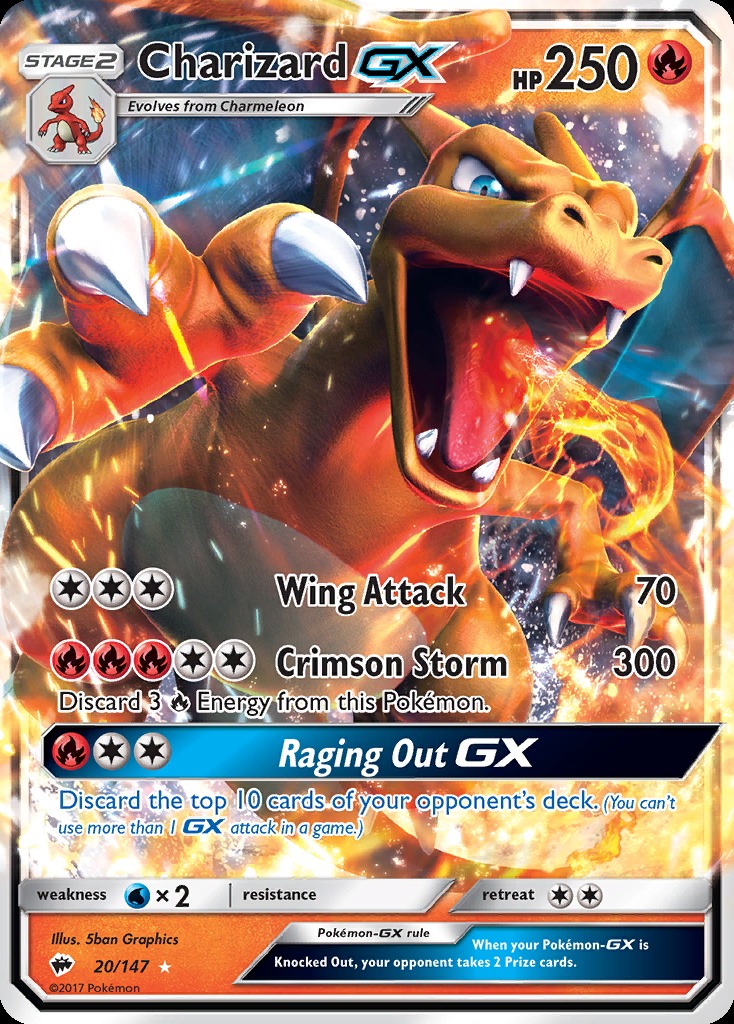
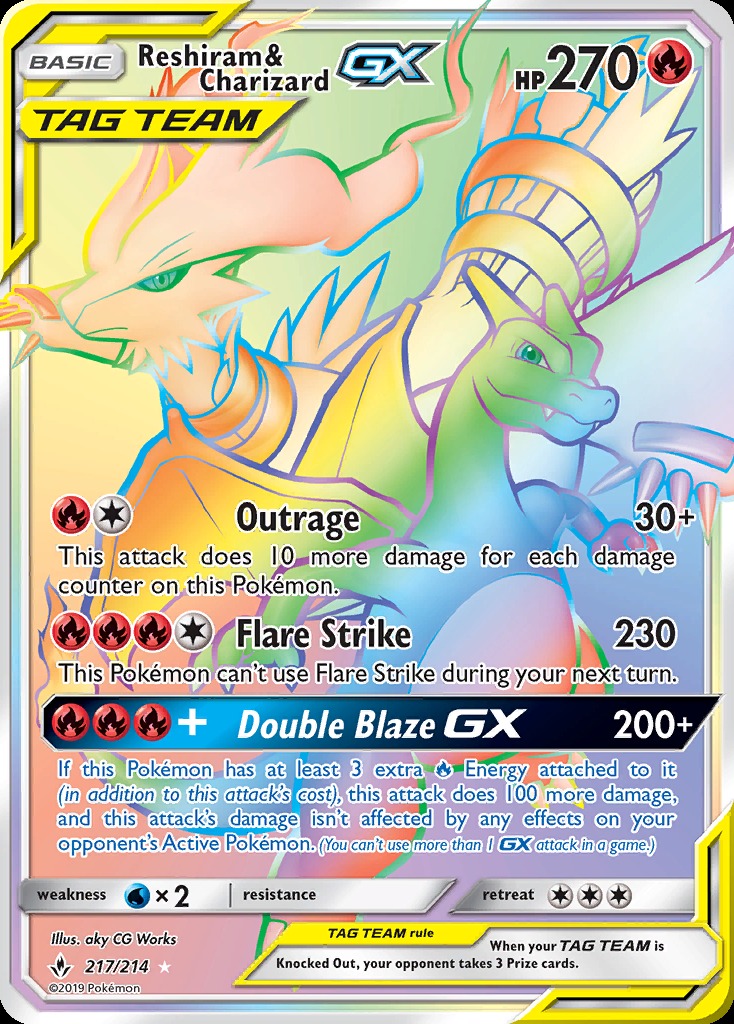
Image sources for this page: images.pokemontcg.io/sm1/147_hires.png (Lillie, full art), sm3/20_hires.png (Charizard-GX, standard art) and sm10/217_hires.png (Reshiram & Charizard-GX, rainbow rare). Served from /wp-content/uploads/2026/10/. Card names and artwork are trademarks of Nintendo, Creatures Inc. and GAME FREAK inc.; scans are used here for identification and commentary.
Frequently asked questions
What is a GX Pokémon card?
A card from the 2016–2019 era carrying one GX attack, usable once per game. GX cards were about timing rather than raw power, which is why they did not define the format the way the EX cards before them did.
What is a Tag Team GX card?
A single card depicting two Pokémon, introduced in Team Up in February 2019. It counts as both Pokémon for deck-building and gives up three prize cards when knocked out. The two-character composition is why the tier is collected.
Why are trainer cards from this era so expensive?
Because the full-art trainer format turned a supporter into a portrait, and the story gave those characters a narrative. The premium is driven by character attachment rather than competitive value, which is why it survives format rotation. Lillie and Cynthia are the two clearest examples.
What is a rainbow rare Pokémon card?
A foil tier introduced in the Sun & Moon era that recolours the entire card in a rainbow pattern, with a small gold tag in the corner. Every GX from the era has a rainbow version, and the tier continued into the Sword & Shield era.
Is Hidden Fates a Sun & Moon set?
Yes. It was released in August 2019 as a special set within the era, and contains the Shiny Vault — a 94-card sub-set of shiny Pokémon. It was opened heavily, so high-grade singles are more available than the set’s reputation suggests.
Sources
Sources and further reading
- The Pokémon Company — set records for Sun & Moon (February 2017) through Cosmic Eclipse (November 2019).
- Official card text — the GX attack rule and the Tag Team three-prize rule, both printed on the cards.
- PSA population reports — full-art trainers and Tag Team cards, by grade.
- Third-party graded price trackers — Lillie and Cynthia full-art sales, 2026.
- CardSpicy — Era 8 — XY, the era immediately before this one.
Related reading
- All twelve Pokémon card eras — the timeline this page belongs to.
- Era 8 — XY, 2013 to 2016 — Mega Evolution and the sideways card.
- Era 10 — Sword & Shield, 2019 to 2023 — where the alternate art takes over.
- Era 11 — Scarlet & Violet, 2023 to 2025 — the Art Rare, and the character card at full strength.
- Open or keep sealed — relevant to Dragon Majesty and Forbidden Light.
Nothing on this page is investment advice, and no grade outcome is promised for any card. Prices quoted are published third-party figures as of 2026 and are reference ranges, not offers.
Where to go next
- The CardSpicy card index — every card we track, with its PSA 10 population and market history (195 cards).
- The illustrator index — every artist behind those cards, card by card (110 artists).